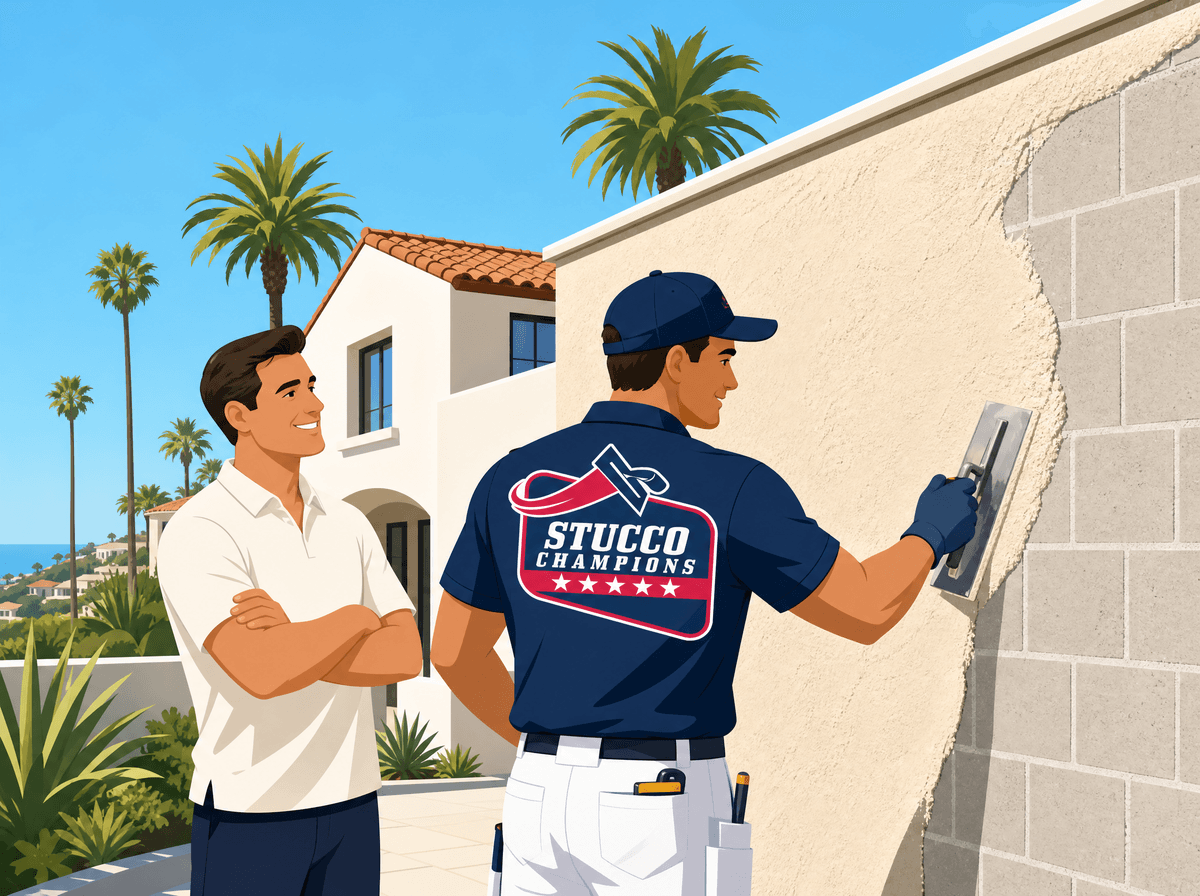
Portland Cement Plaster: The Technical Definition of "Stucco"

Written by Stucco Champions — Southern California’s Authority on Exterior Plastering.
In Southern California, "stucco" is the common term for the durable, textured exterior shell found on millions of homes. However, in architectural plans, engineering documents, and building codes, the proper technical name is Portland Cement Plaster.
This cladding is not just generic cement mud applied to a wall. It is a highly engineered mixture of cementitious binders, hydrated lime, clean graded sand, and water. When applied in successive coats, it cures into a rock-hard, breathable masonry barrier designed to withstand aggressive environmental conditions—from coastal salt air and moisture to intense summer heat. This guide breaks down the technical definitions, system layers, and why traditional plaster remains the gold standard for exterior walls.
1. Defining the Material: Plaster vs. Cement vs. Stucco
In everyday conversation, people often use the terms "cement," "plaster," and "stucco" interchangeably. However, they have distinct definitions in the building trades:
- Portland Cement: The dry binder powder (typically governed by ASTM C150). It is the chemically active "glue" that reacts with water to provide compressive strength.
- Portland Cement Plaster: The final mixture of cementitious binders, aggregate (sand), water, and optional admixtures. Under ASTM C926, the binder can be a combination of Portland Cement and Hydrated Lime (ASTM C207), Plastic Cement (ASTM C1328), or Masonry Cement (ASTM C91).
- Stucco: The common, historically derived term for Portland cement plaster applied to exterior walls.
Do not confuse traditional Portland cement plaster with EIFS (Exterior Insulation and Finish Systems). Traditional stucco is a hard-coat, cement-based system applied over wire lath or solid masonry. EIFS is a synthetic siding system utilizing expanded polystyrene (EPS) foam board, a thin polymer-based basecoat reinforced with fiberglass mesh, and a 100% acrylic finish coat. Traditional plaster offers far superior impact resistance and fire protection.
Free Assessment
Noticing Stucco Damage?
Get a free on-site assessment from a licensed contractor. $0 deposit, no obligation.
GET FREE ASSESSMENT2. System Comparison: Traditional Plaster vs. Synthetic EIFS
Choosing between traditional cement plaster and a synthetic system impacts everything from impact durability to R-value insulation. Here is a side-by-side comparison:
| Feature / Specification | Portland Cement Plaster (Traditional) | EIFS (Synthetic/Acrylic) |
|---|---|---|
| Core Materials | Portland cement, hydrated lime, plaster sand, and water | EPS foam insulation boards, polymer basecoat, acrylic finish |
| Structural Support | Applied over self-furred metal wire lath (ASTM C1063) or masonry | Adhered or mechanically fastened rigid foam sheathing |
| Base Thickness | 3/4-inch nominal base coat (scratch + brown) | 1/16 to 1/8-inch polymer basecoat with fiberglass mesh |
| Fire Performance | Non-combustible; provides an inherent 1-hour fire rating (at 7/8" thickness) | Requires fire-tested assemblies (NFPA 285) due to combustible foam |
| Impact Durability | Extremely high (rock-hard solid shell) | Low to moderate (prone to punctures from hail or pests) |
3. Where Is Portland Cement Plaster Used?
Portland cement plaster is exceptionally versatile, which is why it forms the backbone of commercial and residential construction in Southern California. Standard applications include:
- Framed Construction (New Build & Remodels): Applied over wood- or metal-stud framing using sheathing, a water-resistive barrier, and galvanized lath.
- Direct-Applied Masonry: Installed directly onto porous, unpainted concrete masonry units (CMU block) or cast-in-place concrete.
- Architectural Details: Formed over structural wire frames to create arches, decorative window pop-outs, soffits, and columns.
- Renovations & Re-Stuccoing: Used to overlay and reinforce older, degraded stucco surfaces, giving the building a fresh protective envelope.
4. The Standard Three-Coat Plaster System
For framed walls in residential homes, building codes mandate a three-coat system installed in accordance with ASTM C926:
- Scratch Coat (First Coat): Applied at 3/8-inch thickness, pressed firmly to encase and lock into the metal lath (ASTM C1063), and horizontally scored to provide a mechanical key. It must be moist cured for a minimum of 48 hours.
- Brown Coat (Second Coat): Applied at 3/8-inch thickness to flatten and level the wall, floated for consolidation, and moist cured for 48 hours. It should cure and dry for at least 7 days before finish application.
- Finish Coat (Third Coat): Applied at 1/8-inch thickness over the pre-dampened base coat to provide color, texture, and weather sealing.
5. Why Traditional Plaster Remains the Gold Standard
Despite modern synthetic cladding options, Portland cement plaster remains the choice of architects and engineers for several key reasons:
- Moisture Management: Combined with two layers of Grade D building paper and properly integrated foundation weep screeds, it creates an effective drainage plane that sheds bulk water while letting vapor escape.
- Inherent Durability: Unlike wood or vinyl, cement plaster does not degrade under Southern California's intense UV exposure, nor does it rot, warp, or support fungal growth.
- Design Flexibility: Supports a wide variety of textures—from smooth Santa Barbara finish to heavy Spanish lace—and can be integrally colored or painted.
A durable plaster system relies on strict mix consistency. The standard volumetric proportions under ASTM C926 specify 1 part cementitious binder to 3 or 4 parts clean, graded plaster sand conforming to ASTM C897. Adding too much sand ("sand drowning") or excess water to ease application weakens the cement matrix, leading to map cracking, dusting, and premature plaster failure.
6. Key Technical Standards for Inspection
To avoid structural callbacks, local inspectors and quality contractors monitor three vital components:
- Lath Attachment (ASTM C1063): Wire lath must be securely fastened to studs and self-furred 1/4 inch off the sheathing to allow plaster to flow behind and fully embed the metal skeleton.
- Control Joints: Placed at a maximum of 144 square feet (with length-to-width ratios not exceeding 2.5:1) to relieve drying shrinkage stress and control cracking.
- Pre-Dampening: The cured base coat must be moistened with water right before applying the finish coat. This prevents the dry base coat from sucking the moisture out of the fresh finish plaster, which causes blotchiness and poor adhesion.
Technical Resources
For more detailed engineering and application specifications, refer to these industry standards:
- Portland Cement Association (PCA) Stucco Resources
- ASTM C926: Standard Specification for Application of Portland Cement-Based Plaster
- ASTM C1063: Standard Specification for Installation of Lathing and Furring
- ASTM C897: Standard Specification for Aggregate for Job-Mixed Portland Cement-Based Plasters
Need Expert Plastering Services in Southern California?
Portland cement plaster is a highly technical material that requires skilled craftsmanship to install correctly. Stucco Champions is a CSLB-licensed plastering contractor serving Los Angeles, Orange County, and the surrounding areas. Contact Stucco Champions today for a free consultation and estimate on your next residential or commercial project!
Frequently Asked Questions About Stucco
How much does stucco repair cost in Orange County and Los Angeles?+
Stucco repair typically ranges from $500 for minor crack patching to $5,000+ for full re-stucco of a single elevation. The exact cost depends on the damage type (hairline cracks, water damage, delamination, weep screed failure), the square footage involved, and whether the original three-coat or one-coat stucco system needs to be matched. Stucco Champions provides fixed-price written estimates after a free on-site assessment — no hourly billing, no surprise change orders. See our stucco repair cost guide for detailed pricing by repair type.
How long does stucco last in Southern California?+
Properly installed three-coat stucco lasts 50-80+ years in Southern California's climate. The most common failure points aren't the stucco itself — they're the supporting components: corroded weep screed, deteriorated building paper behind the stucco, and improperly sealed window flashing. Most "stucco failures" are actually moisture-intrusion failures that start at one of these points. Annual visual inspection catches problems before they spread, which is why we offer free weep screed assessments for homeowners in our service area.
Can I repair stucco myself, or do I need a contractor?+
Hairline cracks under 1/8 inch wide can be sealed with elastomeric caulk by a homeowner. Anything larger — pattern cracks, delamination (where stucco pulls away from the wall), water-damaged areas, or chimney/window leak repairs — requires a licensed contractor. Improper DIY repair on these is the #1 cause of repeat failures because the underlying cause (usually moisture) isn't addressed. California's CSLB requires a license for any stucco work over $500. Looking for a highly-rated stucco contractor in Southern California? We are a CSLB-licensed and insured team ready to help.
How do I know if I need stucco repair vs. full re-stucco?+
If less than 30% of an elevation has visible damage, repair is the right call. If you see large areas of cracking, multiple zones of delamination, or the underlying paper and lath have rotted across an entire wall, full re-stucco of that elevation is more cost-effective long-term. Our free assessment includes a moisture survey and lath inspection so you get a defensible recommendation either way — not just a quote pushing whichever option costs more.
Do you offer warranties on stucco work?+
Approved stucco repair work includes a 1-year written workmanship warranty. The applicable terms are documented with the approved scope. Stucco Champions is CSLB licensed and insured; verify license #1122006 through the official state lookup. Request a free estimate to review the scope and warranty terms before you sign.
How long does a stucco repair take?+
Most patch repairs are completed in 1-2 days, including a 24-hour cure time before texture matching and color application. Full re-stucco of a single elevation runs 5-7 working days because each coat (scratch, brown, finish) needs to cure properly before the next is applied. We schedule around weather — California stucco needs daytime temperatures above 50°F with no rain forecast for at least 24 hours after each coat. Our crew shows up on time, every time.
Stucco Diagnostics & Calculators
Diagnose specific wall damage symptoms or estimate job scope with our free guides and calculators.
Related Professional Services
A licensed assessment identifies the cause before the finish is opened or replaced.