How Thick Should Scratch and Brown Coats Be on Framed Walls?
Written by Stucco Champions — Southern California’s Authority on Exterior Plastering.
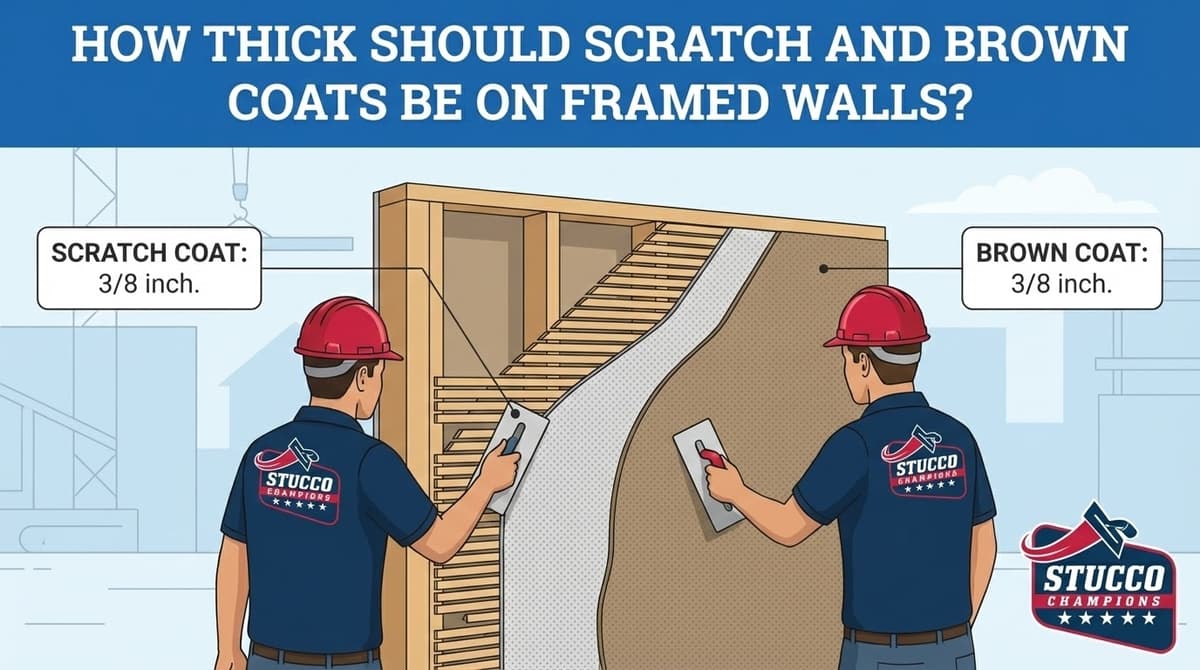
In a traditional three-coat stucco system, the scratch coat and brown coat form the structural backbone of your home's exterior. When plastering over wood or metal-framed walls, the scratch coat should be 3/8 inch thick, and the brown coat should also be 3/8 inch thick. Together, these two base coats establish a solid foundation before the decorative finish coat is applied.
The total thickness for a three-coat stucco system on a vertical metal plaster base is a nominal 7/8 inch once the 1/8-inch finish coat is added. Maintaining this specific depth ensures each layer cures properly, bonds securely, and provides the structural strength that exterior plastering requires.
1. Why Thickness Matters for Base Coats
Each layer in a traditional stucco system has a specific, engineered function. The scratch coat bonds to the metal lath and creates the first layer of strength. To protect the wire reinforcement from rust and corrosion, the scratch coat must completely encase the metal mesh. The brown coat builds on that foundation, leveling out irregularities to create a flat, even surface for the finish coat.
If either base coat is too thin, the stucco system loses structural integrity, fails to protect the metal lath from oxidation, and becomes highly prone to cracking. Local building codes throughout Los Angeles and Orange Counties reference ASTM C926, which dictates these standard thicknesses. Inspectors will measure the total base coat thickness during rough inspections to ensure compliance before any finish work can begin (read more in our guide to stucco repair permits in Southern California).
This level of precision is exactly why choosing a qualified plastering contractor is essential. Working with a professional team prevents failed inspections, costly rework, and premature stucco failure. To schedule a free consultation for your project, you can contact us today.
Free Assessment
Noticing Stucco Damage?
Get a free on-site assessment from a licensed contractor. $0 deposit, no obligation.
GET FREE ASSESSMENT2. How to Apply the Scratch Coat
The scratch coat is applied directly over the weather-resistive barrier (WRB) and metal lath. Installers trowel the mortar onto the lath at a nominal 3/8 inch thickness, pressing firmly to fill all the openings in the mesh and ensure the lath is fully embedded.
Once the plaster begins to set and firm up, installers use a scarifier to score horizontal grooves into the surface.
According to the Portland Cement Association (PCA EB049) manual, scoring must be done horizontally on vertical surfaces. These horizontal grooves act as mini water dams to aid curing and create a mechanical grip for the brown coat. Vertical scoring is highly discouraged because it can promote cracking directly over studs and lead to erosion during moist curing.
Under ASTM C926, the scratch coat must be moist cured (typically by light water fogging) for a minimum of 48 hours. This hydration period allows the cement to develop its early strength before the next layer is applied.

3. How to Apply the Brown Coat
The brown coat is also applied at 3/8 inch thick. Installers spread the mortar over the scratch coat and use a straightedge or rod to level the surface.
Unlike the scratch coat, the brown coat is not scored. Instead, once the mortar has begun to set and the surface sheen disappears, installers float the surface with a wood float. This floating process is critical as it consolidates and densifies the plaster, closing up voids and establishing an even plane for the finish coat.
The brown coat must be moist cured for at least 48 hours. Building codes and ASTM C926 mandate that the base coats (scratch + brown) cure and dry for a minimum of 7 days (and up to 14 days in some specifications) before the finish coat is applied. This curing delay is vital because it allows the cement plaster to undergo its initial drying shrinkage. Any hairline shrinkage cracks that develop will form in the base coats and will be sealed and hidden by the final 1/8-inch finish coat, rather than reflecting through the finished wall.
4. Common Mistakes with Base Coat Thickness
Going too thin is the most frequent error. Coats under 3/8 inch may pass a quick visual check but they often fail to provide enough mass to resist cracking. Thin coats also tend to dry too quickly which results in a weaker bond.
Inconsistent thickness across the wall creates high spots and low spots. These variations will show through the finish. Professional applicators use screeds and check their work constantly to keep the plaster uniform.
Stucco Layer Specifications (ASTM C926 & PCA Standards)
| Coat / Layer | Nominal Thickness | Curing & Interval Standard | Primary Purpose |
|---|---|---|---|
| Scratch (First Coat) | 3/8 inch (9.5 mm) | Moist cure for 48 hours minimum | Embeds the wire lath completely, protects metal from corrosion, and provides mechanical key (scored horizontally). |
| Brown (Second Coat) | 3/8 inch (9.5 mm) | Moist cure for 48 hours; dry 7 days minimum total before finish | Levels and flattens the wall, floated to densify the plaster, and absorbs drying shrinkage stresses. |
| Finish (Third Coat) | 1/8 inch (3.0 mm) | Air cure (base coat must be predampened prior to application) | Provides final color, texture, and aesthetic appeal while offering weather protection. |
| Total System | 7/8 inch (22.0 mm) nominal | Moist cure base coats; 7-14 days total curing schedule | Creates a fire-resistant, water-shedding, and durable exterior envelope. |
Note: Under ASTM C926, the nominal thickness of the total base coat (scratch + brown) is 3/4 inch (19 mm) on metal lath, and 7/8 inch when the 1/8-inch finish coat is added. For solid plaster bases like masonry or concrete, the plaster thicknesses vary (see below).
5. What Affects Base Coat Thickness
Lath Installation: Metal reinforcement must be self-furred or held 1/4 inch away from the sheathing or framing. This gap allows the scratch coat plaster to slump behind the mesh and embed the lath completely. If the lath is installed flat against the wall, the plaster cannot encase it, leading to structural weakness and rust.
Wall Substrate: Framed walls with metal or wood studs require a standard three-coat system for a total nominal 7/8-inch thickness. In contrast, solid masonry or concrete walls may allow for a two-coat system (base and finish) with different thickness requirements, typically 1/2 inch total thickness (read more in our guide to stucco over concrete and CMU block).
Temperature and Humidity: Environmental conditions dictate how cement plaster hydrates. In hot, dry, or windy conditions, base coats require frequent fogging to prevent rapid water loss and map cracking. In cold climates (below 40°F), heated enclosures must be maintained for at least 48 hours to prevent the fresh plaster from freezing and losing its bond.
Trust Signals You Should Expect
Any contractor applying scratch and brown coats on your home must be licensed, bonded, and fully insured. Stucco Champions is a CSLB-licensed plastering contractor. We never ask for down payments before starting work, provide a comprehensive warranty on all installations, and offer flexible payment options to keep your project on track.
Frequently Asked Questions
Can you combine the scratch and brown coats into one thick layer to save time?
No. Attempting to apply a single thick base coat instead of two separate, properly cured coats compromises the entire system. Each coat must be allowed to set and bond independently. Doubling the thickness in a single pass leads to severe sagging, cracks, and delamination from the lath.
Do you need to wet the scratch coat before applying the brown coat?
Yes. Highly absorptive surfaces like a dry scratch coat must be pre-dampened with water prior to applying the brown coat. If you skip this, the dry scratch coat will rapidly suck the mix water out of the fresh brown coat, preventing proper cement hydration and weakening the bond between layers.
How thick should scratch and brown coats be on framed walls for fire ratings?
For standard one-hour fire-rated wood or steel-framed assemblies, building codes typically require a minimum nominal 7/8-inch thick Portland cement plaster (stucco) system, which includes the 3/8-inch scratch coat, 3/8-inch brown coat, and 1/8-inch finish coat, applied over approved lath and fire-resistant sheathing.
Ready to Simplify Your Stucco Work?
Precision plastering requires expertise, the right tools, and strict adherence to ASTM standards. Whether you are dealing with a failed inspection or starting a new build, Stucco Champions is here to help. Contact Stucco Champions today for a free consultation and estimate on your project! You can also check out our homepage to learn more about our exterior plastering and stucco repair services.
Frequently Asked Questions About Stucco
How much does stucco repair cost in Orange County and Los Angeles?+
Small stucco patches start at $650, larger repairs start at $1,200, and re-stucco of a single elevation up to about 400 sq ft runs about $1,400 - $5,900+. The exact cost depends on the damage type (hairline cracks, water damage, delamination, weep screed failure), the square footage involved, and whether the original three-coat or one-coat stucco system needs to be matched. Stucco Champions provides fixed-price written estimates after a free on-site assessment — no hourly billing, no surprise change orders. See our stucco repair cost guide for detailed pricing by repair type.
How long does stucco last in Southern California?+
Properly installed three-coat stucco lasts 50-80+ years in Southern California's climate. The most common failure points aren't the stucco itself — they're the supporting components: corroded weep screed, deteriorated building paper behind the stucco, and improperly sealed window flashing. Most "stucco failures" are actually moisture-intrusion failures that start at one of these points. Annual visual inspection catches problems before they spread, which is why we offer free weep screed assessments for homeowners in our service area.
Can I repair stucco myself, or do I need a contractor?+
Hairline cracks under 1/8 inch wide can be sealed with elastomeric caulk by a homeowner. Anything larger — pattern cracks, delamination (where stucco pulls away from the wall), water-damaged areas, or chimney/window leak repairs — requires a licensed contractor. Improper DIY repair on these is the #1 cause of repeat failures because the underlying cause (usually moisture) isn't addressed. California's CSLB requires a license for any stucco work over $500. Looking for a highly-rated stucco contractor in Southern California? We are a CSLB-licensed and insured team ready to help.
How do I know if I need stucco repair vs. full re-stucco?+
If less than 30% of an elevation has visible damage, repair is the right call. If you see large areas of cracking, multiple zones of delamination, or the underlying paper and lath have rotted across an entire wall, full re-stucco of that elevation is more cost-effective long-term. Our free assessment includes a moisture survey and lath inspection so you get a defensible recommendation either way — not just a quote pushing whichever option costs more.
Do you offer warranties on stucco work?+
Approved stucco repair work includes a 1-year written workmanship warranty. The applicable terms are documented with the approved scope. Stucco Champions is CSLB licensed and insured; verify license #1122006 through the official state lookup. Request a free estimate to review the scope and warranty terms before you sign.
How long does a stucco repair take?+
Most patch repairs are completed in 1-2 days, including a 24-hour cure time before texture matching and color application. Full re-stucco of a single elevation runs 5-7 working days because each coat (scratch, brown, finish) needs to cure properly before the next is applied. We schedule around weather — California stucco needs daytime temperatures above 50°F with no rain forecast for at least 24 hours after each coat. Our crew shows up on time, every time.
Stucco Diagnostics & Calculators
Diagnose specific wall damage symptoms or estimate job scope with our free guides and calculators.
Related Professional Services
A licensed assessment identifies the cause before the finish is opened or replaced.