Two-Coat vs. Three-Coat Stucco: Selecting the Right System
Written by Stucco Champions — Southern California’s Authority on Exterior Plastering.
In the plastering industry, terms like "two-coat" and "three-coat" are often used, but they are not interchangeable. For homeowners and property managers planning a project in Southern California, understanding the difference is essential. Is one system better? Is one more cost-effective? The answer depends entirely on the substrate—the surface underneath the plaster.
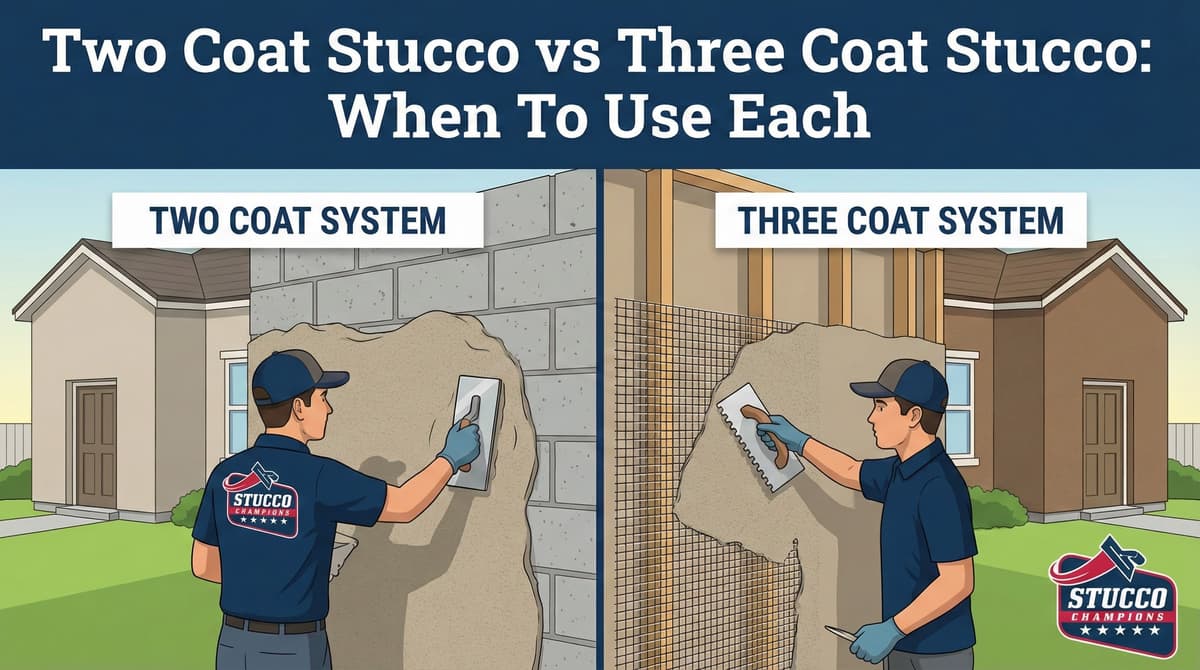
If you are plastering over a wood- or metal-framed wall, building codes and ASTM standards require a traditional three-coat system. If you are applying plaster over a solid, clean masonry or concrete wall, a two-coat system is the standard. Let's look at the engineering reasons why the substrate dictates which system is required.
1. The Three-Coat System (For Framed Walls)
Three-coat stucco is the traditional standard for wood- or metal-framed structures in California. Because framed walls are hollow and subject to movement (especially under seismic loads), they require a rigid, reinforced exterior cement shell to protect the building envelope.
Free Assessment
Noticing Stucco Damage?
Get a free on-site assessment from a licensed contractor. $0 deposit, no obligation.
GET FREE ASSESSMENTThe Anatomy of a Three-Coat System
- Water-Resistive Barrier (WRB): Typically two layers of Grade D building paper or an approved fluid-applied membrane.
- Metal Lath: Self-furred galvanized wire mesh (governed by ASTM C1063) which acts as the structural "skeleton."
- 1. Scratch Coat (First Coat): Applied at 3/8-inch thickness, pressed firmly to fully embed the metal lath. It is scored horizontally to create a mechanical key.
- 2. Brown Coat (Second Coat): Applied at 3/8-inch thickness to level the surface, floated for density, and left to cure.
- 3. Finish Coat (Third Coat): Applied at 1/8-inch thickness to provide the final color, texture, and weather resistance.
A three-coat system has a total nominal thickness of 7/8 inch (3/4-inch base coat + 1/8-inch finish coat). This depth provides the necessary mass to achieve a code-compliant one-hour fire resistance rating and the impact resistance needed to span the hollow space between studs.
2. The Two-Coat System (For Solid Masonry & Concrete)
Direct-applied two-coat stucco is designed specifically for solid, rigid substrates like concrete masonry units (CMU block), brick, tilt-up concrete, or cast-in-place concrete. Because these substrates are already solid, fire-resistant, and structural, they do not require metal lath or the extra bulk of a scratch coat.
The Anatomy of a Two-Coat System
- Substrate Preparation: The surface must be clean, unpainted, and porous. A liquid bonding agent or a cementitious "dash coat" is applied to ensure adhesion.
- 1. Base Coat (First Coat): Applied directly to the masonry or concrete to level out irregularities.
- 2. Finish Coat (Second Coat): Applied at 1/8-inch thickness to provide the final color and texture.
Under ASTM C926 Table 4, the required thicknesses for direct-applied two-coat stucco are:
• On Unit Masonry (CMU/Brick): A nominal 1/2-inch total thickness (3/8-inch base coat + 1/8-inch finish coat).
• On Cast-in-Place / Precast Concrete: A nominal 3/8-inch total thickness (1/4-inch base coat + 1/8-inch finish coat).
3. Clarifying "One-Coat Stucco" (The Framed Wall Exception)
A common point of confusion is "One-Coat Stucco." Despite its name, one-coat stucco is physically applied as a two-layer system (a basecoat and a finish coat). However, unlike traditional direct-applied two-coat stucco, proprietary one-coat stucco is approved for use on wood-framed walls.
One-coat stucco utilizes a proprietary, polymer-modified cementitious basecoat (typically applied at 3/8 to 5/8 inch thick) that is reinforced with fiberglass fibers. It is installed over metal lath and rigid foam insulation sheathing. Because of the polymer additives and fiber reinforcement, it can resist cracking at thinner depths over flexible framing. It is classified as a proprietary system and must be installed in strict compliance with the manufacturer's Evaluation Services Report (ESR).
4. Field Test: Which System Does Your Wall Need?
Before planning your stucco project, you can determine the correct system with these field checks:
- Knock on the Wall: If the wall sounds hollow, it is framed and requires a full three-coat system with metal lath. If it sounds completely solid, it is masonry/concrete and is a candidate for a two-coat system.
- Water Absorption Test: Spray water on the bare masonry. If the water quickly absorbs into the block, you can apply a direct two-coat system. If it beads up or repels water, the concrete is sealed or painted, and you must prepare it first.
- Dealing with Paint or Coatings: You cannot apply cement plaster directly over painted masonry because the paint blocks the mechanical and chemical bond. You must either sandblast the paint off to expose bare masonry, or anchor metal lath to the wall and install a three-coat lath-and-plaster system.
5. System Comparison Matrix (ASTM C926 Standards)
| Feature / Specification | Traditional Two-Coat System | Traditional Three-Coat System |
|---|---|---|
| Approved Substrates | Solid Masonry, Brick, Concrete Blocks, Poured Concrete | Wood Framing, Metal Studs, Sheathed Walls |
| Nominal Total Thickness | 1/2 inch (on Masonry) or 3/8 inch (on Concrete) | 7/8 inch (on Metal Plaster Base) |
| Metal Lath Required? | No (direct chemical & mechanical bond to porous substrate) | Yes (wire mesh to span studs and reinforce plaster) |
| Curing Schedule | Moist cure base coat for 48 hours; dry before finish | Moist cure scratch and brown coats 48 hours each; 7-14 days total before finish |
| Material Behavior | Relies on substrate rigidity to prevent cracking | Relies on lath skeleton and base coat mass to absorb framing flexing |
Conclusion: Let the Substrate Decide
You cannot apply a direct two-coat plaster system over wood framing; without lath and the proper thickness, it will quickly crack, delaminate, and fall off. Conversely, while you can install lath and a three-coat system over clean concrete block, it is generally unnecessary and adds extra labor and material costs. Let the wall's structure dictate the system.
Related Resources
For a detailed breakdown of plastering over CMU blocks, check out our guide to Stucco Over Concrete, CMU, and Cinder Block. If you are preparing for a framed wall project, read our guide on proper scratch and brown coat thickness.
Need a Professional Stucco Consultation?
Applying the wrong stucco system leads to rapid failure, water intrusion, and costly callbacks. Stucco Champions is a CSLB-licensed contractor serving Orange County, Los Angeles, and the Inland Empire. Contact Stucco Champions today for a professional inspection and free estimate for your home or commercial property!
Frequently Asked Questions About Stucco
How much does stucco repair cost in Orange County and Los Angeles?+
Small stucco patches start at $650, larger repairs start at $1,200, and re-stucco of a single elevation up to about 400 sq ft runs about $1,400 - $5,900+. The exact cost depends on the damage type (hairline cracks, water damage, delamination, weep screed failure), the square footage involved, and whether the original three-coat or one-coat stucco system needs to be matched. Stucco Champions provides fixed-price written estimates after a free on-site assessment — no hourly billing, no surprise change orders. See our stucco repair cost guide for detailed pricing by repair type.
How long does stucco last in Southern California?+
Properly installed three-coat stucco lasts 50-80+ years in Southern California's climate. The most common failure points aren't the stucco itself — they're the supporting components: corroded weep screed, deteriorated building paper behind the stucco, and improperly sealed window flashing. Most "stucco failures" are actually moisture-intrusion failures that start at one of these points. Annual visual inspection catches problems before they spread, which is why we offer free weep screed assessments for homeowners in our service area.
Can I repair stucco myself, or do I need a contractor?+
Hairline cracks under 1/8 inch wide can be sealed with elastomeric caulk by a homeowner. Anything larger — pattern cracks, delamination (where stucco pulls away from the wall), water-damaged areas, or chimney/window leak repairs — requires a licensed contractor. Improper DIY repair on these is the #1 cause of repeat failures because the underlying cause (usually moisture) isn't addressed. California's CSLB requires a license for any stucco work over $500. Looking for a highly-rated stucco contractor in Southern California? We are a CSLB-licensed and insured team ready to help.
How do I know if I need stucco repair vs. full re-stucco?+
If less than 30% of an elevation has visible damage, repair is the right call. If you see large areas of cracking, multiple zones of delamination, or the underlying paper and lath have rotted across an entire wall, full re-stucco of that elevation is more cost-effective long-term. Our free assessment includes a moisture survey and lath inspection so you get a defensible recommendation either way — not just a quote pushing whichever option costs more.
Do you offer warranties on stucco work?+
Approved stucco repair work includes a 1-year written workmanship warranty. The applicable terms are documented with the approved scope. Stucco Champions is CSLB licensed and insured; verify license #1122006 through the official state lookup. Request a free estimate to review the scope and warranty terms before you sign.
How long does a stucco repair take?+
Most patch repairs are completed in 1-2 days, including a 24-hour cure time before texture matching and color application. Full re-stucco of a single elevation runs 5-7 working days because each coat (scratch, brown, finish) needs to cure properly before the next is applied. We schedule around weather — California stucco needs daytime temperatures above 50°F with no rain forecast for at least 24 hours after each coat. Our crew shows up on time, every time.
Stucco Diagnostics & Calculators
Diagnose specific wall damage symptoms or estimate job scope with our free guides and calculators.
Related Professional Services
A licensed assessment identifies the cause before the finish is opened or replaced.