Elevate Your Exterior: Modern Stucco Trends That Define California Homes
Written by Stucco Champions — Southern California’s Authority on Exterior Plastering.
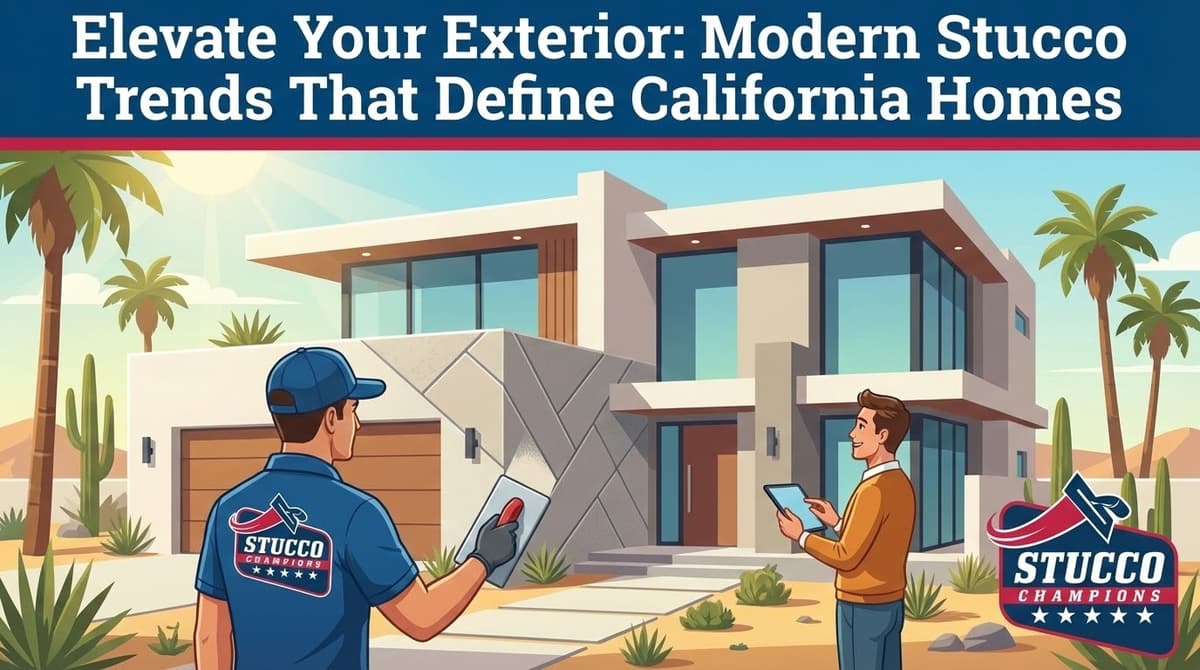
In Southern California, residential architecture is shifting. The heavy, Spanish-style "knockdown" textures and ornate Tuscan trims of the early 2000s are fading, replaced by the crisp geometry and clean lines of Modern Minimalism. Stucco remains the dominant exterior cladding, but how it is engineered and styled has significantly evolved.
Today's modern stucco trends are not just about aesthetics; they are about high performance. From heat-reflective "cool wall" coatings to crack-resistant polymer bases, modern exterior plastering is an engineered system designed to protect and beautify. This guide explores the top design trends transforming Southern California neighborhoods.
1. The "Santa Barbara" Smooth Finish
The number-one design request we receive from homeowners in Orange County and Los Angeles is smoothing out old, rough stucco walls.
The Look: A velvety, hand-troweled, semi-smooth finish that mimics polished concrete or limestone. It is sleek, minimalist, and timeless, perfectly complementing modern architectural styles.
The Engineering: Achieving a flawless Santa Barbara finish requires a specialized "hard trowel" technique. Because smooth stucco is highly unforgiving and highlights the slightest wall imperfections, the underlying base coats must be perfectly flat and rodded. We often use an acrylic-modified cement finish coat to increase material flexibility and reduce the hairline mapping cracks common in smooth finishes.
Free Assessment
Noticing Stucco Damage?
Get a free on-site assessment from a licensed contractor. $0 deposit, no obligation.
GET FREE ASSESSMENT2. Dark and Moody Color Palettes
Beige and sand tones are giving way to deep charcoal grey, slate, and near-black facades.
The Challenge: Traditional cement-based color coats cannot hold deep pigments. Solar UV radiation causes them to fade rapidly, and moisture brings salt deposits to the surface (efflorescence), turning dark walls chalky and streaky.
The Solution: We utilize **100% acrylic synthetic finish coats** for dark colors. The synthetic acrylic polymers encapsulate the pigment particles, shielding them from UV burnout and water penetration. This ensures a dark slate or charcoal home stays rich and vibrant for decades.
Dark exterior walls absorb massive amounts of solar energy, with surface temperatures often exceeding 150°F. This high heat leads to aggressive thermal expansion and contraction. When applying dark colors, we recommend upgrading the base layers to a **mesh-reinforced base coat** (embedding fiberglass mesh into a polymer-modified basecoat) to absorb thermal stress and prevent cracking.
3. Mixed-Media Facades
Modern design thrives on texture contrast. It is rare to see contemporary custom homes constructed with stucco alone. Instead, designers pair smooth stucco with contrasting accents:
- Natural Wood Siding: Accents of cedar, redwood, or dense Ipe siding to bring warmth to the design.
- Sleek Metals: Black aluminum window frames, fascia boards, and steel beams.
- Raw Stone: Grey stacked stone wainscoting or architectural accents.
Where stucco meets a dissimilar material like wood or stone, proper transition flashing (such as a Z-bar flashing) and high-performance polyurethane sealants are essential. Failing to detail these transitions correctly creates pathways for water to bypass the drainage plane, causing hidden framing rot.
4. Geometric and Architectural Foam Accents
Modern homes still utilize architectural foam detailing, but with a focus on geometric simplicity:
- Window Pop-Outs: Sharp, square-edge pop-outs that create a deep, recessed window appearance.
- Parapets: Simple, flat parapet caps instead of ornate, tiered cornices.
By using high-density expanded polystyrene (EPS) foam panels coated with basecoat, mesh, and smooth stucco, we can create bold geometric depth and shadows without adding structural weight to the framing.
5. Sustainable "Cool Wall" Technology
With aggressive California heat cycles and rising energy costs, homeowners are increasingly requesting sustainable claddings.
The Technology: Heat-reflective stucco finishes utilize specialized infrared-reflective pigments. Instead of absorbing heat, these coatings reflect infrared light back into the atmosphere, lowering the exterior wall surface temperature by up to 40°F compared to standard paint.
The Benefit: Lower surface temperatures translate directly to cooler interiors, reducing air conditioning load and extending the life of the stucco system by minimizing thermal movement.
Conclusion: Modernize with Confidence
Whether you are building a contemporary custom home in Malibu or updating a mid-century tract home in Irvine, modern stucco offers design flexibility and durability that standard siding cannot match. By combining smooth textures, UV-resistant acrylic colors, and energy-efficient coatings, Stucco Champions delivers future-proof exteriors.
Related Resources
To learn how to safely combine materials on your home, read our Guide to Stucco and Stone Exterior Design. For a comparison of stucco with other claddings, check out our guide on Stucco vs. Hardie Board.
For additional inspiration, you can browse Houzz Modern Stucco Ideas.
Ready to Elevate Your Home's Curb Appeal?
Applying smooth finishes and dark acrylic coatings requires specialized equipment and experienced plasterers. Stucco Champions is a CSLB-licensed contractor specializing in modern stucco transformations. Contact Stucco Champions today for a free consultation and estimate!
Frequently Asked Questions About Stucco
How much does stucco repair cost in Orange County and Los Angeles?+
Small stucco patches start at $650, larger repairs start at $1,200, and re-stucco of a single elevation up to about 400 sq ft runs about $1,400 - $5,900+. The exact cost depends on the damage type (hairline cracks, water damage, delamination, weep screed failure), the square footage involved, and whether the original three-coat or one-coat stucco system needs to be matched. Stucco Champions provides fixed-price written estimates after a free on-site assessment — no hourly billing, no surprise change orders. See our stucco repair cost guide for detailed pricing by repair type.
How long does stucco last in Southern California?+
Properly installed three-coat stucco lasts 50-80+ years in Southern California's climate. The most common failure points aren't the stucco itself — they're the supporting components: corroded weep screed, deteriorated building paper behind the stucco, and improperly sealed window flashing. Most "stucco failures" are actually moisture-intrusion failures that start at one of these points. Annual visual inspection catches problems before they spread, which is why we offer free weep screed assessments for homeowners in our service area.
Can I repair stucco myself, or do I need a contractor?+
Hairline cracks under 1/8 inch wide can be sealed with elastomeric caulk by a homeowner. Anything larger — pattern cracks, delamination (where stucco pulls away from the wall), water-damaged areas, or chimney/window leak repairs — requires a licensed contractor. Improper DIY repair on these is the #1 cause of repeat failures because the underlying cause (usually moisture) isn't addressed. California's CSLB requires a license for any stucco work over $500. Looking for a highly-rated stucco contractor in Southern California? We are a CSLB-licensed and insured team ready to help.
How do I know if I need stucco repair vs. full re-stucco?+
If less than 30% of an elevation has visible damage, repair is the right call. If you see large areas of cracking, multiple zones of delamination, or the underlying paper and lath have rotted across an entire wall, full re-stucco of that elevation is more cost-effective long-term. Our free assessment includes a moisture survey and lath inspection so you get a defensible recommendation either way — not just a quote pushing whichever option costs more.
Do you offer warranties on stucco work?+
Approved stucco repair work includes a 1-year written workmanship warranty. The applicable terms are documented with the approved scope. Stucco Champions is CSLB licensed and insured; verify license #1122006 through the official state lookup. Request a free estimate to review the scope and warranty terms before you sign.
How long does a stucco repair take?+
Most patch repairs are completed in 1-2 days, including a 24-hour cure time before texture matching and color application. Full re-stucco of a single elevation runs 5-7 working days because each coat (scratch, brown, finish) needs to cure properly before the next is applied. We schedule around weather — California stucco needs daytime temperatures above 50°F with no rain forecast for at least 24 hours after each coat. Our crew shows up on time, every time.
Stucco Diagnostics & Calculators
Diagnose specific wall damage symptoms or estimate job scope with our free guides and calculators.
Related Professional Services
A licensed assessment identifies the cause before the finish is opened or replaced.