Grade D Building Paper for Stucco: Code Requirements and Benefits
Written by Stucco Champions - Southern California's Authority on Exterior Plastering.
Grade D Building Paper: What It Does Behind a Stucco Wall
The stucco you see from the outside is only one part of the wall system. Behind the plaster, a water-resistive barrier helps protect moisture-sensitive sheathing and framing while giving incidental water a path back outside.
Grade D building paper is one traditional type of water-resistive barrier used behind exterior cement plaster. It is water resistant and vapor permeable, but it is not the only code-approved option. Modern stucco assemblies may use Grade D paper, an approved synthetic water-resistive barrier, fluid-applied products, foam separation, or a designed drainage space.
The correct assembly depends on the substrate, climate classification, product approvals, local code, and the flashing details used throughout the wall.
Free Assessment
Noticing Stucco Damage?
Get a free on-site assessment from a licensed contractor. $0 deposit, no obligation.
GET FREE ASSESSMENTWhat Grade D Building Paper Is
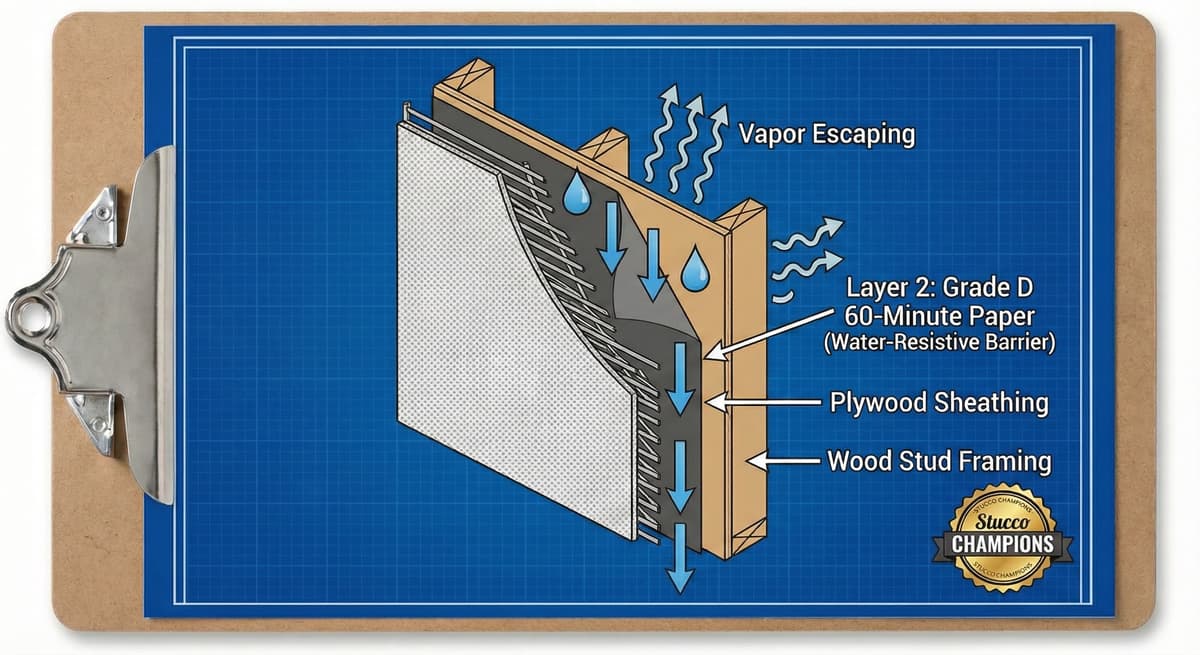
Grade D paper is a water-resistant, vapor-permeable building paper traditionally manufactured from treated kraft paper. It is installed behind exterior stucco over framed walls to help manage water that reaches the back of the plaster.
Its main functions are:
- Water control: It helps prevent incidental liquid water from reaching wood-based sheathing and framing.
- Drainage: When properly lapped and connected to flashing and the weep screed, it helps direct water downward and outward.
- Vapor permeability: It allows some water vapor to pass through the material. This can support drying, but condensation control still depends on the complete wall assembly, climate, insulation, and indoor conditions.
- Separation: In multi-layer assemblies, the layers provide separate continuous planes between the stucco and the moisture-sensitive wall components.
Grade D paper is not a substitute for flashing, sealant joints, or a functioning weep screed. Those parts must work together as one moisture-management system.
Why Stucco Needs a Water-Management Layer
Portland cement plaster is a durable, highly water-resistant exterior facing, but it should not be treated as the wall's only defense against moisture. Small cracks, window and door openings, penetrations, and transitions can allow incidental water to move behind the plaster.
The water-resistive barrier is intended to manage that water before it reaches the framing. For the system to work, the barrier must remain continuous, free of unnecessary holes and tears, and integrated with flashings in shingle-fashion.
In practical terms, upper layers overlap lower layers so gravity carries water toward the exterior. Reverse laps can direct water into the wall.
What California Code Requires
California code provisions for exterior stucco over wood-based sheathing distinguish between dry climates and moist or marine climates. They also permit approved alternatives to traditional Grade D paper.
For a dry-climate residential assembly, common code paths include:
- Two independently installed layers of 10-minute Grade D paper, or an approved water-resistive barrier with equivalent performance.
- A 60-minute Grade D paper or equivalent Type II barrier when it is separated from the stucco by foam plastic sheathing, another substantially non-water-absorbing layer, or an approved drainage space.
Moist or marine climate provisions generally require additional drainage outside the water-resistive barrier. The exact requirement depends on the code edition adopted by the jurisdiction and the approved wall design.
This means the phrase "two layers of Grade D paper are always required" is too broad. Two layers are one recognized approach, but they are not the only compliant assembly.
For a real project, the approved plans, local building department, product evaluation reports, and manufacturer installation instructions control.
10-Minute and 60-Minute Paper: What the Rating Means
The 10-minute and 60-minute labels refer to laboratory water-resistance classifications. They do not mean the paper fails after 10 or 60 minutes in a wall, and they should not be interpreted as a direct service-life warranty.
| Rating | How it is commonly used | Important limitation |
|---|---|---|
| 10-minute Grade D | Often installed as two independent layers in an approved dry-climate assembly | Must remain continuous and properly integrated with flashing |
| 60-minute Grade D | May be used as part of an approved assembly with separation or drainage provisions | A higher laboratory rating does not correct poor laps, tears, or missing flashing |
Material rating matters, but installation quality usually determines whether the wall manages water successfully.
How the Layers Work Together
In a multi-layer paper assembly, each layer should form its own continuous plane. Flashing intended to drain into the water-resistive barrier must be directed into the correct drainage plane.
A simplified wall sequence may include:
- Wood framing and approved sheathing
- Water-resistive barrier or approved equivalent
- Flashing at windows, doors, penetrations, and wall transitions
- Lath and corrosion-resistant accessories
- Stucco base coats and finish coat
- Weep screed or another approved drainage termination at the bottom of the wall
The order and integration matter more than any individual brand name.
Flashing and Weep Screed Are Part of the Same System
The water-resistive barrier cannot protect the wall if window flashing drains behind it or if the bottom of the wall has no functioning outlet.
Window and door flashing should direct water downward and outward while remaining integrated with the WRB. Read our stucco window flashing guide for a homeowner-friendly explanation of those transitions.
At the base of a framed stucco wall, the weep screed provides a plaster termination and allows moisture to drain outside. If it is buried, blocked, corroded, or installed incorrectly, water can remain trapped near the bottom of the wall. Learn more about weep screed repair and drainage.
Common Installation Problems
Even a high-rated product can fail as part of the wall system when installation is poor. Common problems include:
- Reverse-lapped building paper
- Tears or excessive fastener damage
- Unsealed penetrations
- Window flashing that drains behind the WRB
- Missing continuity at corners and transitions
- Paper or flashing that does not lap the weep screed correctly
- A buried or obstructed drainage outlet
- Mixing incompatible products without an approved detail
These failures are usually hidden after lath and plaster are installed, which is why pre-plaster inspection and photo documentation are valuable.
Signs the Barrier Behind the Stucco May Be Failing
A homeowner cannot normally see the WRB without opening the wall, but visible symptoms may suggest a moisture-management problem:
- Persistent staining below windows or wall penetrations
- Soft, bulging, or hollow-sounding stucco
- Rust staining from corroding metal lath or accessories
- Interior drywall staining after rain
- Musty odors near exterior walls
- Repeated cracks or failed patches in the same area
- Damage concentrated near the bottom of the wall
These symptoms do not prove that the paper itself failed. The source may be flashing, sealant, roof-to-wall transitions, plumbing, or another penetration. A proper inspection should trace the water path before recommending repairs.
Repairing Damaged Building Paper
Building paper cannot usually be repaired correctly from the exterior surface without removing some stucco. If the WRB is torn, reverse-lapped, or disconnected from flashing, the affected area generally needs to be opened so the drainage layers can be inspected and restored.
A localized repair may include removing damaged plaster, inspecting the sheathing and framing, replacing compromised WRB, correcting flashing laps, reinstalling lath, and matching the existing stucco texture.
The repair scope should follow the actual damage. A small opening may be enough for a localized defect, while widespread deterioration may require a larger wall section.
What Homeowners Should Ask a Contractor
Before approving stucco work over framed walls, ask:
- Which WRB assembly is specified for this project?
- Which code edition and climate provision applies?
- How will window, door, deck, roof, and utility flashings connect to the WRB?
- How will water drain at the bottom of the wall?
- Are the products compatible and approved for the assembly?
- Will the concealed work be photographed before plaster is applied?
A contractor should be able to explain the complete drainage path, not just the brand or minute rating printed on the paper.
Final Takeaway
Grade D building paper is an important and proven water-management material behind stucco, but it is not a standalone waterproofing solution.
A durable wall depends on:
- The correct WRB assembly for the substrate and climate
- Independent, continuous layers where required
- Proper shingle-lapping
- Compatible window and door flashing
- A functioning weep screed or drainage termination
- Careful installation without tears or reverse laps
If your home has recurring stains, bulging stucco, rust marks, or interior moisture, the visible plaster may only be part of the problem. A qualified inspection can determine whether the water-resistive barrier and flashing system are directing water outside as intended.
Technical note: Building-code requirements vary by adopted code edition, climate classification, jurisdiction, substrate, and approved assembly. Confirm project-specific requirements with the local building department and the applicable product documentation.
Frequently Asked Questions About Stucco
How much does stucco repair cost in Orange County and Los Angeles?+
Small stucco patches start at $650, larger repairs start at $1,200, and re-stucco of a single elevation up to about 400 sq ft runs about $1,400 - $5,900+. The exact cost depends on the damage type (hairline cracks, water damage, delamination, weep screed failure), the square footage involved, and whether the original three-coat or one-coat stucco system needs to be matched. Stucco Champions provides fixed-price written estimates after a free on-site assessment — no hourly billing, no surprise change orders. See our stucco repair cost guide for detailed pricing by repair type.
How long does stucco last in Southern California?+
Properly installed three-coat stucco lasts 50-80+ years in Southern California's climate. The most common failure points aren't the stucco itself — they're the supporting components: corroded weep screed, deteriorated building paper behind the stucco, and improperly sealed window flashing. Most "stucco failures" are actually moisture-intrusion failures that start at one of these points. Annual visual inspection catches problems before they spread, which is why we offer free weep screed assessments for homeowners in our service area.
Can I repair stucco myself, or do I need a contractor?+
Hairline cracks under 1/8 inch wide can be sealed with elastomeric caulk by a homeowner. Anything larger — pattern cracks, delamination (where stucco pulls away from the wall), water-damaged areas, or chimney/window leak repairs — requires a licensed contractor. Improper DIY repair on these is the #1 cause of repeat failures because the underlying cause (usually moisture) isn't addressed. California's CSLB requires a license for any stucco work over $500. Looking for a highly-rated stucco contractor in Southern California? We are a CSLB-licensed and insured team ready to help.
How do I know if I need stucco repair vs. full re-stucco?+
If less than 30% of an elevation has visible damage, repair is the right call. If you see large areas of cracking, multiple zones of delamination, or the underlying paper and lath have rotted across an entire wall, full re-stucco of that elevation is more cost-effective long-term. Our free assessment includes a moisture survey and lath inspection so you get a defensible recommendation either way — not just a quote pushing whichever option costs more.
Do you offer warranties on stucco work?+
Approved stucco repair work includes a 1-year written workmanship warranty. The applicable terms are documented with the approved scope. Stucco Champions is CSLB licensed and insured; verify license #1122006 through the official state lookup. Request a free estimate to review the scope and warranty terms before you sign.
How long does a stucco repair take?+
Most patch repairs are completed in 1-2 days, including a 24-hour cure time before texture matching and color application. Full re-stucco of a single elevation runs 5-7 working days because each coat (scratch, brown, finish) needs to cure properly before the next is applied. We schedule around weather — California stucco needs daytime temperatures above 50°F with no rain forecast for at least 24 hours after each coat. Our crew shows up on time, every time.
Stucco Diagnostics & Calculators
Diagnose specific wall damage symptoms or estimate job scope with our free guides and calculators.
Related Professional Services
A licensed assessment identifies the cause before the finish is opened or replaced.