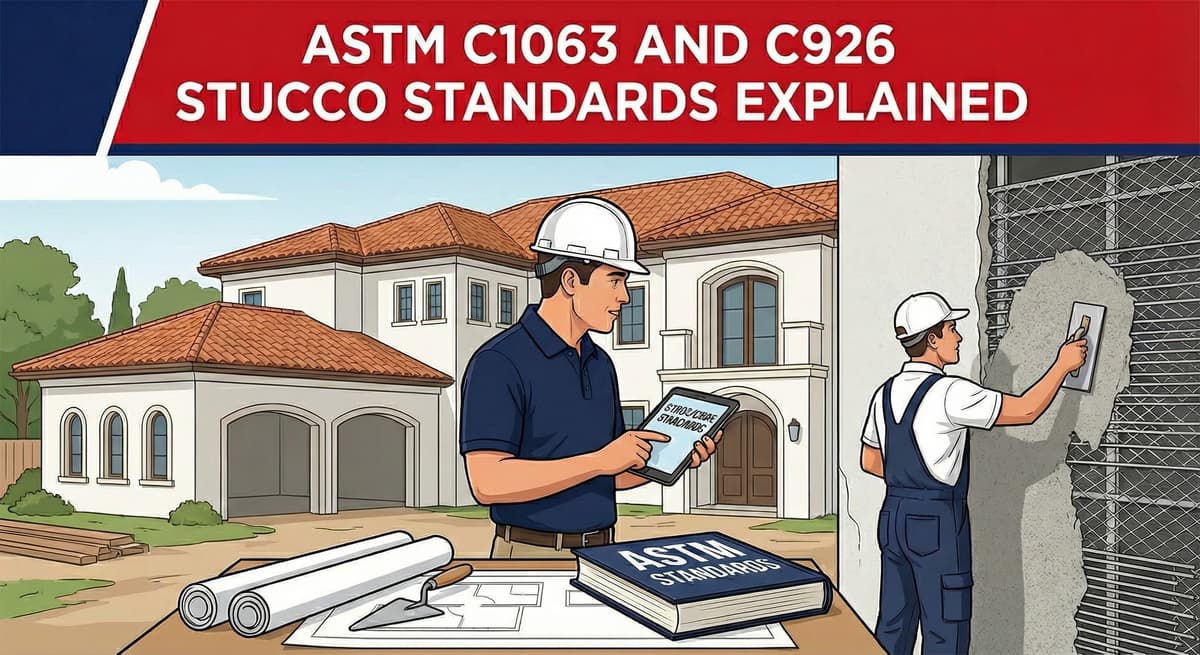
ASTM C1063 and C926 Stucco Standards Explained
Written by Stucco Champions — Southern California’s Authority on Exterior Plastering.
The Bible of Plastering: Decoding ASTM C1063 and C926 Standards
In the construction industry, there is "Building to Code" and there is "Building to Standard." While local codes set the minimum legal requirement, ASTM Standards define the best practices for longevity and performance.
For stucco, there are two critical documents that dictate everything we do: ASTM C1063 (Installation of Lathing) and ASTM C926 (Application of Plaster). If a contractor ignores these rules, the manufacturer's warranty is void, and the wall is destined to fail. This guide translates the engineering jargon into homeowner reality.
Free Assessment
Noticing Stucco Damage?
Get a free on-site assessment from a licensed contractor. $0 deposit, no obligation.
GET FREE ASSESSMENT1. ASTM C1063: The Skeleton (Lathing & Accessories)
This standard governs everything before the cement hits the wall. It dictates how we attach the metal reinforcement to the wood frame and integrate drainage accessories:
- Fastener Penetration: Staples or nails must penetrate the wood studs by a minimum of 3/4 inch to support the weight of the system (typically 10 to 12 lbs per square foot).
- Lath Overlap: Under ASTM C1063, woven wire lath must overlap by at least 1 inch horizontally and vertically. Expanded metal lath requires a minimum 1/2-inch side lap and 1-inch end lap. A 2-inch vertical end overlap on studs is industry best practice to prevent structural cracking.
- Furring: The lath must be held 1/4 inch away from the substrate (using furring nails or self-furred wire) to allow the cement scratch coat to get behind and fully encapsulate the metal.
- Weep Screed Clearances: The foundation weep screed must be installed to allow drainage, maintaining clearances of at least 4 inches above raw earth/soil and 2 inches above paved concrete.
2. ASTM C926: The Skin (Portland Cement Plastering)
This standard governs the mixing, application, and curing of the Portland cement plaster itself.
- Three-Coat Thickness: The total plaster system must be a nominal 7/8 inch thick (3/8" nominal scratch coat, 3/8" nominal brown coat, and 1/8" nominal finish coat) to achieve a verified ASTM E119 1-hour fire rating.
- Moist Curing: The base coats must be kept damp (fogged/misted with water) for at least 48 hours to ensure proper cement hydration and design strength.
- Curing/Dry Timelines: The scratch coat must be moist-cured for a minimum of 48 hours before the brown coat is applied. The brown coat must then be moist-cured for at least 48 hours and allowed to dry for a total of 7 to 14 days before the finish color coat is applied. This enables the base coats to undergo initial shrinkage and cracking before the aesthetic coat is laid.
3. Why It Matters: The Failure Points
When we inspect failed stucco in Los Angeles and Orange County, it is almost always a violation of these two standards.
If the contractor installs wire lath tight against the building paper (violating C1063 furring rules), the cement cannot key behind the wire. The result is a weak surface bond that delaminates (sheets off) in chunks over time.
If the finish coat is applied over a "green" (uncured) brown coat (violating C926 curing rules), the subsequent shrinkage of the base coat will tear the finish coat apart. This leads to extensive map cracking within the first year.
4. Code vs. Standard
Building Code (CRC): The law. Municipal inspectors check this at designated stages (such as the lath inspection before plastering).
ASTM Standard: The engineering methodology. While inspectors rarely check every detail on site, ASTM standards form the legal basis for construction defect lawsuits and manufacturer warranty validations.
At Stucco Champions, we build to ASTM standards because it is the only way to guarantee a 50-year lifespan for the wall.
Conclusion: Ask the Question
When interviewing contractors, ask: "Do you follow ASTM C1063 for lathing and ASTM C926 for plastering?" If they look confused or dismiss these standards, hire someone else. These standards are the playbook for professional plastering.
Last week, we shared The Comprehensive Guide to Stucco Lathing Wire Types. Learn how the wire fits into the C1063 standard.
Frequently Asked Questions About Stucco
How much does stucco repair cost in Orange County and Los Angeles?+
Small stucco patches start at $650, larger repairs start at $1,200, and re-stucco of a single elevation up to about 400 sq ft runs about $1,400 - $5,900+. The exact cost depends on the damage type (hairline cracks, water damage, delamination, weep screed failure), the square footage involved, and whether the original three-coat or one-coat stucco system needs to be matched. Stucco Champions provides fixed-price written estimates after a free on-site assessment — no hourly billing, no surprise change orders. See our stucco repair cost guide for detailed pricing by repair type.
How long does stucco last in Southern California?+
Properly installed three-coat stucco lasts 50-80+ years in Southern California's climate. The most common failure points aren't the stucco itself — they're the supporting components: corroded weep screed, deteriorated building paper behind the stucco, and improperly sealed window flashing. Most "stucco failures" are actually moisture-intrusion failures that start at one of these points. Annual visual inspection catches problems before they spread, which is why we offer free weep screed assessments for homeowners in our service area.
Can I repair stucco myself, or do I need a contractor?+
Hairline cracks under 1/8 inch wide can be sealed with elastomeric caulk by a homeowner. Anything larger — pattern cracks, delamination (where stucco pulls away from the wall), water-damaged areas, or chimney/window leak repairs — requires a licensed contractor. Improper DIY repair on these is the #1 cause of repeat failures because the underlying cause (usually moisture) isn't addressed. California's CSLB requires a license for any stucco work over $500. Looking for a highly-rated stucco contractor in Southern California? We are a CSLB-licensed and insured team ready to help.
How do I know if I need stucco repair vs. full re-stucco?+
If less than 30% of an elevation has visible damage, repair is the right call. If you see large areas of cracking, multiple zones of delamination, or the underlying paper and lath have rotted across an entire wall, full re-stucco of that elevation is more cost-effective long-term. Our free assessment includes a moisture survey and lath inspection so you get a defensible recommendation either way — not just a quote pushing whichever option costs more.
Do you offer warranties on stucco work?+
Approved stucco repair work includes a 1-year written workmanship warranty. The applicable terms are documented with the approved scope. Stucco Champions is CSLB licensed and insured; verify license #1122006 through the official state lookup. Request a free estimate to review the scope and warranty terms before you sign.
How long does a stucco repair take?+
Most patch repairs are completed in 1-2 days, including a 24-hour cure time before texture matching and color application. Full re-stucco of a single elevation runs 5-7 working days because each coat (scratch, brown, finish) needs to cure properly before the next is applied. We schedule around weather — California stucco needs daytime temperatures above 50°F with no rain forecast for at least 24 hours after each coat. Our crew shows up on time, every time.
Stucco Diagnostics & Calculators
Diagnose specific wall damage symptoms or estimate job scope with our free guides and calculators.
Related Professional Services
A licensed assessment identifies the cause before the finish is opened or replaced.