Weather-Resistant Building Paper: Stucco Protection Guide
Written by Stucco Champions — Southern California’s Authority on Exterior Plastering.
Stucco is an exceptional cladding material: it is highly impact-resistant, fireproof, and can easily endure for 50 to 80 years. However, stucco has one critical physical property that homeowners must understand: it is not waterproof. Because it is a Portland cement-based plaster, stucco is naturally porous and acts as a reservoir cladding, absorbing rainwater and releasing it through evaporation.
The true protection for your home's structural framing isn't the decorative plaster texture you see on the surface; it is the hidden layer underneath known as the **Weather-Resistant Barrier (WRB)**. If this layer is installed incorrectly, moisture that penetrates the 7/8-inch stucco shell has nowhere to go but into your wood framing, leading to dry rot, structural decay, and mold. This guide details the physics, code requirements, and installation rules of the stucco drainage plane.
1. What is Grade D Building Paper?
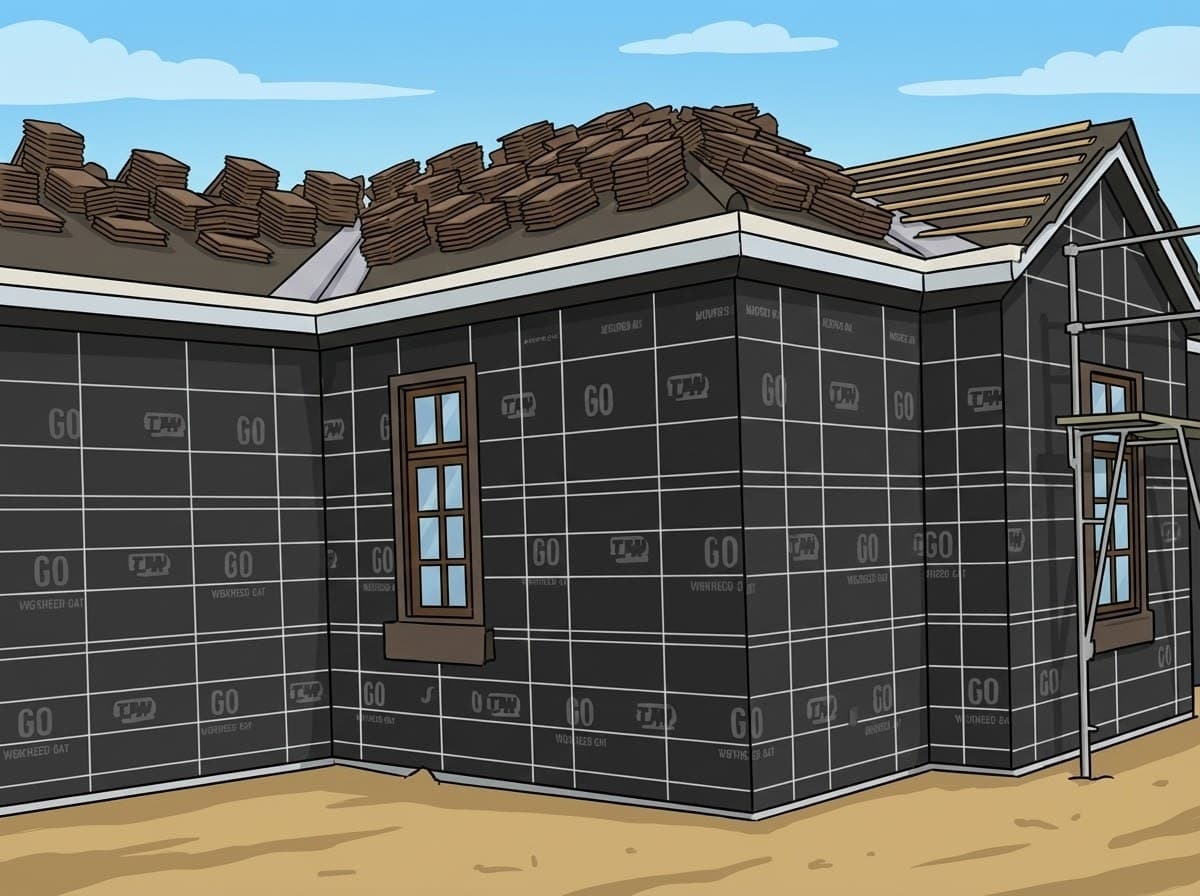
In the exterior plastering trade, we utilize **Grade D Building Paper** as our primary weather barrier. Grade D paper is an asphalt-saturated Kraft paper (conforming to federal specification **UU-B-790a** Type I, Grade D, Style 2) engineered to be vapor-permeable. Unlike plastic vapor barriers, Grade D paper allows moisture vapor migrating from inside the home to escape outward, while repelling bulk liquid water from the outside.
Free Assessment
Noticing Stucco Damage?
Get a free on-site assessment from a licensed contractor. $0 deposit, no obligation.
GET FREE ASSESSMENT2. The Two-Layer Building Code Mandate
Over wood-based sheathings (such as plywood or OSB), the **California Residential Code (Section R703.7.3)** and **ASTM C926 / C1063** standards mandate a **double-layer weather-resistive barrier** (or equivalent). This double layer is not just for extra thickness; it serves a specific mechanical function known as a **bond breaker**:
- Layer 1 (The Sacrificial Bond Breaker): When wet stucco plaster is troweled onto the metal lath, it adheres and mechanically bonds to this outer layer of paper. As the stucco cures, it shrinks and wrinkly binds to this paper.
- Layer 2 (The Primary WRB & Drainage Plane): Because the outer layer is bound to the cement, the inner layer remains unattached and flat against the sheathing. This creates a microscopic air gap (capillary break) between the two sheets. Water that penetrates the stucco hits this gap and drains harmlessly down to the foundation weep screed by gravity.
3. Material Quality: 10-Minute vs. 60-Minute Paper
The "minute" rating of building paper is tested under **ASTM D779** (often called the water resistance boat test), which measures how long the paper can withstand direct, standing water contact before saturating:
- 10-Minute Paper: This is the bare minimum allowed by building code. It is thin, tears easily during lath fastening, and offers minimal protection. We refuse to use it.
- 60-Minute "Super Jumbo Tex": The professional standard. It is significantly thicker, highly resistant to tearing from lath fasteners, and offers 600% more water resistance than the minimum standard. For custom homes, coastal properties, and high-wind zones, 60-minute paper is non-negotiable.
4. Installation Rules: The Shingle Principle
Even the highest-quality paper will fail if it is not integrated correctly. We install all weather-resistive barriers strictly according to **ASTM C1063** and the **Shingle Principle**:
- Bottom-Up Sequencing: Installation must start at the foundation weep screed and work upward, ensuring that each upper sheet laps over the sheet below it.
- Lapping Dimensions: Horizontal seams must overlap by a minimum of 2 inches. Vertical seams must overlap by a minimum of 6 inches.
- Weep Screed Integration: The building paper must overlap the metal attachment flange of the foundation weep screed by a minimum of 2 inches. This ensures water exiting the drainage plane is routed to the outside of the building. If the paper is tucked behind the weep screed flange, water will drain directly into the wooden sill plate, causing catastrophic rot.
Can you use standard plastic housewrap (like Tyvek) under stucco? Yes, but never as a single layer. Standard housewraps are subject to surfactant degradation. The salts, soaps, and wood sugars present in wet cement plaster act as surfactants, destroying the water-repelling properties of plastic housewraps. If Tyvek is used as an air barrier, building codes require installing a separate layer of Grade D building paper over it to act as the sacrificial bond breaker and drainage plane.
Conclusion: The Foundation of Your Envelope
Once the stucco base coats are applied, the weather-resistive barrier is permanently sealed inside the wall. Changing or repairing failed paper requires complete demolition of the stucco shell. Investing in a high-quality, double-layer 60-minute Grade D paper system adds minor cost during construction but adds decades to the life of your home’s envelope.
Need a professional inspection of your home’s waterproofing or stucco?
Stucco Champions is a CSLB-licensed (#1122006) plastering contractor specializing in water damage diagnostics and envelope remediation. Contact us today to schedule a technical consultation!
Related Resources:
Read our in-depth article on Grade D Building Paper for Stucco: Code Requirements and Benefits to understand the regulatory codes governing exterior moisture barriers.
Frequently Asked Questions About Stucco
How much does stucco repair cost in Orange County and Los Angeles?+
Small stucco patches start at $650, larger repairs start at $1,200, and re-stucco of a single elevation up to about 400 sq ft runs about $1,400 - $5,900+. The exact cost depends on the damage type (hairline cracks, water damage, delamination, weep screed failure), the square footage involved, and whether the original three-coat or one-coat stucco system needs to be matched. Stucco Champions provides fixed-price written estimates after a free on-site assessment — no hourly billing, no surprise change orders. See our stucco repair cost guide for detailed pricing by repair type.
How long does stucco last in Southern California?+
Properly installed three-coat stucco lasts 50-80+ years in Southern California's climate. The most common failure points aren't the stucco itself — they're the supporting components: corroded weep screed, deteriorated building paper behind the stucco, and improperly sealed window flashing. Most "stucco failures" are actually moisture-intrusion failures that start at one of these points. Annual visual inspection catches problems before they spread, which is why we offer free weep screed assessments for homeowners in our service area.
Can I repair stucco myself, or do I need a contractor?+
Hairline cracks under 1/8 inch wide can be sealed with elastomeric caulk by a homeowner. Anything larger — pattern cracks, delamination (where stucco pulls away from the wall), water-damaged areas, or chimney/window leak repairs — requires a licensed contractor. Improper DIY repair on these is the #1 cause of repeat failures because the underlying cause (usually moisture) isn't addressed. California's CSLB requires a license for any stucco work over $500. Looking for a highly-rated stucco contractor in Southern California? We are a CSLB-licensed and insured team ready to help.
How do I know if I need stucco repair vs. full re-stucco?+
If less than 30% of an elevation has visible damage, repair is the right call. If you see large areas of cracking, multiple zones of delamination, or the underlying paper and lath have rotted across an entire wall, full re-stucco of that elevation is more cost-effective long-term. Our free assessment includes a moisture survey and lath inspection so you get a defensible recommendation either way — not just a quote pushing whichever option costs more.
Do you offer warranties on stucco work?+
Approved stucco repair work includes a 1-year written workmanship warranty. The applicable terms are documented with the approved scope. Stucco Champions is CSLB licensed and insured; verify license #1122006 through the official state lookup. Request a free estimate to review the scope and warranty terms before you sign.
How long does a stucco repair take?+
Most patch repairs are completed in 1-2 days, including a 24-hour cure time before texture matching and color application. Full re-stucco of a single elevation runs 5-7 working days because each coat (scratch, brown, finish) needs to cure properly before the next is applied. We schedule around weather — California stucco needs daytime temperatures above 50°F with no rain forecast for at least 24 hours after each coat. Our crew shows up on time, every time.
Stucco Diagnostics & Tools
Diagnose specific wall damage symptoms or estimate job scope with our free guides and calculators.
Related Professional Services
A licensed assessment identifies the cause before the finish is opened or replaced.