Stucco Staple Guns: Choosing Wide Crown Tools for Wire Lath
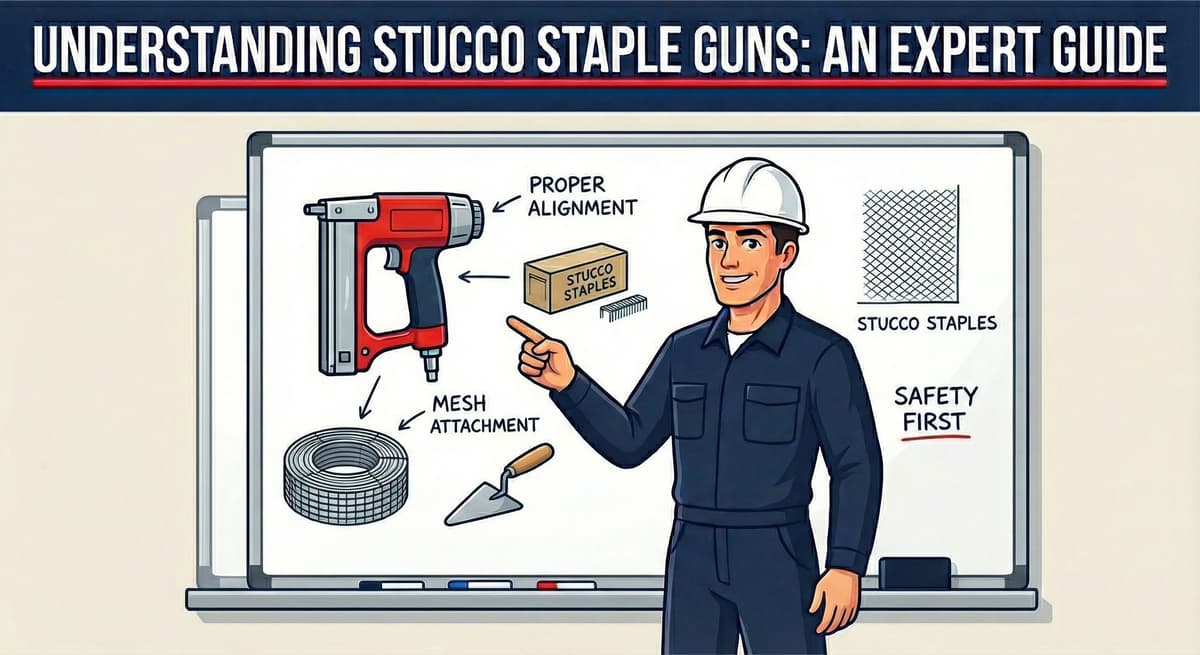
Stucco staple guns are essential pneumatic tools for attaching the galvanized wire lath to the wood framing underneath. Because the wire lath supports the entire weight of the heavy cement cladding, fastening it securely to the studs is critical for structural integrity and passing county inspections.
In this guide, we break down the necessary specifications for a stucco stapler and compare the most reliable models used in the trade.
1. Crown Sizes: 1-Inch vs. 15/16-Inch
Stucco staple guns generally require Wide Crown Staples to ensure they properly trap and hold the wire mesh without slipping through the gaps.
The two industry standards are the 1-inch crown and the 15/16-inch crown. It is crucial to note that these are not interchangeable. You must purchase staples that exactly match the magazine specifications of your specific gun model, or the tool will jam instantly.
Free Assessment
Noticing Stucco Damage?
Get a free on-site assessment from a licensed contractor. $0 deposit, no obligation.
GET FREE ASSESSMENT2. Staple Length & Building Codes
The staple must be long enough to penetrate through the wire, the layers of weather-resistant barrier (WRB), the exterior sheathing (like plywood), and embed deeply into the wooden stud.
- Three-Coat Stucco (Standard): For traditional installations over standard lath, staples between 1-1/4" and 1-1/2" long are typically required.
- One-Coat Systems (Foam-Backed): Because you must shoot through an additional 1-inch of rigid EPS foam board, 2-inch long staples are standard.
Staples must be driven firmly enough to hold the lath tight against the wall, but the compressor pressure should not be set so high that the staple cuts through the wire or unnecessarily damages the WRB. Proper depth adjustment is critical.
3. Top Professional Models
The Premium Workhorse: Senco PS15XP
The Senco PS15XP (1-inch crown) is renowned as a legendary tool in the stucco industry. It is highly favored by professionals for its durability and consistent driving power. With a maximum staple length of 1-1/2 inches, it is perfectly suited for traditional three-coat stucco systems. It is robust, easy to clear if jammed, and built for daily commercial abuse.
The Balanced Choice: Metabo HPT 1" Wide Crown Stapler
Formerly Hitachi, the Metabo HPT series shines with its blend of affordability and reliable performance. It is notably lightweight, making it excellent for overhead work or long days on scaffolding. They offer models in both 1" and 15/16" crown sizes to fit your existing fastener supply.
The Feature-Rich Option: Makita AT2550A
The Makita AT2550A is a slight step up in price but offers excellent ergonomics, a built-in air filter to keep dust out of the cylinder, and a handy hook for hanging on scaffolding or tool belts. Its robust construction makes it a worthwhile investment for contractors.
What Makes a Staple Gun for Stucco Different?
A staple gun for stucco is not selected only by brand. The real requirement is whether it can consistently drive the correct wide-crown fastener through lath, paper, sheathing, and into framing without cutting the wire or crushing the wall assembly.
ASTM-referenced lath installation guidance focuses on secure attachment, correct laps, and full embedment of reinforcement. If staples are under-driven, the lath can move while the scratch coat is applied. If they are over-driven, they can damage the wire, paper, or foam layer. Either mistake can lead to cracking, sagging, or water-sensitive weak spots.
For homeowners, the takeaway is simple: if a contractor is repairing stucco around windows, wall bottoms, or foam details, ask how the lath will be reattached before the finish is blended. The tool matters, but the installation detail matters more.
Conclusion
Choosing the right stucco staple gun depends on your budget and whether you are shooting standard wire or through rigid foam. Investing in a professional-grade wide crown stapler ensures your lath is secured tightly, preventing the cement cladding from sagging or cracking down the line.
Frequently Asked Questions About Stucco
How much does stucco repair cost in Orange County and Los Angeles?+
Stucco repair typically ranges from $500 for minor crack patching to $5,000+ for full re-stucco of a single elevation. The exact cost depends on the damage type (hairline cracks, water damage, delamination, weep screed failure), the square footage involved, and whether the original three-coat or one-coat stucco system needs to be matched. Stucco Champions provides fixed-price written estimates after a free on-site assessment — no hourly billing, no surprise change orders. See our stucco repair cost guide for detailed pricing by repair type.
How long does stucco last in Southern California?+
Properly installed three-coat stucco lasts 50-80+ years in Southern California's climate. The most common failure points aren't the stucco itself — they're the supporting components: corroded weep screed, deteriorated building paper behind the stucco, and improperly sealed window flashing. Most "stucco failures" are actually moisture-intrusion failures that start at one of these points. Annual visual inspection catches problems before they spread, which is why we offer free weep screed assessments for homeowners in our service area.
Can I repair stucco myself, or do I need a contractor?+
Hairline cracks under 1/8 inch wide can be sealed with elastomeric caulk by a homeowner. Anything larger — pattern cracks, delamination (where stucco pulls away from the wall), water-damaged areas, or chimney/window leak repairs — requires a licensed contractor. Improper DIY repair on these is the #1 cause of repeat failures because the underlying cause (usually moisture) isn't addressed. California's CSLB requires a license for any stucco work over $500. Looking for a highly-rated stucco contractor in Southern California? We are a CSLB-licensed and insured team ready to help.
How do I know if I need stucco repair vs. full re-stucco?+
If less than 30% of an elevation has visible damage, repair is the right call. If you see large areas of cracking, multiple zones of delamination, or the underlying paper and lath have rotted across an entire wall, full re-stucco of that elevation is more cost-effective long-term. Our free assessment includes a moisture survey and lath inspection so you get a defensible recommendation either way — not just a quote pushing whichever option costs more.
Do you offer warranties on stucco work?+
Approved stucco repair work includes a 1-year written workmanship warranty. The applicable terms are documented with the approved scope. Stucco Champions is CSLB licensed and insured; verify license #1122006 through the official state lookup. Request a free estimate to review the scope and warranty terms before you sign.
How long does a stucco repair take?+
Most patch repairs are completed in 1-2 days, including a 24-hour cure time before texture matching and color application. Full re-stucco of a single elevation runs 5-7 working days because each coat (scratch, brown, finish) needs to cure properly before the next is applied. We schedule around weather — California stucco needs daytime temperatures above 50°F with no rain forecast for at least 24 hours after each coat. Our crew shows up on time, every time.
Stucco Diagnostics & Calculators
Diagnose specific wall damage symptoms or estimate job scope with our free guides and calculators.
Related Professional Services
A licensed assessment identifies the cause before the finish is opened or replaced.