What Is Dryvit Stucco? EIFS, Synthetic Stucco & Repairs
Written by Stucco Champions - Southern California's Authority on Exterior Plastering.
What is Dryvit stucco? In most homeowner conversations, "Dryvit stucco" means EIFS, or Exterior Insulation and Finish System. Dryvit is a manufacturer brand, while EIFS is the type of wall system. The system usually includes foam insulation board, reinforced base coat, fiberglass mesh, and an acrylic textured finish that can look similar to traditional stucco from the street.
The important point is that Dryvit-style EIFS is not the same as traditional cement stucco. Traditional stucco is a hard, cement-based plaster system. EIFS is lighter, more insulating, more flexible, and more moisture-sensitive when the system is poorly detailed or neglected.
This guide explains what people mean by Dryvit stucco, how it compares with traditional stucco, how to identify it on a home, and what maintenance or repair issues homeowners should watch for.
Quick Answer: What Is Dryvit Stucco?
Dryvit stucco is a common shorthand for Dryvit-brand EIFS, a synthetic exterior wall system that uses foam insulation and a reinforced acrylic finish instead of thick cement plaster. It can look like stucco, but it behaves differently from hard-coat stucco.
| Term | What It Means |
|---|---|
| Dryvit | A brand/manufacturer of exterior wall systems, finishes, coatings, EIFS, and related assemblies. |
| EIFS | Exterior Insulation and Finish System: foam insulation, reinforced base coat, mesh, and finish coat. |
| Synthetic stucco | A common nickname for EIFS because the finish can resemble stucco but is not traditional cement plaster. |
| Traditional stucco | A cement plaster system installed over lath, scratch coat, brown coat, and finish coat. |
Free Assessment
Noticing Stucco Damage?
Get a free on-site assessment from a licensed contractor. $0 deposit, no obligation.
GET FREE ASSESSMENTDryvit Is a Brand, EIFS Is the System
Homeowners often use the word Dryvit the same way people use a brand name for a whole product category. When someone asks, "Do I have Dryvit?" they are usually asking whether their home has EIFS or synthetic stucco.
Dryvit itself offers a wide range of exterior wall systems, finishes, coatings, and cladding products. Its official site describes high-performance exterior insulation and finish systems, continuous insulation, prefabricated panel options, restoration products, textured finishes, and stucco assemblies. In other words, Dryvit is not one single bucket of material.
For SEO and homeowner clarity, though, the phrase Dryvit stucco usually points to EIFS: a foam-and-acrylic wall system that visually resembles stucco but is built very differently.
How Dryvit-Style EIFS Is Built
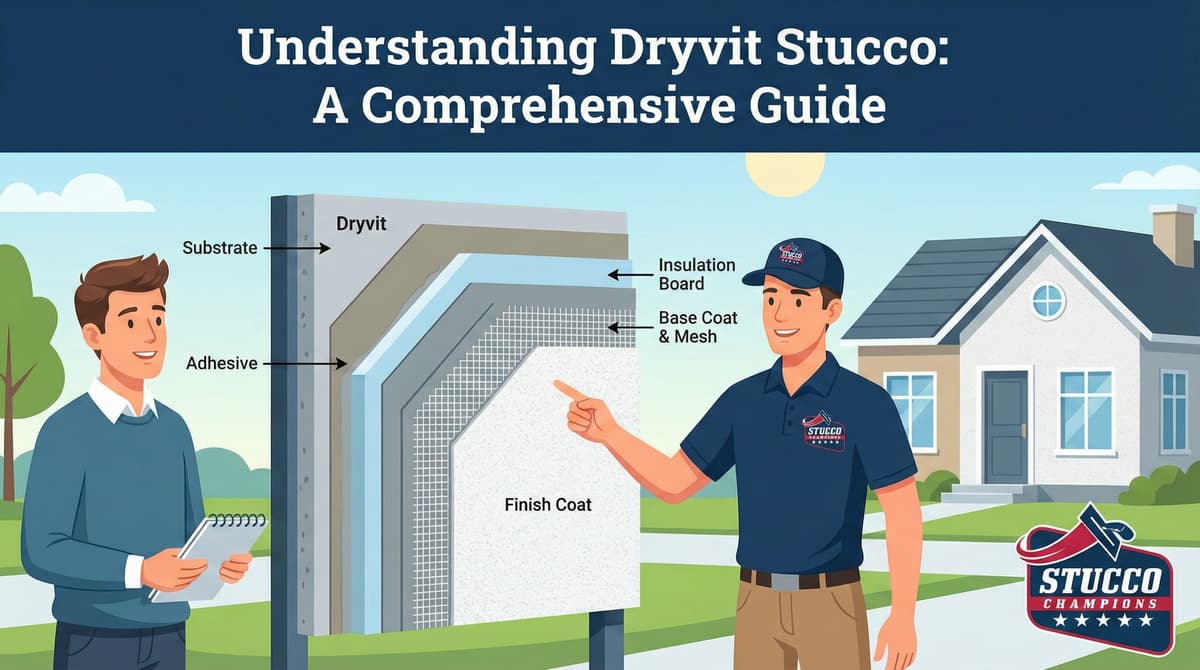
A typical EIFS wall has multiple layers. The exact assembly depends on manufacturer specifications and whether the system is a modern drainage EIFS, but the common components include:
- Substrate: The sheathing or wall surface behind the system.
- Water-resistive barrier or air/weather barrier: Used in many modern systems to manage incidental moisture.
- Adhesive or mechanical attachment: Holds insulation board to the substrate.
- EPS foam insulation board: Provides continuous insulation and the lightweight body of the system.
- Base coat: A polymer-modified layer applied over the foam.
- Fiberglass reinforcing mesh: Embedded into the base coat for strength and impact resistance.
- Acrylic finish coat: The visible color and texture layer.
This is very different from a traditional three-coat stucco wall, which uses building paper, metal lath, scratch coat, brown coat, and a cement or acrylic finish coat. For a direct comparison, see our guide to stucco vs. EIFS.
Dryvit Stucco vs. Traditional Stucco
Dryvit-style EIFS and traditional stucco can look similar from the sidewalk, but they behave differently in the field.
| Feature | Dryvit / EIFS | Traditional Stucco |
|---|---|---|
| Core material | Foam insulation with reinforced base coat and acrylic finish. | Cement plaster over lath and weather barrier. |
| Feel | Softer, lighter, and sometimes slightly compressible. | Hard, dense, and masonry-like. |
| Insulation | Better continuous insulation because of foam. | Minimal insulation value from the stucco itself. |
| Impact resistance | Depends on mesh/base coat design; can dent more easily in light-duty areas. | Generally more impact resistant because of cement thickness. |
| Moisture risk | Sealant and drainage details are critical; trapped water can damage sheathing. | Still needs drainage, but the hard-coat system behaves differently and is more vapor open. |
How to Tell If Your House Has Dryvit or EIFS
You can often identify EIFS with simple visual and touch clues, although a contractor should confirm before repair work begins.
- Tap test: Traditional stucco usually sounds hard and solid. EIFS often has a hollower, softer sound.
- Push test: EIFS may have slight give under firm thumb pressure. Cement stucco should not compress.
- Exposed edge: Damaged EIFS may show foam behind the finish. Traditional stucco shows cement and lath.
- Wall thickness at penetrations: EIFS can be thicker overall because of foam insulation, but the outer coating is thin.
- Decorative shapes: Foam trim, cornices, and lightweight architectural shapes are common with EIFS systems.
If you are still unsure, our stucco systems identification guide explains how to tell hard-coat stucco, one-coat stucco, and EIFS apart.
Dryvit Stucco vs. Acrylic Finish
Dryvit stucco and acrylic finish are related terms, but they are not identical. EIFS usually uses an acrylic finish coat as the visible outer layer, but an acrylic finish can also be used over other properly prepared stucco assemblies. The finish coat is only the surface layer. The wall system behind it determines how the exterior behaves.
This matters because homeowners sometimes think a textured acrylic finish automatically means the house is Dryvit or EIFS. That is not always true. A traditional stucco wall can have an acrylic finish coat, while an EIFS wall uses foam insulation and fiberglass mesh under the finish. For more on the material itself, see our guide to what acrylic stucco is.
Why Moisture Matters With Dryvit Stucco
The biggest concern with older EIFS is moisture trapped behind the foam. If water enters around windows, doors, deck connections, roof transitions, or failed sealant joints, it may not dry out quickly. That can damage sheathing and framing before the exterior surface looks serious.
Modern drainage EIFS systems were developed to address this weakness. These systems typically include a water-resistive barrier and a drainage path behind the foam so incidental water can move down and out. Dryvit's own product language emphasizes continuous insulation, water-intrusion resistance, textured finishes, and system performance, but the performance still depends on correct detailing and maintenance.
Warning signs that need attention include:
- Soft or spongy areas around windows and doors.
- Brown staining, bubbling, or swelling.
- Cracked or missing sealant at penetrations.
- Interior moisture smells or staining near exterior walls.
- Damage at deck attachments, roof lines, or wall bases.
If you see these symptoms, do not simply paint over them. Start with moisture diagnosis. Our stucco water damage repair page explains why trapped moisture needs to be addressed before cosmetic finish work.
Can Dryvit Stucco Be Repaired?
Dryvit-style EIFS can be repaired, but it should not be patched with ordinary cement stucco. EIFS repairs need compatible foam, mesh, base coat, finish material, texture, and sealant details. A rigid cement patch on a flexible foam system can crack or separate.
The repair method depends on the damage:
- Small surface damage: May require compatible base coat, reinforcing mesh, and finish texture.
- Impact dents or holes: May require foam replacement and reinforced patching.
- Moisture damage: Requires opening the wall enough to evaluate sheathing, framing, and drainage details.
- Failed sealant joints: Need correct sealant replacement, not just surface paint.
If you are comparing repair scope, our stucco patching and texture matching page is useful for understanding why the finish texture and wall system must be matched.
Maintenance Checklist for Dryvit or EIFS Homes
EIFS maintenance is mostly about keeping water out of places where the system was not designed to absorb it.
- Inspect sealant around windows, doors, utility penetrations, lights, and trim every year.
- Repair failed caulking before rain can enter behind the foam.
- Avoid aggressive pressure washing that can damage the acrylic finish.
- Keep sprinklers from spraying directly against the wall.
- Watch lower wall sections for impact damage and soft spots.
- Use compatible coatings and repair materials, not generic masonry products.
The maintenance profile is different from hard-coat stucco. Traditional stucco also needs cracks and drainage details maintained, but EIFS is especially sensitive to sealant failure at penetrations.
Is Dryvit Stucco Bad?
Dryvit stucco is not automatically bad. A properly designed, drained, installed, and maintained EIFS system can perform well and provide useful insulation. The problems usually come from old barrier-style systems, poor installation, failed sealants, missing drainage, or repairs made with incompatible materials.
For single-family homes in Orange County and Los Angeles, traditional stucco is more common than EIFS. EIFS is more common on commercial buildings, some multi-family buildings, and certain custom homes. If a home inspection identifies EIFS, it is not automatically a dealbreaker, but it should trigger a closer look at moisture, sealants, wall penetrations, and repair history.
Final Recommendation
So, what is Dryvit stucco? It is usually a homeowner term for Dryvit-brand EIFS: a foam-insulated synthetic cladding system with reinforced base coat and acrylic finish. It can resemble stucco, but it is not the same as traditional cement stucco.
Before repairing, painting, drilling, or buying a home with Dryvit-style cladding, identify the wall system first. The right material, anchor, coating, and repair method depends on whether the wall is EIFS, one-coat stucco, or traditional hard-coat stucco.
Need help identifying your exterior system? Contact Stucco Champions for a free consultation and a practical recommendation based on your wall condition.
Frequently Asked Questions About Stucco
How much does stucco repair cost in Orange County and Los Angeles?+
Small stucco patches start at $650, larger repairs start at $1,200, and re-stucco of a single elevation up to about 400 sq ft runs about $1,400 - $5,900+. The exact cost depends on the damage type (hairline cracks, water damage, delamination, weep screed failure), the square footage involved, and whether the original three-coat or one-coat stucco system needs to be matched. Stucco Champions provides fixed-price written estimates after a free on-site assessment — no hourly billing, no surprise change orders. See our stucco repair cost guide for detailed pricing by repair type.
How long does stucco last in Southern California?+
Properly installed three-coat stucco lasts 50-80+ years in Southern California's climate. The most common failure points aren't the stucco itself — they're the supporting components: corroded weep screed, deteriorated building paper behind the stucco, and improperly sealed window flashing. Most "stucco failures" are actually moisture-intrusion failures that start at one of these points. Annual visual inspection catches problems before they spread, which is why we offer free weep screed assessments for homeowners in our service area.
Can I repair stucco myself, or do I need a contractor?+
Hairline cracks under 1/8 inch wide can be sealed with elastomeric caulk by a homeowner. Anything larger — pattern cracks, delamination (where stucco pulls away from the wall), water-damaged areas, or chimney/window leak repairs — requires a licensed contractor. Improper DIY repair on these is the #1 cause of repeat failures because the underlying cause (usually moisture) isn't addressed. California's CSLB requires a license for any stucco work over $500. Looking for a highly-rated stucco contractor in Southern California? We are a CSLB-licensed and insured team ready to help.
How do I know if I need stucco repair vs. full re-stucco?+
If less than 30% of an elevation has visible damage, repair is the right call. If you see large areas of cracking, multiple zones of delamination, or the underlying paper and lath have rotted across an entire wall, full re-stucco of that elevation is more cost-effective long-term. Our free assessment includes a moisture survey and lath inspection so you get a defensible recommendation either way — not just a quote pushing whichever option costs more.
Do you offer warranties on stucco work?+
Approved stucco repair work includes a 1-year written workmanship warranty. The applicable terms are documented with the approved scope. Stucco Champions is CSLB licensed and insured; verify license #1122006 through the official state lookup. Request a free estimate to review the scope and warranty terms before you sign.
How long does a stucco repair take?+
Most patch repairs are completed in 1-2 days, including a 24-hour cure time before texture matching and color application. Full re-stucco of a single elevation runs 5-7 working days because each coat (scratch, brown, finish) needs to cure properly before the next is applied. We schedule around weather — California stucco needs daytime temperatures above 50°F with no rain forecast for at least 24 hours after each coat. Our crew shows up on time, every time.
Stucco Diagnostics & Calculators
Diagnose specific wall damage symptoms or estimate job scope with our free guides and calculators.
Related Professional Services
A licensed assessment identifies the cause before the finish is opened or replaced.