Stucco vs Hardie Board: Which Is Better for California Homes?
Written by Stucco Champions — Southern California’s Authority on Exterior Plastering.
Stucco vs Hardie Board: Which Is Better for California Homes?
If you are choosing exterior cladding for your Southern California home, two materials dominate the conversation: traditional three-coat stucco and James Hardie fiber cement siding (commonly called Hardie board). Both are cement-based, noncombustible, and built to last decades — but they perform very differently in the climate and conditions specific to Orange County and Los Angeles.
This guide compares the two materials on what actually matters for SoCal homeowners: heat performance, wildfire resistance, earthquake resilience, and long-term durability in our dry, sun-drenched environment.
Free Assessment
Noticing Stucco Damage?
Get a free on-site assessment from a licensed contractor. $0 deposit, no obligation.
GET FREE ASSESSMENTWhat Are These Materials?
Traditional stucco is a three-layer system of Portland cement, sand, lime, and water applied over wire lath. The scratch coat, brown coat, and finish coat create a continuous, seamless shell approximately 7/8 inch thick. It has been the defining exterior material of Southern California architecture for over a century — from Spanish Colonial Revival estates to modern minimalist homes.
Hardie board (James Hardie fiber cement siding) is a factory-manufactured product made from cement, silica sand, and wood cellulose fibers. It comes as pre-formed panels, lap siding, or shingles and is installed as individual boards fastened to the structure with visible seams and joints.
Durability and Lifespan
In Southern California's dry climate, properly installed stucco routinely lasts 60 to 80+ years. Many historic stucco homes in Orange County and Los Angeles have original exteriors still performing well after half a century. The material's longevity in arid conditions is unmatched.
James Hardie rates their fiber cement siding at 30 to 50 years. That is respectable for a manufactured product, but it means a Hardie board exterior will likely need full replacement while a stucco home built in the same year is still going strong.
Stucco's seamless application also means there are no joints or fastener penetrations that degrade over time. Hardie board relies on caulking at every seam and joint — and caulking has a much shorter lifespan than either cladding material, requiring ongoing maintenance to prevent water intrusion.
Fire Resistance — A Critical Factor in California
After the devastating wildfires across Los Angeles and Southern California, fire resistance is not optional — it is essential. Here is where the two materials differ significantly.
Stucco provides a verified 1-hour fire barrier when tested per ASTM E119 and UL 263 standards. It is classified as noncombustible under ASTM E136 and meets California Building Code Chapter 707A for homes in Wildland-Urban Interface (WUI) zones. Critically, stucco's continuous, seamless surface has no joints or seams where embers can penetrate — one of the primary ways wildfires ignite homes.
Hardie board carries a Class A fire rating (the highest flame spread rating available) and is also noncombustible. However, Hardie board alone does not achieve a 1-hour fire rating — it only qualifies as part of rated assemblies when combined with other components. And its panel joints and seams create potential entry points for wind-driven embers during wildfire events.
Earthquake Performance
This is the comparison most articles overlook — and it matters enormously in Southern California.
After the 1994 Northridge earthquake (magnitude 6.7), structural engineers found that wood-framed buildings clad in traditional three-coat stucco performed significantly better than buildings with other cladding types. University of British Columbia shaker-table tests recreating both the Northridge and Kobe earthquakes consistently rated stucco-clad structures as survivable with only minor repairs required.
The numbers tell the story: stucco provides approximately 200 pounds per linear foot of seismic shear strength, compared to wood siding's 100 pounds per linear foot — effectively double the earthquake resistance. While stucco is not a primary structural element per California building code, it acts as a supplemental bracing layer that meaningfully improves a home's seismic performance.
Hardie board, as a panel system attached with fasteners, does not contribute comparable shear resistance. Individual panels can crack or detach at fastener points during seismic events.
Southern California Climate Performance
Heat and Sun Exposure
Stucco's thermal mass is a significant advantage in SoCal. The dense, layered material absorbs heat during the day and releases it slowly at night, naturally buffering indoor temperature swings. Research shows that cool-colored stucco coatings can reduce annual cooling energy use by 4 to 13 percent.
Hardie board has no meaningful thermal mass — it transfers heat rather than absorbing and moderating it. In a climate where cooling costs drive energy bills, stucco's passive temperature regulation is a genuine performance benefit.
Santa Ana Winds
Stucco's monolithic surface has no seams or joints for wind-driven debris to exploit. The continuous shell wraps the home in a single, unbroken barrier. Hardie board panels have edges and joints that can be vulnerable to wind-driven rain and particulates during Santa Ana events.
UV Exposure
Southern California's intense UV degrades paint on any surface. Stucco with integral color — where pigment is mixed throughout the finish coat — is more UV-resilient than surface-applied paint because the color exists through the entire material. Even as the surface weathers, the color beneath is identical. Hardie board's factory ColorPlus finish resists fading but is still a surface coating that will eventually need repainting.
Dry Climate Advantage
Most criticisms of stucco center on moisture performance — and those criticisms come from wetter climates like the Pacific Northwest, Southeast, and Northeast. Southern California averages only about 15 inches of annual rainfall. Stucco's moisture sensitivity is largely irrelevant here, while it is the dominant talking point in comparison articles written for other regions.
Hardie board's primary marketing advantage — superior moisture resistance — matters far less in a dry climate.
Design and Aesthetics
Stucco creates a seamless, monolithic surface with no visible joints, seams, or fastener points. It wraps smoothly around corners, curves, arches, and irregular architectural shapes without visible transitions. The available textures — smooth (Santa Barbara finish), sand float, dash, lace, skip trowel, Spanish drag — are hand-applied, creating genuine artisan character unique to each home.
Colors can be integrally mixed into the finish coat for through-body color that will not chip or peel to reveal a different shade underneath. The palette is essentially unlimited through custom color matching.
Hardie board is available as lap siding, shingles, and panels in a range of factory colors. It can mimic wood grain or smooth textures effectively. But panel joints and seams are always visible — Hardie board physically cannot replicate stucco's truly seamless look. It is better suited to Craftsman, farmhouse, or traditional lap-siding aesthetics than to the Mediterranean, Spanish Colonial, and modern architectural styles that define Southern California.
Maintenance Requirements
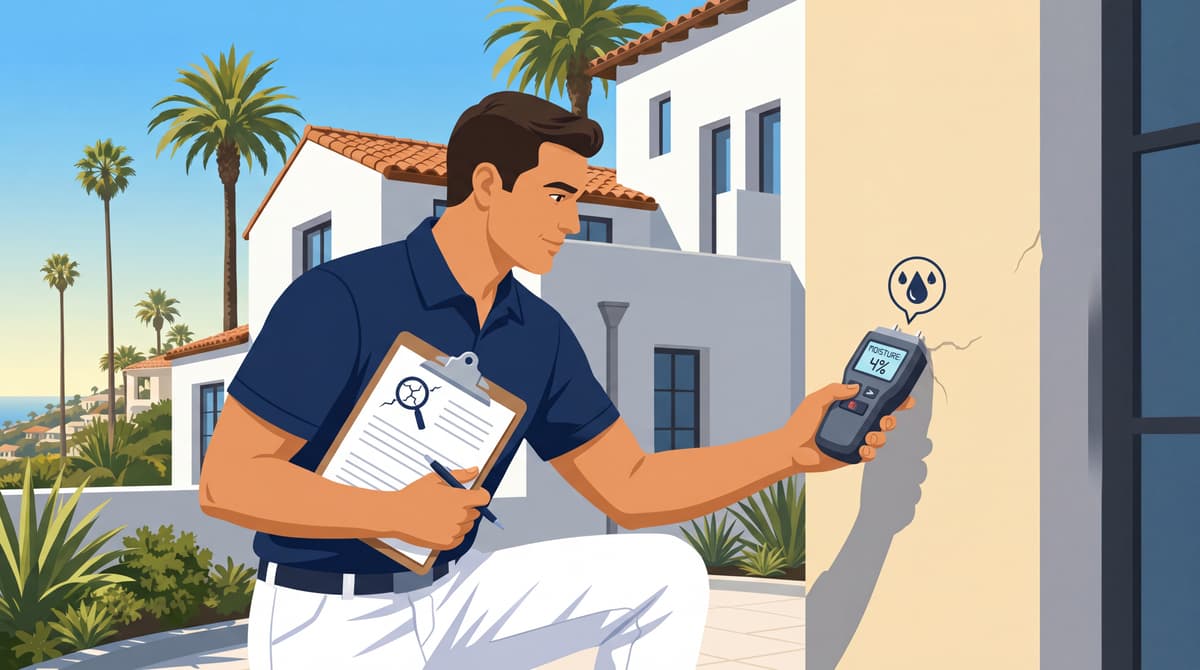
Stucco needs repainting every 5 to 7 years in SoCal's UV-intense environment (longer with integral color), periodic crack inspection, and annual cleaning. When hairline cracks appear, they are cosmetic and easily addressed. Repairs require skilled labor to blend seamlessly with existing texture — this is not DIY work, but it is infrequent when the original installation is done right.
Hardie board needs repainting every 10 to 15 years (less frequently, though touch-ups may be needed sooner), annual cleaning, and ongoing caulking maintenance at every seam and joint. Individual damaged boards can be replaced without affecting the whole wall, which is a practical advantage. However, coastal OC/LA homeowners should know that fastener corrosion in salt air environments is a documented issue with fiber cement installations.
Common Problems
Stucco Issues to Watch For
- Hairline cracks — cosmetic, typically caused by normal settling. Easily repaired.
- Pattern cracking — usually from improper curing during installation. Avoidable with experienced contractors.
- Staining — from irrigation overspray or windblown dust. Resolved with cleaning.
- Moisture intrusion — almost always caused by missing flashing or weep screed during installation, not the material itself.
Hardie Board Issues to Watch For
- Cracking at cut edges and corners — the material is strong but brittle.
- Paint peeling and finish failure — especially on unprimed cut edges exposed during installation.
- Moisture damage at board edges — swelling, warping, and potential mold when water seeps into unprotected edges.
- Fastener corrosion — particularly relevant for coastal Orange County and LA properties.
- Caulking failure — joint sealants deteriorate faster than the boards themselves, creating water entry points.
It is worth noting that class action lawsuits have been filed against James Hardie alleging premature product failure including cracking, warping, discoloration, and shrinkage.
Is Hardie Board Better Than Stucco?
In certain climates, Hardie board makes a strong case — particularly in regions with heavy rainfall, high humidity, or frequent freeze-thaw cycles where stucco's moisture sensitivity becomes a real concern.
But for Southern California specifically? Traditional stucco holds clear advantages:
- Longer lifespan in our dry climate (60-80+ years vs. 30-50)
- Superior fire protection with a 1-hour fire barrier and no ember entry points
- Proven earthquake resilience validated by Northridge data
- Better energy performance through thermal mass in our hot, sunny climate
- Seamless design that complements SoCal's architectural heritage
- Irrelevant moisture weakness in a region that gets 15 inches of rain annually
Hardie board is a solid product with real strengths. But when you are building or renovating in Orange County or Los Angeles, stucco is not just the traditional choice — it is the technically superior one for our specific environment.
Choosing the Right Contractor Matters More Than the Material
Here is the truth that gets lost in material comparisons: the quality of the installation matters more than the material itself. A perfectly manufactured Hardie board system installed poorly will fail. A stucco system installed by experienced professionals who understand building science — proper lath, weather-resistant barriers, code-compliant weep screed, correct flashing details — will protect your home for generations.
If you are considering stucco for your Southern California home, the single most important decision is not the material — it is who installs it.
Frequently Asked Questions About Stucco
How much does stucco repair cost in Orange County and Los Angeles?+
Stucco repair typically ranges from $500 for minor crack patching to $5,000+ for full re-stucco of a single elevation. The exact cost depends on the damage type (hairline cracks, water damage, delamination, weep screed failure), the square footage involved, and whether the original three-coat or one-coat stucco system needs to be matched. Stucco Champions provides fixed-price written estimates after a free on-site assessment — no hourly billing, no surprise change orders. See our stucco repair cost guide for detailed pricing by repair type.
How long does stucco last in Southern California?+
Properly installed three-coat stucco lasts 50-80+ years in Southern California's climate. The most common failure points aren't the stucco itself — they're the supporting components: corroded weep screed, deteriorated building paper behind the stucco, and improperly sealed window flashing. Most "stucco failures" are actually moisture-intrusion failures that start at one of these points. Annual visual inspection catches problems before they spread, which is why we offer free weep screed assessments for homeowners in our service area.
Can I repair stucco myself, or do I need a contractor?+
Hairline cracks under 1/8 inch wide can be sealed with elastomeric caulk by a homeowner. Anything larger — pattern cracks, delamination (where stucco pulls away from the wall), water-damaged areas, or chimney/window leak repairs — requires a licensed contractor. Improper DIY repair on these is the #1 cause of repeat failures because the underlying cause (usually moisture) isn't addressed. California's CSLB requires a license for any stucco work over $500. Looking for a highly-rated stucco contractor in Southern California? We are a CSLB-licensed and insured team ready to help.
How do I know if I need stucco repair vs. full re-stucco?+
If less than 30% of an elevation has visible damage, repair is the right call. If you see large areas of cracking, multiple zones of delamination, or the underlying paper and lath have rotted across an entire wall, full re-stucco of that elevation is more cost-effective long-term. Our free assessment includes a moisture survey and lath inspection so you get a defensible recommendation either way — not just a quote pushing whichever option costs more.
Do you offer warranties on stucco work?+
Yes. Stucco Champions provides a written 5-year workmanship warranty on all stucco repairs and a 10-year warranty on full re-stucco. We're a CSLB-licensed and insured contractor (license #1122006 — verifiable at cslb.ca.gov), which means our work is backed by California's contractor licensing board, not just our own promise. Request a free estimate to see the warranty terms in writing before you sign anything.
How long does a stucco repair take?+
Most patch repairs are completed in 1-2 days, including a 24-hour cure time before texture matching and color application. Full re-stucco of a single elevation runs 5-7 working days because each coat (scratch, brown, finish) needs to cure properly before the next is applied. We schedule around weather — California stucco needs daytime temperatures above 50°F with no rain forecast for at least 24 hours after each coat. Our crew shows up on time, every time.