Three Coat Stucco vs One Coat: What You Need to Know Before You Build
Written by Stucco Champions — Southern California’s Authority on Exterior Plastering.
Three-Coat Stucco vs. One-Coat: What You Need to Know Before You Build
When planning a new custom home or a major exterior renovation in Southern California, you will face a critical decision: "Do I install a traditional Three-Coat system or a modern One-Coat system?"
This is not just a matter of price; it is a matter of engineering. The Three-Coat system relies on mass and thickness (7/8") for durability, while the One-Coat system relies on foam insulation and fiber-reinforced cement for energy efficiency. This guide breaks down the technical differences to help you choose the right envelope for your property.
Free Assessment
Noticing Stucco Damage?
Get a free on-site assessment from a licensed contractor. $0 deposit, no obligation.
GET FREE ASSESSMENT1. The Three-Coat System: The Gold Standard
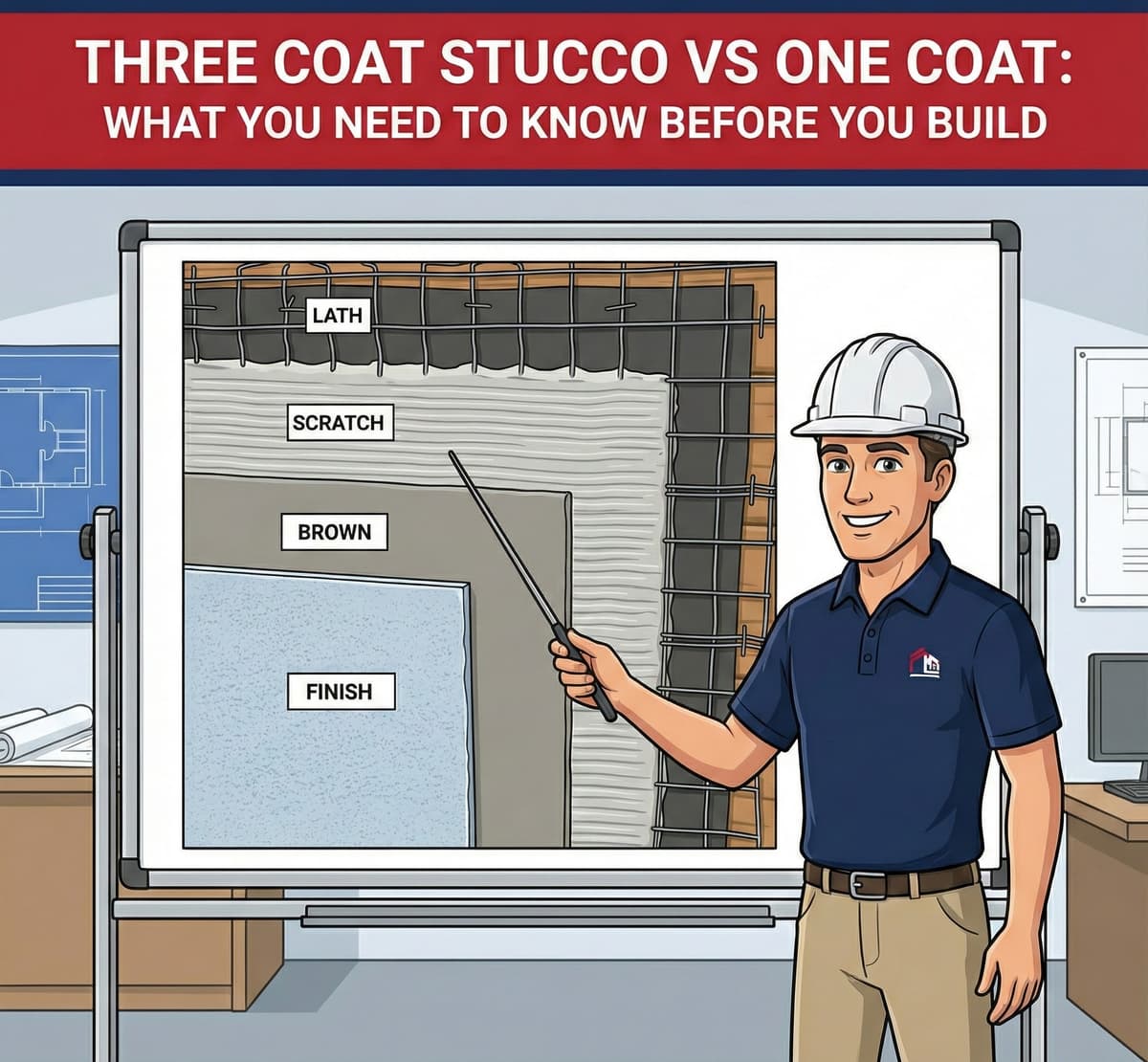
This is the system that built California. It is defined by ASTM C926 and consists of a solid, 7/8-inch thick slab of Portland cement applied over wire lath.
The Anatomy:
- 1. Scratch Coat (3/8"): The foundation. It embeds the wire mesh and is horizontally grooved (scarified) to provide a mechanical key.
- 2. Brown Coat (3/8"): The leveling layer. This coat creates the flat, plumb surface and provides the bulk of the wall's strength.
- 3. Finish Coat (1/8"): The decorative skin. This can be a traditional cement texture or an acrylic finish.
Why Choose Three-Coat?
Impact Resistance: It is solid rock. A baseball or heavy object will bounce off it.
Fire Rating: A 7/8" thick cement wall provides a verified 1-hour fire rating, which is critical for homes in High Fire Severity Zones (canyons/hills).
Longevity: Properly maintained, this system can last 50+ years.
2. The One-Coat System: The Energy Solution
Despite the name "One-Coat," this is actually a two-step process applied over rigid foam insulation. It is designed to meet Title 24 energy codes.
The Anatomy:
- 1. Insulation Layer: 1-inch EPS foam board is stapled or screwed to the framing.
- 2. Base Coat (3/8" - 1/2"): A proprietary cement blend reinforced with chopped fiberglass strands. This is applied in a single pass over the foam.
- 3. Finish Coat: Standard texture coat.
Why Choose One-Coat?
Insulation (R-Value): The foam layer breaks the "thermal bridge" of the wood studs, keeping the home significantly cooler in summer.
Flexibility: The foam acts as a shock absorber, reducing the hairline cracking associated with settling foundations.
Speed: It eliminates the 48-hour cure time between scratch and brown coats, speeding up the construction schedule.
3. The Durability Trade-Off
There is no perfect system. You must choose your priority.
⚠️ Impact Vulnerability
The cement shell on a One-Coat system is much thinner (approx 1/2") and backed by soft foam. A heavy impact can puncture the wall, requiring a complex patch. If your home is in a high-traffic area (e.g., a driveway where kids play sports), the Three-Coat system is safer.
4. Cost Comparison
Surprisingly, the cost difference is often negligible in new construction.
- Three-Coat: Higher labor costs (multiple trips/cure times), but cheaper materials (sand/cement).
- One-Coat: Lower labor costs (faster application), but expensive proprietary materials (foam/fiber bags).
Conclusion: Context is Key
If you are building a custom estate in a fire zone, stick with the Three-Coat System for its mass and fire rating. If you are retrofitting a tract home and want to lower your AC bills, the One-Coat Foam System is the superior energy choice. At Stucco Champions, we install both systems to strict ASTM standards.
Related ResourcesLast week, we shared Introduction to One-Coat Plastering Products. Learn about the specific brands (Omega/Western) we use.
Frequently Asked Questions About Stucco
How much does stucco repair cost in Orange County and Los Angeles?+
Small stucco patches start at $650, larger repairs start at $1,200, and re-stucco of a single elevation up to about 400 sq ft runs about $1,400 - $5,900+. The exact cost depends on the damage type (hairline cracks, water damage, delamination, weep screed failure), the square footage involved, and whether the original three-coat or one-coat stucco system needs to be matched. Stucco Champions provides fixed-price written estimates after a free on-site assessment — no hourly billing, no surprise change orders. See our stucco repair cost guide for detailed pricing by repair type.
How long does stucco last in Southern California?+
Properly installed three-coat stucco lasts 50-80+ years in Southern California's climate. The most common failure points aren't the stucco itself — they're the supporting components: corroded weep screed, deteriorated building paper behind the stucco, and improperly sealed window flashing. Most "stucco failures" are actually moisture-intrusion failures that start at one of these points. Annual visual inspection catches problems before they spread, which is why we offer free weep screed assessments for homeowners in our service area.
Can I repair stucco myself, or do I need a contractor?+
Hairline cracks under 1/8 inch wide can be sealed with elastomeric caulk by a homeowner. Anything larger — pattern cracks, delamination (where stucco pulls away from the wall), water-damaged areas, or chimney/window leak repairs — requires a licensed contractor. Improper DIY repair on these is the #1 cause of repeat failures because the underlying cause (usually moisture) isn't addressed. California's CSLB requires a license for any stucco work over $500. Looking for a highly-rated stucco contractor in Southern California? We are a CSLB-licensed and insured team ready to help.
How do I know if I need stucco repair vs. full re-stucco?+
If less than 30% of an elevation has visible damage, repair is the right call. If you see large areas of cracking, multiple zones of delamination, or the underlying paper and lath have rotted across an entire wall, full re-stucco of that elevation is more cost-effective long-term. Our free assessment includes a moisture survey and lath inspection so you get a defensible recommendation either way — not just a quote pushing whichever option costs more.
Do you offer warranties on stucco work?+
Approved stucco repair work includes a 1-year written workmanship warranty. The applicable terms are documented with the approved scope. Stucco Champions is CSLB licensed and insured; verify license #1122006 through the official state lookup. Request a free estimate to review the scope and warranty terms before you sign.
How long does a stucco repair take?+
Most patch repairs are completed in 1-2 days, including a 24-hour cure time before texture matching and color application. Full re-stucco of a single elevation runs 5-7 working days because each coat (scratch, brown, finish) needs to cure properly before the next is applied. We schedule around weather — California stucco needs daytime temperatures above 50°F with no rain forecast for at least 24 hours after each coat. Our crew shows up on time, every time.
Stucco Diagnostics & Calculators
Diagnose specific wall damage symptoms or estimate job scope with our free guides and calculators.
Related Professional Services
A licensed assessment identifies the cause before the finish is opened or replaced.