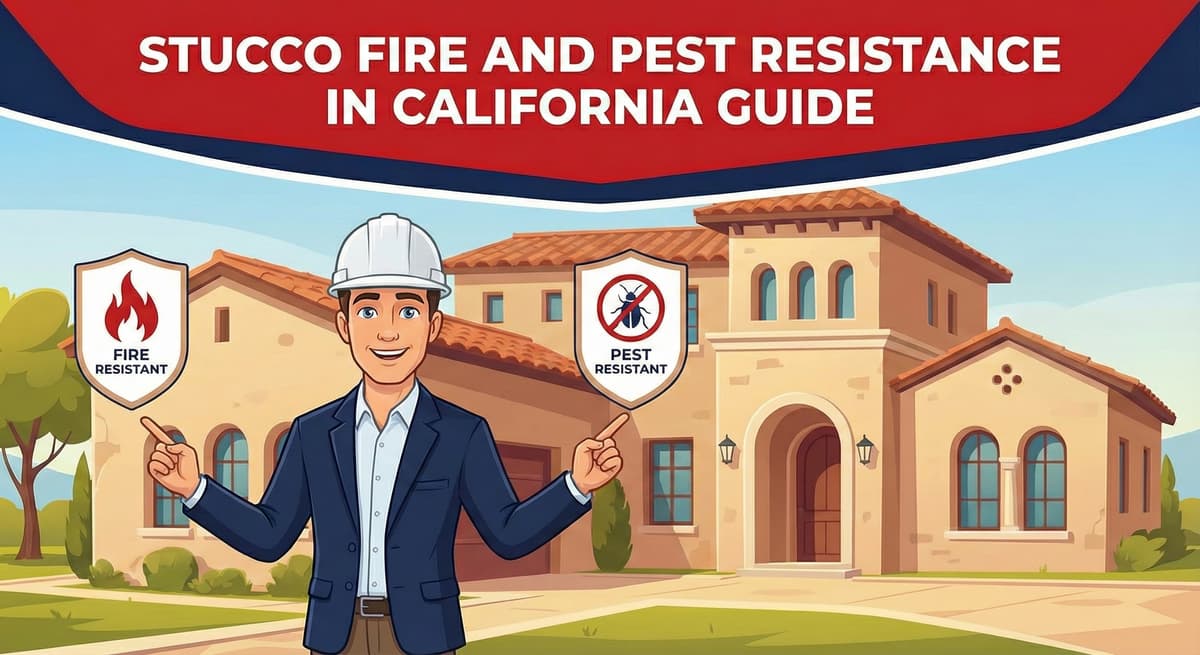
Fire and Pest Resistance: Why Stucco is California’s Smartest Exterior Choice
Written by Stucco Champions — Southern California’s Authority on Exterior Plastering.
Fire and Pest Resistance: Why Stucco is California’s Smartest Exterior Choice
In Southern California, choosing an exterior cladding is about more than just styling; it is about protecting your home against severe environmental hazards. Between the wildfire risks in our canyons and dry hills and the subterranean termite activity in our soils, your home’s cladding is its primary shield.
While wood siding and vinyl are common in other regions, they are highly vulnerable in our climate. A properly installed Three-Coat Stucco System offers a non-combustible, monolithic barrier that protects your home from the two biggest threats to California real estate: fire and pests.
Free Assessment
Noticing Stucco Damage?
Get a free on-site assessment from a licensed contractor. $0 deposit, no obligation.
GET FREE ASSESSMENT1. The Firewall: Stucco in the WUI Zone
Many homes in Los Angeles, Orange, and San Diego counties fall into designated Wildland-Urban Interface (WUI) areas. Under the California Building Code (CBC) **Chapter 7A (Section 707A)**, exterior cladding materials must be non-combustible or ignition-resistant. Stucco is the premier choice for these high-risk fire zones.
The ASTM E119 1-Hour Fire Rating
Stucco is composed of Portland cement, sand, lime, and water. It is inherently non-combustible.
A standard nominal 7/8-inch thick Three-Coat system creates a verified ASTM E119 1-Hour Fire Barrier. This means that in the event of a neighboring structure fire or a passing wildfire front, the stucco protects the combustible wood framing underneath from igniting for at least one hour, giving emergency crews critical time to suppress the fire. Vinyl siding, by comparison, melts quickly, while wood siding actively fuels the flame.
2. The Fortress: Pest Exclusion
Termites and rodents are opportunists. They seek out structural gaps, moist framing, and soft entry points. A solid stucco system denies them access.
Subterranean Termite Defense
Termites cannot chew through cement plaster. Unlike wood siding, which requires regular chemical treatments and paint seals to deter wood-boring pests, stucco provides zero food source.
The Monolithic Seal: Because stucco is applied wet, it cures into a single, seamless shell. There are no overlapping horizontal joints (like in siding) for termites or other wood-boring insects to crawl between.
Rodent Barrier
Mice and rats can gnaw through wood siding, vinyl, and foam boards. They cannot chew through 7/8 inch of solid cement plaster reinforced with steel wire mesh. A properly lathed house is essentially encased in a steel cage.
While the stucco wall is impenetrable, the bottom drainage boundary is a critical vector. Under **ASTM C1063**, we must maintain clearances of at least 4 inches above raw earth/soil and 2 inches above paved concrete. If you bury the stucco or weep holes in soil, mulch, or landscaping, you create a direct moisture and termite bridge, allowing subterranean termites to bypass the stucco entirely and enter the framing from below.
3. The Hidden Strength: Code-Compliant Lath
The fire and pest resistance of stucco relies entirely on the integrity of the lathing skeleton underneath. If the lath is loose or corrodes, the protective seal breaks.
At Stucco Champions, we adhere to ASTM C1063 and ASTM C926 standards on every build:
- Galvanized Steel Mesh: We use hot-dipped galvanized woven wire mesh (17-gauge) to resist corrosion and prevent rodents from gnawing through the backing.
- Two-Layer Cleavage Plane: We install two layers of Grade D paper (Super Jumbo Tex) complying with **CRC Section R703.7.3** to ensure that even if the outer stucco shell develops hairline cracks, the inner barrier keeps out both moisture and the pests attracted to it.
Conclusion: Build for the California Environment
If you are building or remodeling in Southern California, you must design for the environment we live in. Stucco provides the thermal mass to regulate summer heat, the durability to resist pests, and the non-combustible composition to survive fire seasons. It is the ultimate protective armor for your home.
Last week, we shared the What Is a Three-Coat Stucco System? Read more about the individual layers that provide this protection.
Frequently Asked Questions About Stucco
How much does stucco repair cost in Orange County and Los Angeles?+
Small stucco patches start at $650, larger repairs start at $1,200, and re-stucco of a single elevation up to about 400 sq ft runs about $1,400 - $5,900+. The exact cost depends on the damage type (hairline cracks, water damage, delamination, weep screed failure), the square footage involved, and whether the original three-coat or one-coat stucco system needs to be matched. Stucco Champions provides fixed-price written estimates after a free on-site assessment — no hourly billing, no surprise change orders. See our stucco repair cost guide for detailed pricing by repair type.
How long does stucco last in Southern California?+
Properly installed three-coat stucco lasts 50-80+ years in Southern California's climate. The most common failure points aren't the stucco itself — they're the supporting components: corroded weep screed, deteriorated building paper behind the stucco, and improperly sealed window flashing. Most "stucco failures" are actually moisture-intrusion failures that start at one of these points. Annual visual inspection catches problems before they spread, which is why we offer free weep screed assessments for homeowners in our service area.
Can I repair stucco myself, or do I need a contractor?+
Hairline cracks under 1/8 inch wide can be sealed with elastomeric caulk by a homeowner. Anything larger — pattern cracks, delamination (where stucco pulls away from the wall), water-damaged areas, or chimney/window leak repairs — requires a licensed contractor. Improper DIY repair on these is the #1 cause of repeat failures because the underlying cause (usually moisture) isn't addressed. California's CSLB requires a license for any stucco work over $500. Looking for a highly-rated stucco contractor in Southern California? We are a CSLB-licensed and insured team ready to help.
How do I know if I need stucco repair vs. full re-stucco?+
If less than 30% of an elevation has visible damage, repair is the right call. If you see large areas of cracking, multiple zones of delamination, or the underlying paper and lath have rotted across an entire wall, full re-stucco of that elevation is more cost-effective long-term. Our free assessment includes a moisture survey and lath inspection so you get a defensible recommendation either way — not just a quote pushing whichever option costs more.
Do you offer warranties on stucco work?+
Approved stucco repair work includes a 1-year written workmanship warranty. The applicable terms are documented with the approved scope. Stucco Champions is CSLB licensed and insured; verify license #1122006 through the official state lookup. Request a free estimate to review the scope and warranty terms before you sign.
How long does a stucco repair take?+
Most patch repairs are completed in 1-2 days, including a 24-hour cure time before texture matching and color application. Full re-stucco of a single elevation runs 5-7 working days because each coat (scratch, brown, finish) needs to cure properly before the next is applied. We schedule around weather — California stucco needs daytime temperatures above 50°F with no rain forecast for at least 24 hours after each coat. Our crew shows up on time, every time.
Stucco Diagnostics & Calculators
Diagnose specific wall damage symptoms or estimate job scope with our free guides and calculators.
Related Professional Services
A licensed assessment identifies the cause before the finish is opened or replaced.