What is a Three-Coat Stucco System? The Traditional Method Explained
In the world of exterior cladding, the Three-Coat Stucco System is the time-tested standard. It is the traditional method of applying Portland cement plaster that has protected homes for over a century.
Unlike modern "One-Coat" systems that often rely on foam board for thickness, a Three-Coat system builds a solid, dense cement shell (typically 7/8-inch total thickness) around the home. It offers excellent impact resistance, fire protection, and longevity. This guide breaks down the anatomy of the system according to ASTM C926 standards.
1. The Anatomy of the System
A Three-Coat system is not just three layers of cement; it is a complete moisture management and cladding assembly.
Free Assessment
Noticing Stucco Damage?
Get a free on-site assessment from a licensed contractor. $0 deposit, no obligation.
GET FREE ASSESSMENTLayer 0: The Drainage Plane & Skeleton
Before any cement is applied, the substrate must be prepared to handle moisture.
- Waterproofing (WRB): We strictly adhere to building codes by installing a Weather-Resistant Barrier (such as two layers of Grade D building paper or house wrap). This separates the wet stucco from the wood framing and directs moisture down to the weep screed.
- Lath: Galvanized metal wire mesh (or expanded metal lath) is fastened through the WRB into the framing. This provides the mechanical grip for the cement.
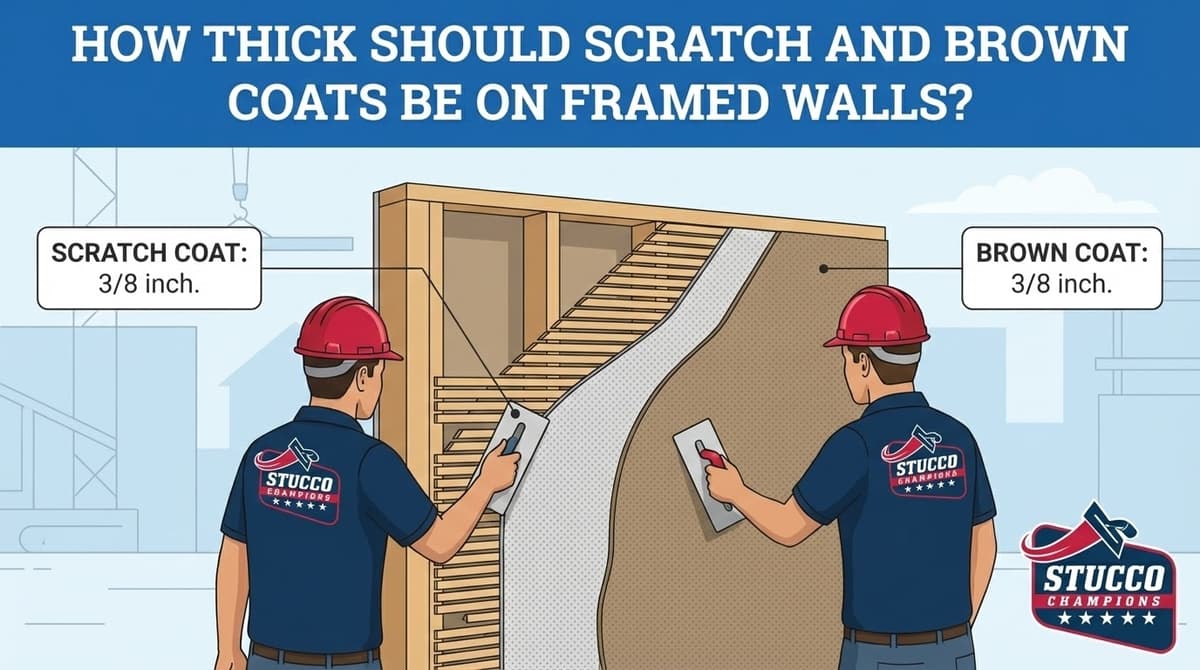
Layer 1: The Scratch Coat
Thickness: Approximately 3/8 inch.
This is the foundational layer. A mixture of Portland cement, lime, and sand is pushed hard through the wire mesh to fully embed the metal and key against the WRB. Before it hardens, a scarifier is run across the surface to cut horizontal grooves ("scratches"). These grooves create a mechanical bond for the next layer.
Layer 2: The Brown Coat
Thickness: Approximately 3/8 inch.
This is the leveling layer. While the Scratch coat follows the wavy contours of the framing and lath, the Brown coat is used to straighten and plumb the wall. Plasterers use long straightedges ("rods" and "darbies") to shave the wall flat.
You cannot rush the cure. ASTM C926 requires a minimum of 48 hours of moist curing between the Scratch and Brown coats. Furthermore, the Brown coat must cure extensively (often 7 to 14 days minimum) before the finish coat is applied. Rushing this process leads to severe shrinkage cracking.
Layer 3: The Finish Coat
Thickness: Approximately 1/8 inch (varies by texture).
This is the decorative skin that provides the final texture and color. It can be a breathable, traditional cement-based finish or a modern, flexible acrylic finish.
2. Why Choose Traditional Three-Coat?
If newer systems are faster, why do architects still specify Three-Coat for custom homes?
- Impact Resistance: It is essentially a solid slab of masonry. A heavy impact will bounce off a Three-Coat wall; on a foam-backed wall, it might puncture the system.
- Fire Rating: A 7/8" thick cement wall provides excellent fire resistance, which is highly desirable in wildfire-prone regions.
- Sound Dampening: The dense mass of the solid wall significantly reduces exterior noise transmission compared to lighter cladding systems.
3. Maintenance Expectations
While incredibly durable, the Three-Coat system is rigid masonry.
Because it is cement, it will naturally develop minor hairline cracks as the house settles, lumber shrinks, and the structure expands and contracts with thermal changes. This is normal behavior. Maintenance involves keeping the foundation weep screeds clear of soil and vegetation, and promptly repairing any cracks that exceed hairline width to prevent water intrusion.
Frequently Asked Questions About Stucco
How much does stucco repair cost in Orange County and Los Angeles?+
Stucco repair typically ranges from $500 for minor crack patching to $5,000+ for full re-stucco of a single elevation. The exact cost depends on the damage type (hairline cracks, water damage, delamination, weep screed failure), the square footage involved, and whether the original three-coat or one-coat stucco system needs to be matched. Stucco Champions provides fixed-price written estimates after a free on-site assessment — no hourly billing, no surprise change orders. See our stucco repair cost guide for detailed pricing by repair type.
How long does stucco last in Southern California?+
Properly installed three-coat stucco lasts 50-80+ years in Southern California's climate. The most common failure points aren't the stucco itself — they're the supporting components: corroded weep screed, deteriorated building paper behind the stucco, and improperly sealed window flashing. Most "stucco failures" are actually moisture-intrusion failures that start at one of these points. Annual visual inspection catches problems before they spread, which is why we offer free weep screed assessments for homeowners in our service area.
Can I repair stucco myself, or do I need a contractor?+
Hairline cracks under 1/8 inch wide can be sealed with elastomeric caulk by a homeowner. Anything larger — pattern cracks, delamination (where stucco pulls away from the wall), water-damaged areas, or chimney/window leak repairs — requires a licensed contractor. Improper DIY repair on these is the #1 cause of repeat failures because the underlying cause (usually moisture) isn't addressed. California's CSLB requires a license for any stucco work over $500. Looking for a highly-rated stucco contractor in Southern California? We are a CSLB-licensed and insured team ready to help.
How do I know if I need stucco repair vs. full re-stucco?+
If less than 30% of an elevation has visible damage, repair is the right call. If you see large areas of cracking, multiple zones of delamination, or the underlying paper and lath have rotted across an entire wall, full re-stucco of that elevation is more cost-effective long-term. Our free assessment includes a moisture survey and lath inspection so you get a defensible recommendation either way — not just a quote pushing whichever option costs more.
Do you offer warranties on stucco work?+
Yes. Stucco Champions provides a written 5-year workmanship warranty on all stucco repairs and a 10-year warranty on full re-stucco. We're a CSLB-licensed and insured contractor (license #1122006 — verifiable at cslb.ca.gov), which means our work is backed by California's contractor licensing board, not just our own promise. Request a free estimate to see the warranty terms in writing before you sign anything.
How long does a stucco repair take?+
Most patch repairs are completed in 1-2 days, including a 24-hour cure time before texture matching and color application. Full re-stucco of a single elevation runs 5-7 working days because each coat (scratch, brown, finish) needs to cure properly before the next is applied. We schedule around weather — California stucco needs daytime temperatures above 50°F with no rain forecast for at least 24 hours after each coat. Our crew shows up on time, every time.