When Stucco Patching Meets Concrete Restoration
Written by Stucco Champions — Southern California’s Authority on Exterior Plastering.
When Stucco Patching Meets Concrete Restoration: A Unified Approach
In Southern California, home restoration is more than just a cosmetic upgrade; it is a vital safeguard against seismic activity, salt air, and thermal shock. When an exterior wall exhibits cracks, delamination, or rust staining, a durable solution requires going deeper than the surface.
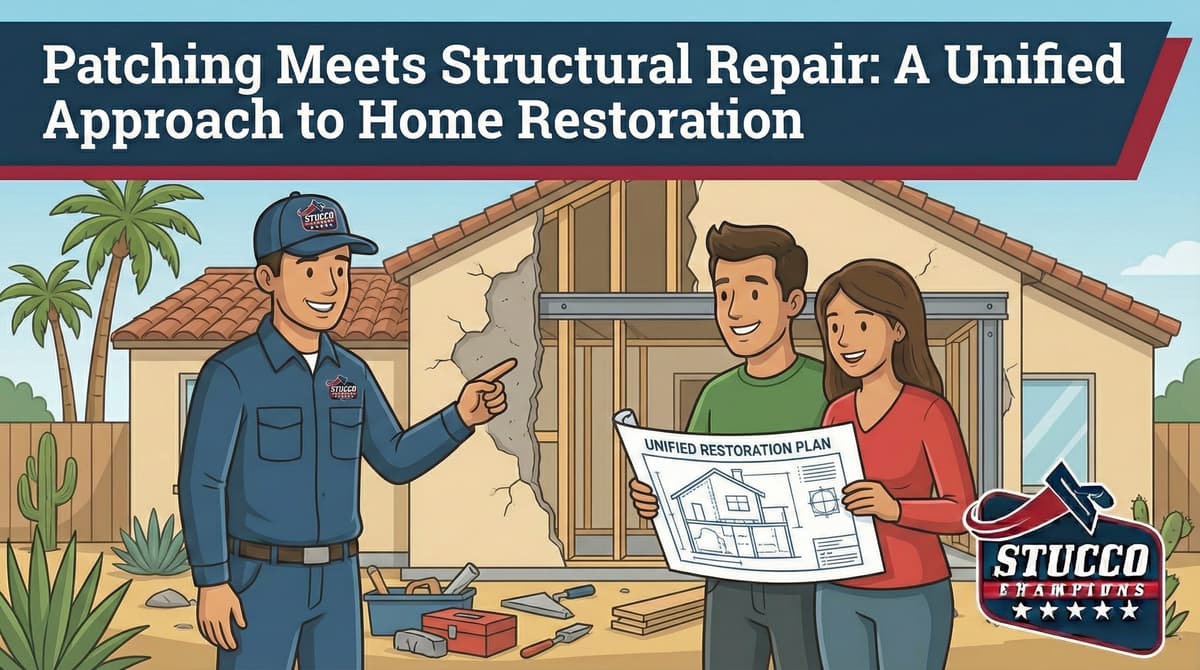
At Stucco Champions, we define "Restoration" as the intersection of two distinct disciplines: **Precision Patching** (the aesthetic finish layer) and **Concrete/Structural Restoration** (the engineering system beneath). This guide explores how these two trades work together to protect your home's structural integrity.
Free Assessment
Noticing Stucco Damage?
Get a free on-site assessment from a licensed contractor. $0 deposit, no obligation.
GET FREE ASSESSMENT1. The Art of Surface Restoration
Patching stucco is not just about filling holes; it is about matching history. Whether working with traditional portland cement plaster or modern acrylic synthetics, the goal is total visual integration:
- Texture Science: Every patch must precisely match the aggregate sand grain size (governed by **ASTM C897** sieve sizes) and trowel style (such as sand float, heavy lace, or smooth trowel) of the surrounding wall to avoid creating unsightly "scars."
- Material Matching: We use polymer-modified patching compounds that bond aggressively to old cement, preventing the patch from popping out when thermal contraction occurs.
2. Technology Meets Craftsmanship
Top-tier professionals combine old-world hand craftsmanship with modern material chemistry:
- Traditional Tools: We utilize hand tools like floats, rods, and darbies to ensure flat planes (aiming for less than 1/4" deviation in 10 feet under **ASTM C926**).
- Modern Chemistry: We use diamond-blade saws for surgical demolition (making clean square cuts to avoid spalling surrounding plaster) and apply specialized liquid bonding agents (such as Weld-Crete, complying with **ASTM C932** for exterior applications) to establish a chemical weld between new and old cementitious substrates.
3. Collaboration: Patching vs. Structural Repair
Many homeowners confuse simple cosmetic patching with structural repair. They are actually distinct, sequential phases of a complete restoration project:
| Feature | Patching (Aesthetic Finish) | Structural Repair (Building Envelope) |
|---|---|---|
| Primary Focus | Surface blending and color/texture matching. | Structural framing, lath, and waterproofing. |
| Standards & Codes | **ASTM C926** plastering application. | **ASTM C1063** lath installation & **CRC R703**. |
| Tools & Techniques | Trowels, sponge floats, color-matching stains. | Demolition saws, new wire lath, sistered studs. |
| Typical Tasks | Hairline crack filling, skim coats, fog coating. | Fixing framing dry rot, replacing rusted weep screeds. |
4. Surface Types and Technical Solutions
Different plaster and masonry substrates require distinct chemical and material approaches. Using the wrong repair compound leads to bond failure:
| Surface Type | Common Failure Modes | Technical Solution |
|---|---|---|
| Stucco (Portland Plaster) | Shrinkage cracks, delamination, rust spots. | Surgical cut-out, Grade D paper repair, galvanized wire lath lapped 2" per **ASTM C1063**, and multi-coat plastering per **ASTM C926**. |
| Concrete / Masonry | Spalling, rebar corrosion, foundation settling. | Rust treatment on rebar, epoxy injection of structural cracks, and high-strength polymer mortar patching. |
| Drywall (Interior) | Water staining, sagging from exterior envelope leaks. | Source-leak repair, replacing gypsum board, taping, and joint compound texture matching. |
Structure First, Finish Second. Never patch a plaster crack without resolving the underlying cause. If a crack is caused by a rusted lath seam or window flashing failure, applying a cosmetic finish patch will only trap moisture, accelerate framing rot, and fail again within months.
5. Choosing the Right Contractor
When vetting a lathing, plastering, or restoration contractor in California, ensure they meet these professional standards:
- Licensure & Insurance: Verify their license via the CSLB. A specialized **C-35 Lathing and Plastering** contractor is legally required for structural plaster assemblies, carrying full general liability and workers' compensation.
- Water Management Focus: Ensure they understand building envelope mechanics—including the double-layer Grade D WRB drainage plane, window flashing sequences, and weep screed code clearances (at least 4 inches above raw earth, 2 inches above concrete paving per **ASTM C1063**).
For more details on masonry and concrete repair materials, resources like the Concrete Network - Surface Repair Techniques provide excellent insights into chemical bonding agents.
6. The Cost of Quality
A professional, code-compliant restoration is a long-term investment:
- Professional Plaster Repair: Typically costs $650 – $1,200+ per patch area (including dust control, surgical cutting, wire integration, multi-coat cure cycles, and color matching).
- Cosmetic Handyman Patches: Often cost less upfront but omit the lath integration or shingle-lap waterproofing, leading to water leaks and failure during the next rain event.
Conclusion: A Unified Solution
At Stucco Champions, we handle both structural building envelope remediation and the final aesthetic plaster blending. By managing the entire sequence—from framing repairs and lathing to the final color-matched texture—we guarantee a repair that is structurally sound and visually invisible.
Read our step-by-step Stucco Cracks and Control Joint Repair Guide to see how we manage structural and thermal stresses on large walls.
A note on fog coat: Stucco Champions does not fog coat older or previously repaired walls. On aged stucco a fog coat telegraphs existing cracks, patch lines, and prior repairs, and it bonds poorly to a rough, chalky, or previously coated surface, so it can dust off or peel. Those walls get a fresh finish coat (re-stucco) instead.
Frequently Asked Questions About Stucco
How much does stucco repair cost in Orange County and Los Angeles?+
Stucco repair typically ranges from $500 for minor crack patching to $5,000+ for full re-stucco of a single elevation. The exact cost depends on the damage type (hairline cracks, water damage, delamination, weep screed failure), the square footage involved, and whether the original three-coat or one-coat stucco system needs to be matched. Stucco Champions provides fixed-price written estimates after a free on-site assessment — no hourly billing, no surprise change orders. See our stucco repair cost guide for detailed pricing by repair type.
How long does stucco last in Southern California?+
Properly installed three-coat stucco lasts 50-80+ years in Southern California's climate. The most common failure points aren't the stucco itself — they're the supporting components: corroded weep screed, deteriorated building paper behind the stucco, and improperly sealed window flashing. Most "stucco failures" are actually moisture-intrusion failures that start at one of these points. Annual visual inspection catches problems before they spread, which is why we offer free weep screed assessments for homeowners in our service area.
Can I repair stucco myself, or do I need a contractor?+
Hairline cracks under 1/8 inch wide can be sealed with elastomeric caulk by a homeowner. Anything larger — pattern cracks, delamination (where stucco pulls away from the wall), water-damaged areas, or chimney/window leak repairs — requires a licensed contractor. Improper DIY repair on these is the #1 cause of repeat failures because the underlying cause (usually moisture) isn't addressed. California's CSLB requires a license for any stucco work over $500. Looking for a highly-rated stucco contractor in Southern California? We are a CSLB-licensed and insured team ready to help.
How do I know if I need stucco repair vs. full re-stucco?+
If less than 30% of an elevation has visible damage, repair is the right call. If you see large areas of cracking, multiple zones of delamination, or the underlying paper and lath have rotted across an entire wall, full re-stucco of that elevation is more cost-effective long-term. Our free assessment includes a moisture survey and lath inspection so you get a defensible recommendation either way — not just a quote pushing whichever option costs more.
Do you offer warranties on stucco work?+
Approved stucco repair work includes a 1-year written workmanship warranty. The applicable terms are documented with the approved scope. Stucco Champions is CSLB licensed and insured; verify license #1122006 through the official state lookup. Request a free estimate to review the scope and warranty terms before you sign.
How long does a stucco repair take?+
Most patch repairs are completed in 1-2 days, including a 24-hour cure time before texture matching and color application. Full re-stucco of a single elevation runs 5-7 working days because each coat (scratch, brown, finish) needs to cure properly before the next is applied. We schedule around weather — California stucco needs daytime temperatures above 50°F with no rain forecast for at least 24 hours after each coat. Our crew shows up on time, every time.
Stucco Diagnostics & Calculators
Diagnose specific wall damage symptoms or estimate job scope with our free guides and calculators.
Related Professional Services
A licensed assessment identifies the cause before the finish is opened or replaced.