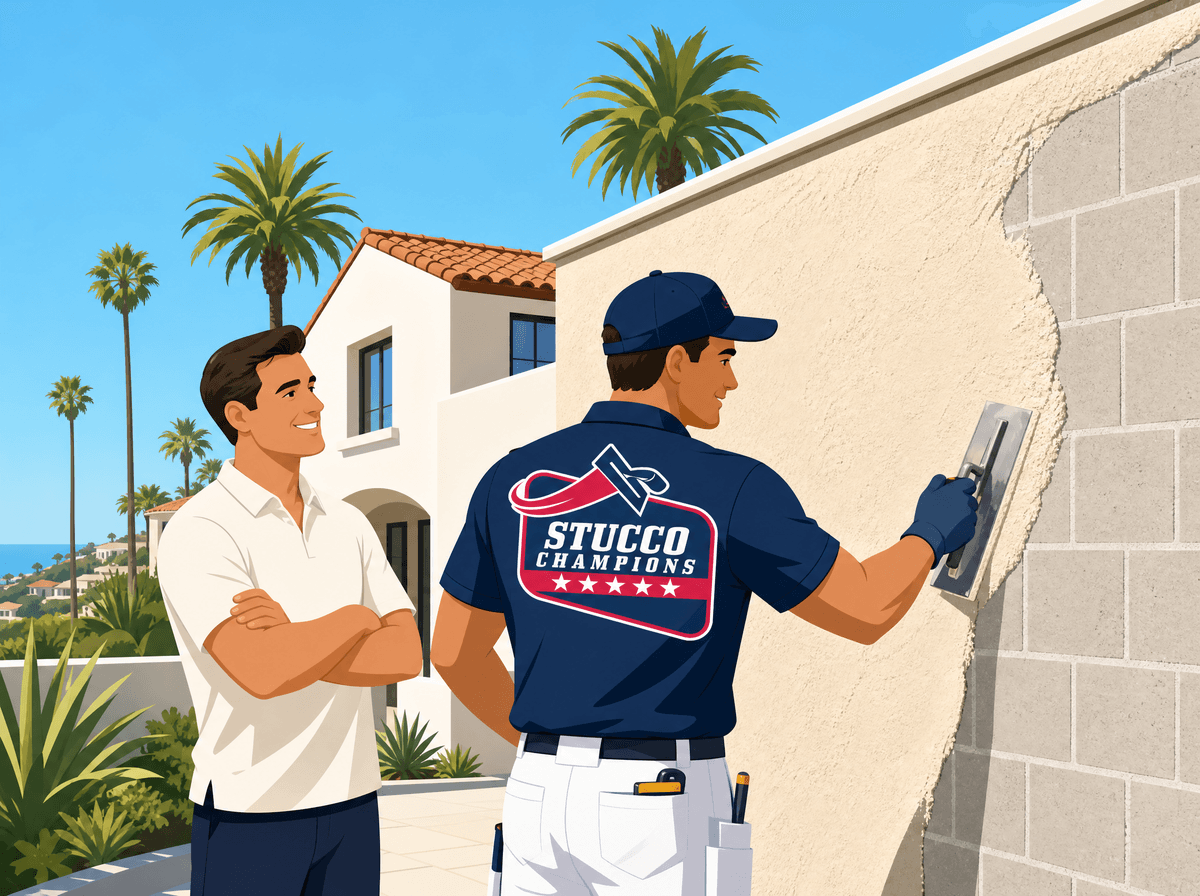
Stucco Myths Homeowners Should Stop Believing

Written by Stucco Champions — Southern California’s Authority on Exterior Plastering.
Stucco Myths Debunked: The Engineering Reality
Stucco has been the dominant building material in California for over a century, yet misconceptions persist. Homeowners often hear that stucco is "prone to cracking" or "high maintenance." The truth is that stucco is one of the most durable, fire-resistant claddings available—if engineered and installed correctly.
Most "stucco failures" are actually failures of lathing or waterproofing design, not the cement plaster itself. This guide separates the folklore from the physics.
Free Assessment
Noticing Stucco Damage?
Get a free on-site assessment from a licensed contractor. $0 deposit, no obligation.
GET FREE ASSESSMENTMyth 1: "Stucco Always Cracks"
The Fear: Every stucco home will eventually look like a spiderweb of fractures.
The Reality: All cementitious products shrink as they cure and expand/contract during thermal cycles. However, unsightly, visible cracking is a result of installation shortcuts, not a natural destiny.
We use **Control Joints** to divide large wall fields into panels (**ASTM C1063** requires joint spacing not to exceed 144 sq ft, with a maximum 18-foot length-to-width dimension and a 2.5:1 aspect ratio). This relieves stress and forces shrinkage cracks to form inside the joint channel. For additional durability, we use polymer-modified **Acrylic/Synthetic finishes** (Durable Polymer Reactant - DPR) which are elastomeric and bridge hairline cracks.
Myth 2: "Stucco is Outdated"
The Fear: Stucco means a heavy, old-fashioned 1970s "Spanish Lace" texture.
The Reality: Stucco is the chameleon of architecture. While traditional lace textures are still excellent for Spanish Revival homes, modern custom estates in Newport Beach and Malibu utilize **Santa Barbara Smooth** finishes. This ultra-smooth plaster mimics polished concrete or limestone, offering a sleek, minimalist aesthetic preferred for contemporary designs.
Myth 3: "Stucco is Not Energy Efficient"
The Fear: It is just a thin layer of rock with no insulating capability.
The Reality: While traditional 3-coat stucco relies on thermal mass (slow heat transfer), modern systems are energy-efficiency powerhouses.
The One-Coat System: Complying with **ASTM C1397** and continuous insulation (CI) guidelines, this modern system includes a layer of **rigid EPS foam board** (typically R-4 or greater). This breaks the thermal bridge of the wood framing, significantly lowering cooling costs and meeting California's strict **Title 24** energy codes.
Myth 4: "Patches Are Always Visible"
The Fear: If I repair a hole or water damage, I will have an ugly "scar" on my wall forever.
The Reality: A bad patch is visible. A professional, code-compliant restoration is invisible.
The Technique: We don't just fill holes with patching compound. We "square cut" the damage back to the studs, tie in new wire lath lapped by at least 2 inches under **ASTM C1063**, apply a zinc cold-galvanizing coating, and scratch/brown the plaster per **ASTM C926**. We then apply a cement-based Fog Coat to blend the color, erasing the repair history.
Myth 5: "Stucco Rots Wood"
The Fear: Stucco traps moisture and rots the framing wood underneath.
The Reality: Stucco is a porous reservoir cladding; it naturally absorbs water. Rot only happens when the waterproofing barrier behind it fails.
For wood-framed structures, **CRC Section R703.7.3** mandates a water-resistive barrier (WRB) consisting of **two layers of Grade D building paper** (or equivalent). This creates a cleavage plane where water drains downward to escape through the weep screed at the bottom of the wall assembly. Rotted framing occurs only when this weather barrier or perimeter flashings are omitted or incorrectly detailed. The weep screed must remain clear of ground surface: at least 4 inches above raw soil/earth and 2 inches above paved concrete, per **ASTM C1063**.
Fact Check Matrix
| The Myth | The Engineering Fact |
|---|---|
| It Cracks | Control joints (ASTM C1063) and elastomeric acrylics manage and bridge movement. |
| It's Ugly / Outdated | Smooth Santa Barbara finishes offer a modern, high-end architectural aesthetic. |
| No Insulation | Continuous insulation foam systems (One-Coat / ASTM C1397) offer R-Value > R-4. |
| High Maintenance | Integral mineral color coats last 20+ years without needing paint, maintaining breathability. |
Conclusion: Trust the System
Stucco is a sophisticated, highly engineered multi-layer wall cladding system. When you hire a licensed C-35 contractor who follows ASTM standards for lathing and waterproofing, you get a fire-resistant, impact-resistant envelope that lasts a lifetime. Ignore the myths and focus on the specifications.
Read our guide on Stucco Problems and How to Prevent Them to learn how to identify real building envelope issues before they become expensive repairs.
A note on fog coat: Stucco Champions does not fog coat older or previously repaired walls. On aged stucco a fog coat telegraphs existing cracks, patch lines, and prior repairs, and it bonds poorly to a rough, chalky, or previously coated surface, so it can dust off or peel. Those walls get a fresh finish coat (re-stucco) instead.
Frequently Asked Questions About Stucco
How much does stucco repair cost in Orange County and Los Angeles?+
Small stucco patches start at $650, larger repairs start at $1,200, and re-stucco of a single elevation up to about 400 sq ft runs about $1,400 - $5,900+. The exact cost depends on the damage type (hairline cracks, water damage, delamination, weep screed failure), the square footage involved, and whether the original three-coat or one-coat stucco system needs to be matched. Stucco Champions provides fixed-price written estimates after a free on-site assessment — no hourly billing, no surprise change orders. See our stucco repair cost guide for detailed pricing by repair type.
How long does stucco last in Southern California?+
Properly installed three-coat stucco lasts 50-80+ years in Southern California's climate. The most common failure points aren't the stucco itself — they're the supporting components: corroded weep screed, deteriorated building paper behind the stucco, and improperly sealed window flashing. Most "stucco failures" are actually moisture-intrusion failures that start at one of these points. Annual visual inspection catches problems before they spread, which is why we offer free weep screed assessments for homeowners in our service area.
Can I repair stucco myself, or do I need a contractor?+
Hairline cracks under 1/8 inch wide can be sealed with elastomeric caulk by a homeowner. Anything larger — pattern cracks, delamination (where stucco pulls away from the wall), water-damaged areas, or chimney/window leak repairs — requires a licensed contractor. Improper DIY repair on these is the #1 cause of repeat failures because the underlying cause (usually moisture) isn't addressed. California's CSLB requires a license for any stucco work over $500. Looking for a highly-rated stucco contractor in Southern California? We are a CSLB-licensed and insured team ready to help.
How do I know if I need stucco repair vs. full re-stucco?+
If less than 30% of an elevation has visible damage, repair is the right call. If you see large areas of cracking, multiple zones of delamination, or the underlying paper and lath have rotted across an entire wall, full re-stucco of that elevation is more cost-effective long-term. Our free assessment includes a moisture survey and lath inspection so you get a defensible recommendation either way — not just a quote pushing whichever option costs more.
Do you offer warranties on stucco work?+
Approved stucco repair work includes a 1-year written workmanship warranty. The applicable terms are documented with the approved scope. Stucco Champions is CSLB licensed and insured; verify license #1122006 through the official state lookup. Request a free estimate to review the scope and warranty terms before you sign.
How long does a stucco repair take?+
Most patch repairs are completed in 1-2 days, including a 24-hour cure time before texture matching and color application. Full re-stucco of a single elevation runs 5-7 working days because each coat (scratch, brown, finish) needs to cure properly before the next is applied. We schedule around weather — California stucco needs daytime temperatures above 50°F with no rain forecast for at least 24 hours after each coat. Our crew shows up on time, every time.
Stucco Diagnostics & Calculators
Diagnose specific wall damage symptoms or estimate job scope with our free guides and calculators.
Related Professional Services
A licensed assessment identifies the cause before the finish is opened or replaced.