Dryvit & EIFS Stucco Repair: How Synthetic Systems Are Patched & What Homeowners Must Know
⚠️ Educational Notice & Service Scope: Stucco Champions specializes exclusively in traditional 1-coat and 3-coat Portland cement hard-coat stucco systems, re-stucco transformations, and structural crack repairs across Southern California. We do not provide installation or repair services for synthetic EIFS/Dryvit systems. This guide is provided for educational and diagnostic purposes to help homeowners understand how synthetic wall systems are constructed, how repairs are performed, and when transitioning from EIFS to durable hard-coat cement stucco makes the most sense.
Understanding Dryvit & EIFS: Why Synthetic Repairs Differ from Traditional Stucco
If your home or commercial building has an exterior that sounds hollow when you tap it or feels slightly soft under direct pressure, you likely have an Exterior Insulation and Finish System (EIFS), commonly referred to by the major manufacturer brand name Dryvit.
Unlike traditional Portland cement stucco—which is a rock-hard, 3/4-inch to 7/8-inch thick concrete shell applied over wire lath—Dryvit is a multi-layered synthetic wall system consisting of:
- Expanded Polystyrene (EPS) Foam Board: Typically 1 to 4 inches of lightweight insulation glued or mechanically fastened to the exterior sheathing.
- Base Coat with Embedded Fiberglass Mesh: A polymer-modified cementitious base coat embedded with high-tensile fiberglass mesh for impact resistance.
- 100% Acrylic Finish Coat: A synthetic, flexible, colored resin coat that resists cracking and provides the final surface texture.
Because EIFS is built on an insulated foam core, standard masonry mortar, hydraulic cement, or off-the-shelf traditional stucco patch products will completely fail to adhere, crack off, or compromise the water barrier.
Free Assessment
Noticing Stucco Damage?
Get a free on-site assessment from a licensed contractor. $0 deposit, no obligation.
GET FREE ASSESSMENTCommon Causes of Dryvit Surface Damage
While Dryvit offers excellent thermal insulation, its thin exterior lamina (typically only 1/16 to 1/8 inch thick) makes it vulnerable to specific types of physical impact and seal failures:
1. Impact Punctures and Dents
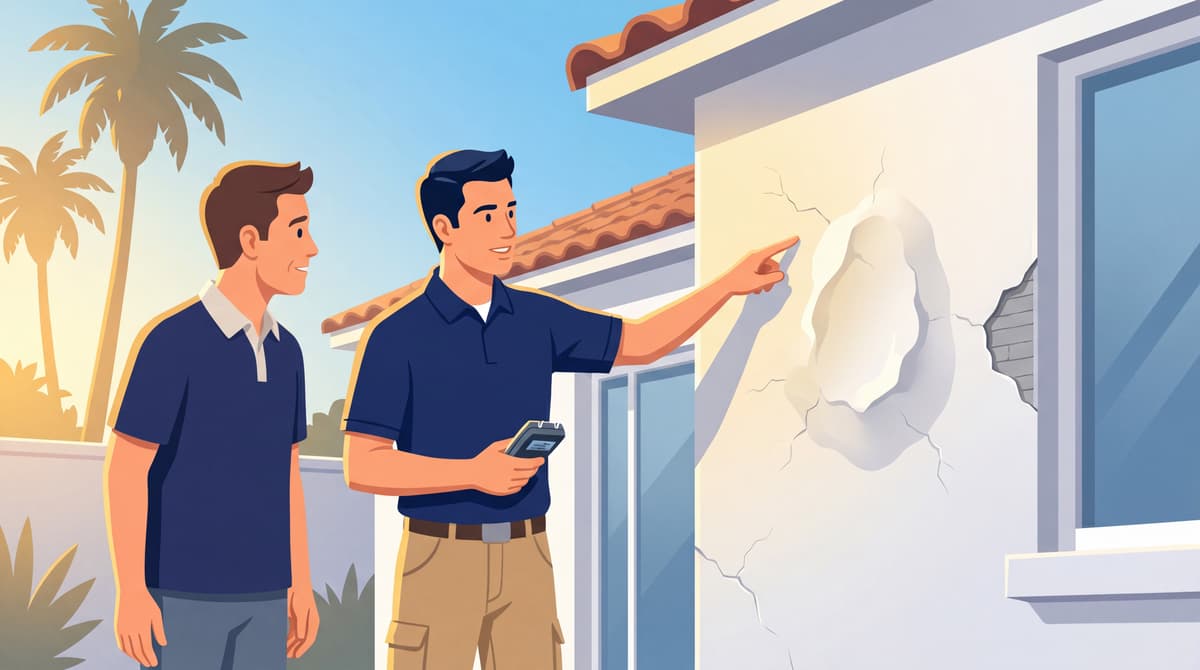
Ladders leaning against the wall, hail storms, weed-whackers near the ground, or stray baseballs can easily puncture through the acrylic finish and crush the soft foam underneath, leaving an exposed cavity.
2. Woodpecker and Rodent Damage
Because the EPS foam core feels hollow and resembles decaying wood to pests, woodpeckers and insects frequently peck through synthetic EIFS finishes to build nests inside the insulation layer.
3. Perimeter Sealant and Flashing Breakdown
Dryvit relies entirely on elastomeric caulking around windows, doors, and roof intersections to keep water out. When this caulk dries out and cracks, rainwater penetrates behind the foam where it cannot easily drain or dry.
How Professional Dryvit & EIFS Patching Is Done (Step-by-Step)
Properly repairing a puncture, hole, or impact crack in a Dryvit wall requires a precise 4-step surgical method to ensure the weather barrier remains watertight:
Step 1: Cutting Out the Damaged Section
The technician cuts a clean rectangle or square around the damaged area using a utility knife or router, removing the broken acrylic finish and crushed EPS foam down to the solid substrate without slicing the underlying weather barrier.
Step 2: Installing Replacement Insulation Foam
A new piece of EPS foam board is cut to the exact dimensions of the cutout and adhered inside using synthetic base coat adhesive, ensuring it sits flush with the existing foam plane.
Step 3: Embedding Reinforcing Fiberglass Mesh (The 2-Inch Overlap Rule)
The technician grinds back approximately 2 inches of the existing acrylic finish around the perimeter of the patch to expose the original base coat. A new patch of fiberglass mesh is embedded into fresh polymer base coat, overlapping the surrounding original mesh by at least 2 inches to prevent hairline edge cracking.
Step 4: Feathering & Matching the 100% Acrylic Finish
Once the base coat cures (typically 24 hours), a matching 100% acrylic textured finish coat is applied, feathered into the surrounding wall texture, and tinted to match the existing wall color.
When to Repair vs. When to Convert to Traditional Hard-Coat Stucco
If your synthetic system only has minor surface dents or small bird holes, localized EIFS patching can restore cosmetic appearance. However, if water has found its way behind the foam layer due to missing drainage channels or aged flashing, hidden wood rot can spread quietly through the home's structural framing.
Many Southern California homeowners with older barrier EIFS systems choose to remove the synthetic cladding and replace it with a genuine, heavy-duty 3-Coat Portland Cement Stucco System. Hard-coat stucco provides:
- Unmatched Impact Resistance: A solid 7/8-inch concrete shell that cannot be dented by ladders, lawn equipment, or hail.
- Complete Pest Immunity: Solid cement that woodpeckers and pests cannot penetrate.
- True Breathability: Integrated with a code-compliant weep screed drainage system that lets moisture safely escape.
- Superior Fire Rating: Class A 1-hour fire resistance, crucial for California fire zones.
Need Hard-Coat Stucco Restoration or Re-Stucco in Southern California?
If you have questions about your exterior walls or are considering upgrading your home from failing synthetic cladding to durable, authentic Portland cement stucco, Stucco Champions is here to help.
We provide full-service re-stucco transformations, traditional stucco repairs, and expert texture matching throughout Orange County and Los Angeles. Contact our team today for a free, comprehensive on-site assessment.
Frequently Asked Questions About Stucco
How much does stucco repair cost in Orange County and Los Angeles?+
Small stucco patches start at $650, larger repairs start at $1,200, and re-stucco of a single elevation up to about 400 sq ft runs about $1,400 - $5,900+. The exact cost depends on the damage type (hairline cracks, water damage, delamination, weep screed failure), the square footage involved, and whether the original three-coat or one-coat stucco system needs to be matched. Stucco Champions provides fixed-price written estimates after a free on-site assessment — no hourly billing, no surprise change orders. See our stucco repair cost guide for detailed pricing by repair type.
How long does stucco last in Southern California?+
Properly installed three-coat stucco lasts 50-80+ years in Southern California's climate. The most common failure points aren't the stucco itself — they're the supporting components: corroded weep screed, deteriorated building paper behind the stucco, and improperly sealed window flashing. Most "stucco failures" are actually moisture-intrusion failures that start at one of these points. Annual visual inspection catches problems before they spread, which is why we offer free weep screed assessments for homeowners in our service area.
Can I repair stucco myself, or do I need a contractor?+
Hairline cracks under 1/8 inch wide can be sealed with elastomeric caulk by a homeowner. Anything larger — pattern cracks, delamination (where stucco pulls away from the wall), water-damaged areas, or chimney/window leak repairs — requires a licensed contractor. Improper DIY repair on these is the #1 cause of repeat failures because the underlying cause (usually moisture) isn't addressed. California's CSLB requires a license for any stucco work over $500. Looking for a highly-rated stucco contractor in Southern California? We are a CSLB-licensed and insured team ready to help.
How do I know if I need stucco repair vs. full re-stucco?+
If less than 30% of an elevation has visible damage, repair is the right call. If you see large areas of cracking, multiple zones of delamination, or the underlying paper and lath have rotted across an entire wall, full re-stucco of that elevation is more cost-effective long-term. Our free assessment includes a moisture survey and lath inspection so you get a defensible recommendation either way — not just a quote pushing whichever option costs more.
Do you offer warranties on stucco work?+
Approved stucco repair work includes a 1-year written workmanship warranty. The applicable terms are documented with the approved scope. Stucco Champions is CSLB licensed and insured; verify license #1122006 through the official state lookup. Request a free estimate to review the scope and warranty terms before you sign.
How long does a stucco repair take?+
Most patch repairs are completed in 1-2 days, including a 24-hour cure time before texture matching and color application. Full re-stucco of a single elevation runs 5-7 working days because each coat (scratch, brown, finish) needs to cure properly before the next is applied. We schedule around weather — California stucco needs daytime temperatures above 50°F with no rain forecast for at least 24 hours after each coat. Our crew shows up on time, every time.
Stucco Diagnostics & Calculators
Diagnose specific wall damage symptoms or estimate job scope with our free guides and calculators.
Related Professional Services
A licensed assessment identifies the cause before the finish is opened or replaced.