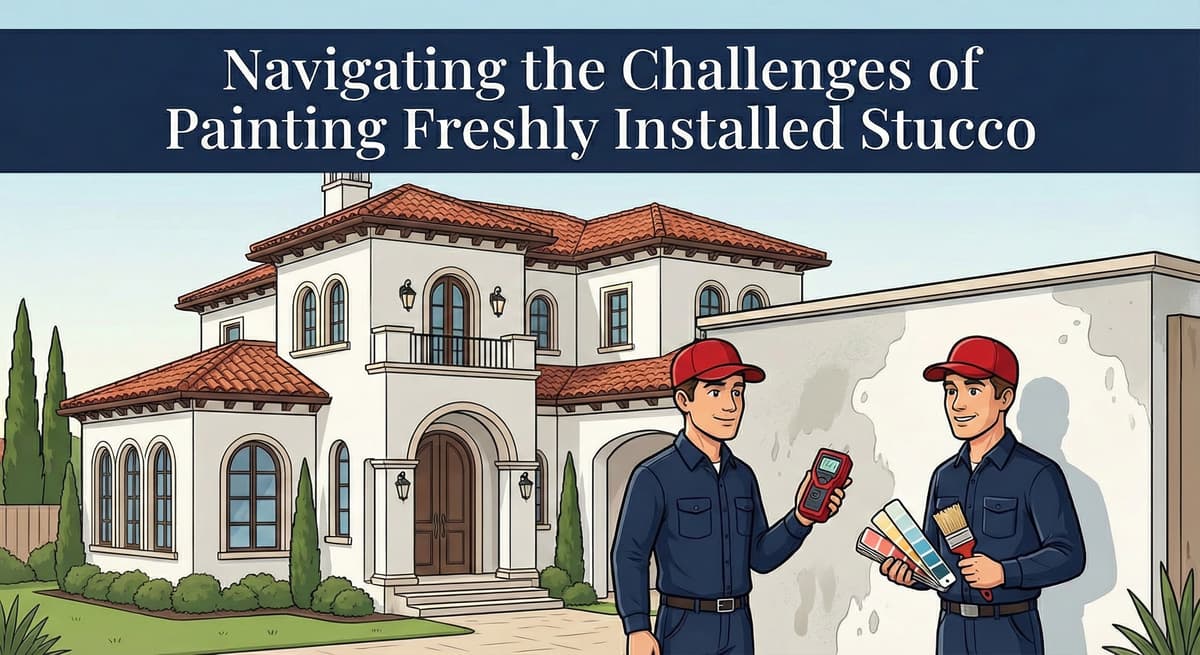
Navigating the Challenges of Painting Freshly Installed Stucco
Written by Stucco Champions — Southern California’s Authority on Exterior Plastering.
Navigating the Challenges of Painting Freshly Installed Stucco
Completing a re-stucco project is highly satisfying, but for many homeowners, the immediate next question is: "When can we paint it?"
This is where patience meets chemistry. Fresh stucco is not a dry, static wall; it is a chemically active surface characterized by high alkalinity and trapped moisture. Painting too soon without the correct protocols results in "Saponification"—a chemical reaction where the high pH of the cement literally "burns" the acrylic resins, turning the paint into a soapy film that slides right off the wall. This guide explains the science of the cure time and how to paint new masonry safely.
Free Assessment
Noticing Stucco Damage?
Get a free on-site assessment from a licensed contractor. $0 deposit, no obligation.
GET FREE ASSESSMENT1. The 28-Day Rule (Standard Cure)
In the commercial construction industry, the Golden Rule for painting cement-based products is 28 Days.
Why? Stucco cures through a chemical process called hydration. It requires roughly four weeks for the water to react fully with the cement and for the surface pH level to drop from a caustic 13+ down to a paint-safe level (typically below 10).
The Vapor Risk: If you apply standard exterior house paint on Day 7, you seal the hydration moisture inside the wall. As the Southern California sun heats the elevation, that moisture turns to vapor and forcefully pushes the new paint off the wall, causing massive blistering.
2. Cheating the Clock: The "Hot Wall" Primer
We understand that leaving scaffolding up for a month isn't always feasible. If the project schedule dictates that you must paint sooner (e.g., after 7 to 14 days), you cannot use standard primer. You must mandate a High-Performance Alkali-Resistant Primer.
Look for primers specifically engineered for "Hot Masonry":
- Dunn-Edwards EFF-Stop: Excellent for resisting efflorescence and neutralizing high pH substrates.
- Sherwin Williams Loxon: Can frequently be applied to surfaces with a pH up to 13 (fresh concrete) after just 7 days of curing.
3. pH Testing: Verify, Do Not Guess
Before the painter applies a single drop of material to the wall, a pH test must be performed.
The Protocol: Wet a small section of the new stucco with distilled water and apply a pH testing pencil or litmus strip directly to the damp cement. If the reading is 10 or higher, you are in the danger zone. You must either wait longer for the wall to cure or utilize the specialized hot-wall primers mentioned above.
4. Acrylic vs. Cement Finishes
The rules regarding paint change entirely depending on what type of finish coat was installed:
Scenario A: Traditional Cement Finish
This is a porous, raw cement material. It requires the full 28-day cure (or a hot primer) before painting. However, many homeowners choose to leave traditional cement unpainted to enjoy a natural, highly breathable "Old World" aesthetic.
Scenario B: Acrylic (Synthetic) Finish
If the contractor installed an Acrylic Finish, do not paint it. An acrylic finish is the final coating. It is an integrally colored, liquid-applied polymer formulated to act as the primary defense layer. Painting over fresh acrylic is redundant, expensive, and can actually decrease the overall permeability of the wall system.
Conclusion
Rushing the paint job is the fastest way to ruin a premium stucco installation. If the schedule permits, wait the full 28 days. If it does not, invest in premium alkali-resistant primers. The cost of proper priming is drastically less than the cost of hydro-blasting peeling paint six months later.
Frequently Asked Questions About Stucco
How much does stucco repair cost in Orange County and Los Angeles?+
Stucco repair typically ranges from $500 for minor crack patching to $5,000+ for full re-stucco of a single elevation. The exact cost depends on the damage type (hairline cracks, water damage, delamination, weep screed failure), the square footage involved, and whether the original three-coat or one-coat stucco system needs to be matched. Stucco Champions provides fixed-price written estimates after a free on-site assessment — no hourly billing, no surprise change orders. See our stucco repair cost guide for detailed pricing by repair type.
How long does stucco last in Southern California?+
Properly installed three-coat stucco lasts 50-80+ years in Southern California's climate. The most common failure points aren't the stucco itself — they're the supporting components: corroded weep screed, deteriorated building paper behind the stucco, and improperly sealed window flashing. Most "stucco failures" are actually moisture-intrusion failures that start at one of these points. Annual visual inspection catches problems before they spread, which is why we offer free weep screed assessments for homeowners in our service area.
Can I repair stucco myself, or do I need a contractor?+
Hairline cracks under 1/8 inch wide can be sealed with elastomeric caulk by a homeowner. Anything larger — pattern cracks, delamination (where stucco pulls away from the wall), water-damaged areas, or chimney/window leak repairs — requires a licensed contractor. Improper DIY repair on these is the #1 cause of repeat failures because the underlying cause (usually moisture) isn't addressed. California's CSLB requires a license for any stucco work over $500. Looking for a highly-rated stucco contractor in Southern California? We are a CSLB-licensed and insured team ready to help.
How do I know if I need stucco repair vs. full re-stucco?+
If less than 30% of an elevation has visible damage, repair is the right call. If you see large areas of cracking, multiple zones of delamination, or the underlying paper and lath have rotted across an entire wall, full re-stucco of that elevation is more cost-effective long-term. Our free assessment includes a moisture survey and lath inspection so you get a defensible recommendation either way — not just a quote pushing whichever option costs more.
Do you offer warranties on stucco work?+
Approved stucco repair work includes a 1-year written workmanship warranty. The applicable terms are documented with the approved scope. Stucco Champions is CSLB licensed and insured; verify license #1122006 through the official state lookup. Request a free estimate to review the scope and warranty terms before you sign.
How long does a stucco repair take?+
Most patch repairs are completed in 1-2 days, including a 24-hour cure time before texture matching and color application. Full re-stucco of a single elevation runs 5-7 working days because each coat (scratch, brown, finish) needs to cure properly before the next is applied. We schedule around weather — California stucco needs daytime temperatures above 50°F with no rain forecast for at least 24 hours after each coat. Our crew shows up on time, every time.
Stucco Diagnostics & Calculators
Diagnose specific wall damage symptoms or estimate job scope with our free guides and calculators.
Related Professional Services
A licensed assessment identifies the cause before the finish is opened or replaced.