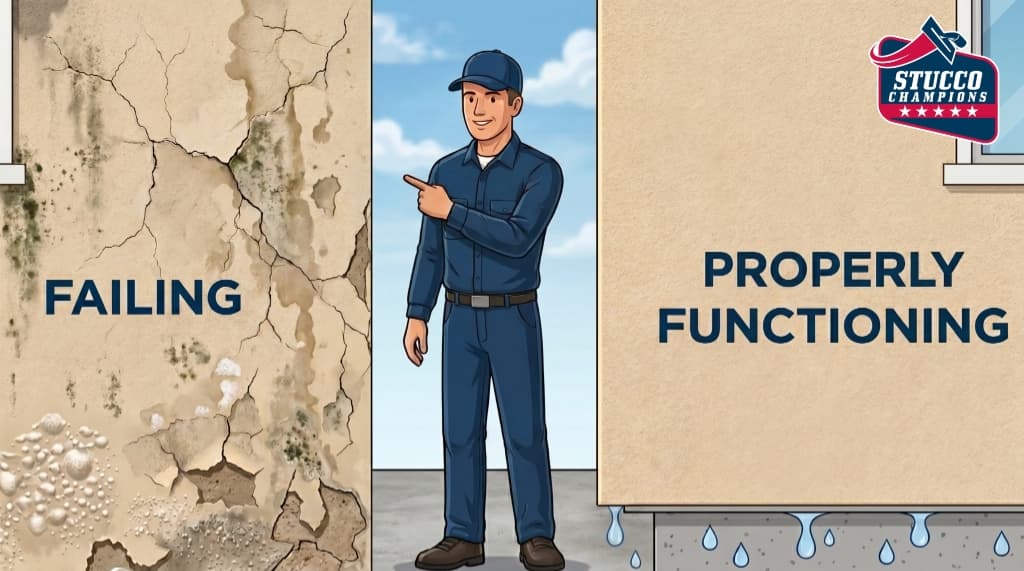
Understanding the Weep Screed Gap: Maintenance and Pests
Written by Stucco Champions — Southern California’s Authority on Exterior Plastering.
The Gap at the Bottom: Understanding the Weep Screed Clearance
One of the most common questions we receive from homeowners inspecting their perimeter is: "There is a gap between the metal at the bottom of my stucco wall and the concrete foundation! Is my house compromised? Can pests get in?"
The Good News: The gap is a result of structural engineering, not a defect.
The Bad News: If you try to "fix" it incorrectly with a caulking gun, you will trap moisture inside your walls, leading to framing rot. This guide explains the physics of the gap and how to manage it.
Free Assessment
Noticing Stucco Damage?
Get a free on-site assessment from a licensed contractor. $0 deposit, no obligation.
GET FREE ASSESSMENT1. Why the Gap Exists
That gap is the result of modern building codes and framing methods.
- Shear Wall Offset: Modern codes require plywood sheathing (shear panels) over the studs. The weep screed is nailed on top of the sheathing, pushing the metal flange 1/2" to 3/4" outward from the bare concrete foundation below it.
- Foundation Variance: Metal weep screeds are rigid and straight. Concrete foundations naturally have slight bows or imperfections. When the concrete bows inward, the gap behind the straight metal flange naturally appears wider.
2. The "Do Not Touch" Zone
The weep screed is the primary exit path for moisture in your stucco cladding. Gravity pulls water down the WRB and out through the weep holes.
NEVER apply caulk over the front face or the weep holes of the metal screed. Caulk, paint, and acrylics do not fix moisture issues; they exacerbate them by plugging the drainage system. Under ASTM C1063, weep holes must remain clear. Sealing these holes turns your wall into a water reservoir, rotting the sill plate.
3. Managing the Gap (Method A: Retrofit Screens)
If the gap is large enough to concern you regarding pests (mice, large spiders), the safest professional solution is a mechanical Weep Screed Screen (such as WeepShield PVC or stainless mesh).
These mesh strips are designed to slide up into the gap from underneath. The mesh is fine enough to block pests but open enough to allow airflow and unobstructed water drainage.
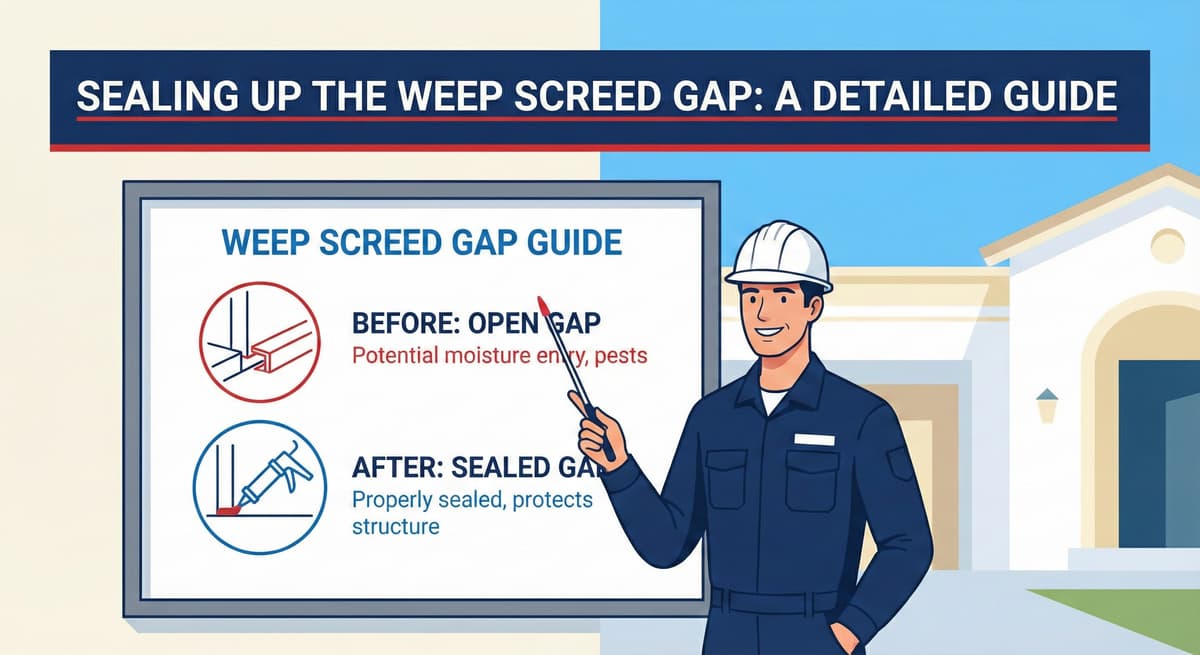
4. Managing the Gap (Method B: Undercarriage Sealant)
If a screen is not viable and you must seal the void directly behind the screed, you must be extremely precise.
The "Undercarriage" Technique:
Apply a bead of high-performance elastomeric sealant (ASTM C920) strictly underneath the metal, bridging the gap between the bottom horizontal return leg of the metal flange and the concrete foundation.
- Do not inject sealant upward into the wall cavity or over the front weep holes.
- Seal only the horizontal plane where the metal hovers over the concrete.
We strongly advise against using expanding spray foam. It expands uncontrollably upward into the wall cavity, permanently blocking the WRB drainage plane.
Conclusion: Airflow is Critical
Unless you have an active pest infestation, the best advice is often to leave the weep screed gap alone. The airflow helps dry the stucco system. If you must secure it, use a mechanical mesh screen to preserve the vital drainage path.
Frequently Asked Questions About Stucco
How much does stucco repair cost in Orange County and Los Angeles?+
Stucco repair typically ranges from $500 for minor crack patching to $5,000+ for full re-stucco of a single elevation. The exact cost depends on the damage type (hairline cracks, water damage, delamination, weep screed failure), the square footage involved, and whether the original three-coat or one-coat stucco system needs to be matched. Stucco Champions provides fixed-price written estimates after a free on-site assessment — no hourly billing, no surprise change orders. See our stucco repair cost guide for detailed pricing by repair type.
How long does stucco last in Southern California?+
Properly installed three-coat stucco lasts 50-80+ years in Southern California's climate. The most common failure points aren't the stucco itself — they're the supporting components: corroded weep screed, deteriorated building paper behind the stucco, and improperly sealed window flashing. Most "stucco failures" are actually moisture-intrusion failures that start at one of these points. Annual visual inspection catches problems before they spread, which is why we offer free weep screed assessments for homeowners in our service area.
Can I repair stucco myself, or do I need a contractor?+
Hairline cracks under 1/8 inch wide can be sealed with elastomeric caulk by a homeowner. Anything larger — pattern cracks, delamination (where stucco pulls away from the wall), water-damaged areas, or chimney/window leak repairs — requires a licensed contractor. Improper DIY repair on these is the #1 cause of repeat failures because the underlying cause (usually moisture) isn't addressed. California's CSLB requires a license for any stucco work over $500. Looking for a highly-rated stucco contractor in Southern California? We are a CSLB-licensed and insured team ready to help.
How do I know if I need stucco repair vs. full re-stucco?+
If less than 30% of an elevation has visible damage, repair is the right call. If you see large areas of cracking, multiple zones of delamination, or the underlying paper and lath have rotted across an entire wall, full re-stucco of that elevation is more cost-effective long-term. Our free assessment includes a moisture survey and lath inspection so you get a defensible recommendation either way — not just a quote pushing whichever option costs more.
Do you offer warranties on stucco work?+
Approved stucco repair work includes a 1-year written workmanship warranty. The applicable terms are documented with the approved scope. Stucco Champions is CSLB licensed and insured; verify license #1122006 through the official state lookup. Request a free estimate to review the scope and warranty terms before you sign.
How long does a stucco repair take?+
Most patch repairs are completed in 1-2 days, including a 24-hour cure time before texture matching and color application. Full re-stucco of a single elevation runs 5-7 working days because each coat (scratch, brown, finish) needs to cure properly before the next is applied. We schedule around weather — California stucco needs daytime temperatures above 50°F with no rain forecast for at least 24 hours after each coat. Our crew shows up on time, every time.
Stucco Diagnostics & Calculators
Diagnose specific wall damage symptoms or estimate job scope with our free guides and calculators.
Related Professional Services
A licensed assessment identifies the cause before the finish is opened or replaced.