Best Tips for Attaching Wood to Stucco Walls | Local Guide
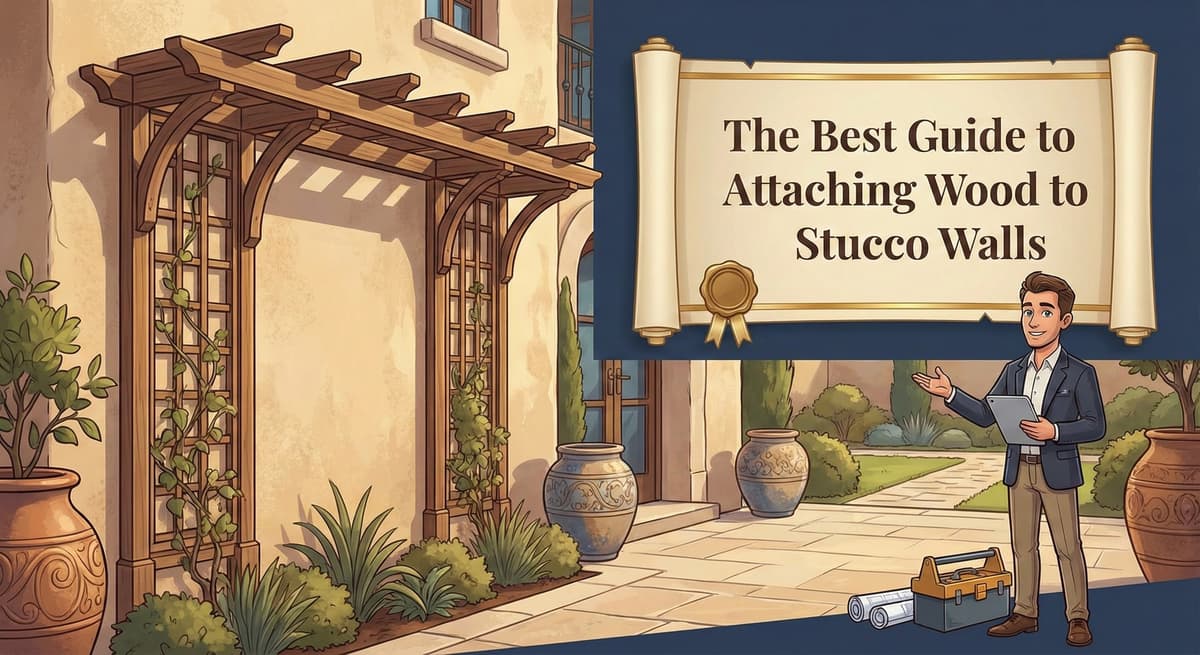
Attaching wood to a stucco wall is not just a fastening problem. It is also a waterproofing problem. The attachment must carry the load into framing or another approved structural backing while preserving the stucco wall’s water-management layers.
For light accessories, a careful surface-mounted approach may be enough. For pergolas, patio covers, deck ledgers, shade structures, railings, or anything overhead, use a qualified contractor or engineer. Stucco itself is a cladding, not a structural anchor.
Understand the Wall Before You Drill
Traditional three-coat stucco over framing typically includes sheathing, water-resistive barrier, metal lath, scratch coat, brown coat, and finish coat. PCA guidance emphasizes that lath is attached to supports rather than simply to sheathing, and SMA guidance emphasizes that WRB and flashing must integrate in shingle fashion.
That means every penetration needs to be planned. A screw hole through stucco can become a water path if it is not sealed and detailed correctly.
Free Assessment
Noticing Stucco Damage?
Get a free on-site assessment from a licensed contractor. $0 deposit, no obligation.
GET FREE ASSESSMENTIdentify the Stucco System
- Three-coat stucco: A traditional cement plaster assembly, commonly about 7/8 inch thick over lath. Heavy loads still need framing or approved backing.
- One-coat stucco: A proprietary hard-coat system, often installed with foam. Follow the manufacturer evaluation report for penetrations and attachments.
- EIFS: A proprietary exterior insulation and finish system. Do not treat EIFS like cement stucco. Penetrations and attachments must follow the system manufacturer’s details.
Rule #1: Do Not Use Stucco as the Structure
Stucco can be hard and durable, but it is not designed to carry heavy attached loads. For structural or heavy attachments, transfer the load to framing, blocking, rim joists, masonry, or another approved substrate. The plaster surface should not be compressed or crushed as the fastener is tightened.
Finding Framing Without Guessing
- Map from the inside: Locate studs from the interior side, then transfer measurements from a window, door, or corner.
- Use construction clues carefully: Eaves, outlet boxes, and some fastener patterns may help, but they are not proof.
- Verify before loading: For heavy items, small exploratory openings or professional layout may be needed.
Waterproofing the Attachment
The safest attachment is one that sheds water before water can reach the wall cavity. Use exterior-rated corrosion-resistant fasteners, compatible sealant, and flashing details where needed.
- Seal the penetration: Pilot holes and fastener penetrations should be sealed with a compatible exterior sealant.
- Do not reverse-lap flashing: Any flashing should direct water out and over lower layers, not behind them.
- Avoid trapping water: Large wood blocks mounted tight to stucco can trap water. Use details that let the assembly drain and dry.
- Protect the finish: Pre-drill carefully with the right masonry bit so the finish does not spall or crack around the fastener.
Light Attachments vs. Structural Attachments
Light Accessories
Items like address plaques, small trim pieces, or lightweight decorations may be mounted with appropriate exterior anchors, sealant, and careful drilling. Keep expectations modest and inspect periodically.
Medium Attachments
Hose reels, shutters, small brackets, and similar items should be fastened into framing or solid backing when possible. If the item will be pulled, leaned on, or loaded repeatedly, treat it as structural.
Heavy or Life-Safety Attachments
Deck ledgers, pergolas, patio covers, guardrails, shade sails, and overhead elements should not be improvised. These require structural fastening, waterproofing, and often permit/code review. The stucco may need to be cut back so flashing and blocking can be installed correctly.
Common Mistakes
- Using plastic plugs for heavy loads: They can loosen and do not solve the waterproofing problem.
- Over-tightening: Crushing the stucco can crack the finish and damage the assembly.
- Caulking everything shut: Seal penetrations, but do not create a pocket that traps water behind wood.
- Ignoring the stucco type: One-coat stucco and EIFS require manufacturer-specific details.
When to Call a Stucco Contractor
Call a professional if the attachment is heavy, overhead, connected to a deck or patio cover, near a window or door, or if the wall already shows cracks, stains, bubbling, or hollow plaster. In those cases, the attachment detail must be coordinated with the wall’s flashing and WRB, not just drilled into place.
Bottom Line
Attach wood to the structure, not to the stucco skin. Seal penetrations, respect the wall’s drainage path, and use manufacturer-specific details for proprietary systems. Done correctly, the attachment can be secure without creating a hidden leak.
Related guide: Fix Hairline Cracks on Stucco Exteriors.
Frequently Asked Questions About Stucco
How much does stucco repair cost in Orange County and Los Angeles?+
Small stucco patches start at $650, larger repairs start at $1,200, and re-stucco of a single elevation up to about 400 sq ft runs about $1,400 - $5,900+. The exact cost depends on the damage type (hairline cracks, water damage, delamination, weep screed failure), the square footage involved, and whether the original three-coat or one-coat stucco system needs to be matched. Stucco Champions provides fixed-price written estimates after a free on-site assessment — no hourly billing, no surprise change orders. See our stucco repair cost guide for detailed pricing by repair type.
How long does stucco last in Southern California?+
Properly installed three-coat stucco lasts 50-80+ years in Southern California's climate. The most common failure points aren't the stucco itself — they're the supporting components: corroded weep screed, deteriorated building paper behind the stucco, and improperly sealed window flashing. Most "stucco failures" are actually moisture-intrusion failures that start at one of these points. Annual visual inspection catches problems before they spread, which is why we offer free weep screed assessments for homeowners in our service area.
Can I repair stucco myself, or do I need a contractor?+
Hairline cracks under 1/8 inch wide can be sealed with elastomeric caulk by a homeowner. Anything larger — pattern cracks, delamination (where stucco pulls away from the wall), water-damaged areas, or chimney/window leak repairs — requires a licensed contractor. Improper DIY repair on these is the #1 cause of repeat failures because the underlying cause (usually moisture) isn't addressed. California's CSLB requires a license for any stucco work over $500. Looking for a highly-rated stucco contractor in Southern California? We are a CSLB-licensed and insured team ready to help.
How do I know if I need stucco repair vs. full re-stucco?+
If less than 30% of an elevation has visible damage, repair is the right call. If you see large areas of cracking, multiple zones of delamination, or the underlying paper and lath have rotted across an entire wall, full re-stucco of that elevation is more cost-effective long-term. Our free assessment includes a moisture survey and lath inspection so you get a defensible recommendation either way — not just a quote pushing whichever option costs more.
Do you offer warranties on stucco work?+
Approved stucco repair work includes a 1-year written workmanship warranty. The applicable terms are documented with the approved scope. Stucco Champions is CSLB licensed and insured; verify license #1122006 through the official state lookup. Request a free estimate to review the scope and warranty terms before you sign.
How long does a stucco repair take?+
Most patch repairs are completed in 1-2 days, including a 24-hour cure time before texture matching and color application. Full re-stucco of a single elevation runs 5-7 working days because each coat (scratch, brown, finish) needs to cure properly before the next is applied. We schedule around weather — California stucco needs daytime temperatures above 50°F with no rain forecast for at least 24 hours after each coat. Our crew shows up on time, every time.
Stucco Diagnostics & Calculators
Diagnose specific wall damage symptoms or estimate job scope with our free guides and calculators.
Related Professional Services
A licensed assessment identifies the cause before the finish is opened or replaced.