What Is a Stucco Weep Screed? Foundation Drainage Explained
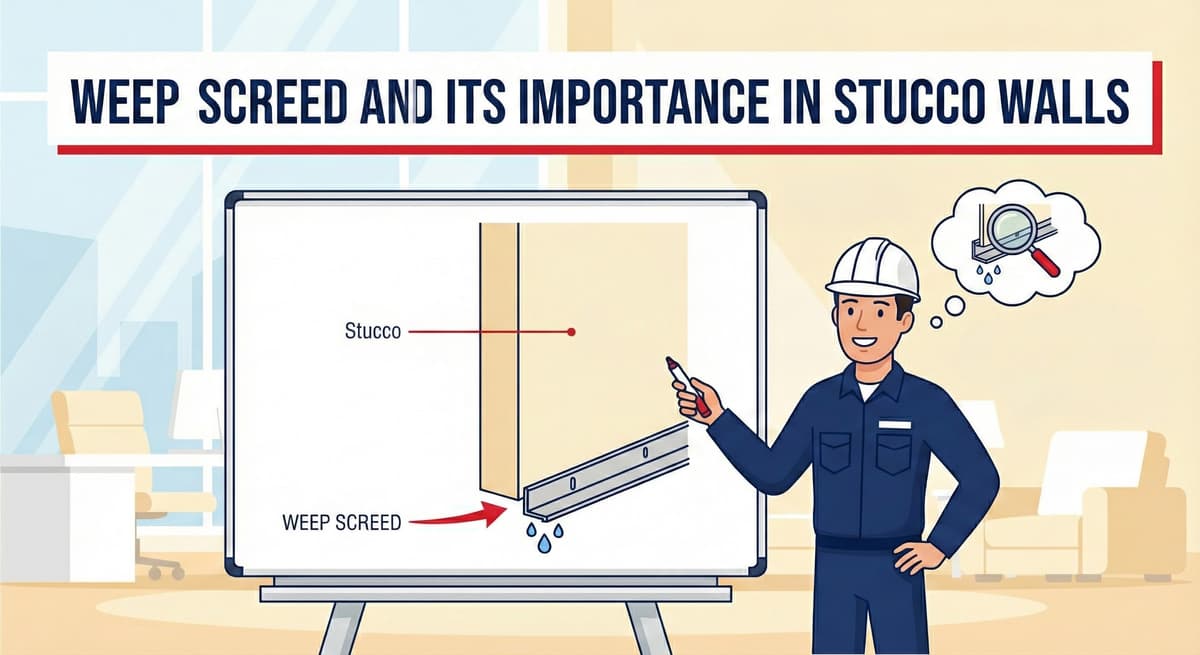
In modern stucco assemblies, the foundation weep screed is a mandatory and critical component. It is a specific piece of metal flashing installed at the base of the wall.
This flashing serves two primary functions: it establishes the proper depth for the plaster (commonly 7/8" for 3-coat systems), and it provides an exit point for incidental moisture that enters the wall cavity. Without it, water can become trapped, potentially rotting the mudsill plate and framing studs.
1. The Mechanics: How It Drains
Stucco cladding is not entirely waterproof; it acts as a reservoir. Rainwater absorbs into the cement and eventually reaches the weather-resistant barrier (WRB), such as building paper or house wrap, located behind the lath.
Gravity pulls this moisture down the face of the WRB. The weep screed is installed at the foundation line, with the WRB lapping over its vertical nailing flange. Water runs down the paper, enters the slanted trough of the screed, and exits through small weep holes punched in the bottom, dripping away from the framing.
Free Assessment
Noticing Stucco Damage?
Get a free on-site assessment from a licensed contractor. $0 deposit, no obligation.
GET FREE ASSESSMENT2. Building Code Clearances
According to ASTM C1063, the weep screed must be positioned at specific heights to prevent moisture wicking from the ground into the stucco (capillary action).
- 4 Inches Above Earth: If the ground below is soil or mulch, the screed must sit at least 4 inches above grade.
- 2 Inches Above Paving: If the ground is a hard surface like a concrete patio or pavers, the screed must sit at least 2 inches above the surface.
If the screed is buried, the weep holes become blocked, rendering the entire drainage plane ineffective.
3. Common Screed Profiles
Not all screeds are the same; the profile used depends on the system and the age of the home.
- The #7 Foundation Screed: This is the V-shaped profile most common in modern 3-coat construction. The V-shape acts as a drip edge, forcing water outward.
- The "J" Weep: This resembles a square "J" channel. While sometimes used in retrofits because of its lower profile, it can be more difficult to integrate properly with the WRB.
- Proprietary 1-Coat Screeds: For systems using rigid foam board, a wider screed (often 1-3/8") is required to accommodate the thickness of the foam and the base coat.
We often encounter homes where the gap between the weep screed and the foundation has been caulked closed by a well-meaning homeowner or painter attempting to "seal" the house. Do not caulk this gap. Doing so traps water inside the wall assembly.
Conclusion: Part of a System
It is important to remember that the weep screed is just one part of the stucco water management system. It relies entirely on the proper installation and lapping of the WRB, flashing at windows and doors, and correct lath integration to function successfully.
Frequently Asked Questions About Stucco
How much does stucco repair cost in Orange County and Los Angeles?+
Stucco repair typically ranges from $500 for minor crack patching to $5,000+ for full re-stucco of a single elevation. The exact cost depends on the damage type (hairline cracks, water damage, delamination, weep screed failure), the square footage involved, and whether the original three-coat or one-coat stucco system needs to be matched. Stucco Champions provides fixed-price written estimates after a free on-site assessment — no hourly billing, no surprise change orders. See our stucco repair cost guide for detailed pricing by repair type.
How long does stucco last in Southern California?+
Properly installed three-coat stucco lasts 50-80+ years in Southern California's climate. The most common failure points aren't the stucco itself — they're the supporting components: corroded weep screed, deteriorated building paper behind the stucco, and improperly sealed window flashing. Most "stucco failures" are actually moisture-intrusion failures that start at one of these points. Annual visual inspection catches problems before they spread, which is why we offer free weep screed assessments for homeowners in our service area.
Can I repair stucco myself, or do I need a contractor?+
Hairline cracks under 1/8 inch wide can be sealed with elastomeric caulk by a homeowner. Anything larger — pattern cracks, delamination (where stucco pulls away from the wall), water-damaged areas, or chimney/window leak repairs — requires a licensed contractor. Improper DIY repair on these is the #1 cause of repeat failures because the underlying cause (usually moisture) isn't addressed. California's CSLB requires a license for any stucco work over $500. Looking for a highly-rated stucco contractor in Southern California? We are a CSLB-licensed and insured team ready to help.
How do I know if I need stucco repair vs. full re-stucco?+
If less than 30% of an elevation has visible damage, repair is the right call. If you see large areas of cracking, multiple zones of delamination, or the underlying paper and lath have rotted across an entire wall, full re-stucco of that elevation is more cost-effective long-term. Our free assessment includes a moisture survey and lath inspection so you get a defensible recommendation either way — not just a quote pushing whichever option costs more.
Do you offer warranties on stucco work?+
Approved stucco repair work includes a 1-year written workmanship warranty. The applicable terms are documented with the approved scope. Stucco Champions is CSLB licensed and insured; verify license #1122006 through the official state lookup. Request a free estimate to review the scope and warranty terms before you sign.
How long does a stucco repair take?+
Most patch repairs are completed in 1-2 days, including a 24-hour cure time before texture matching and color application. Full re-stucco of a single elevation runs 5-7 working days because each coat (scratch, brown, finish) needs to cure properly before the next is applied. We schedule around weather — California stucco needs daytime temperatures above 50°F with no rain forecast for at least 24 hours after each coat. Our crew shows up on time, every time.
Stucco Diagnostics & Calculators
Diagnose specific wall damage symptoms or estimate job scope with our free guides and calculators.
Related Professional Services
A licensed assessment identifies the cause before the finish is opened or replaced.