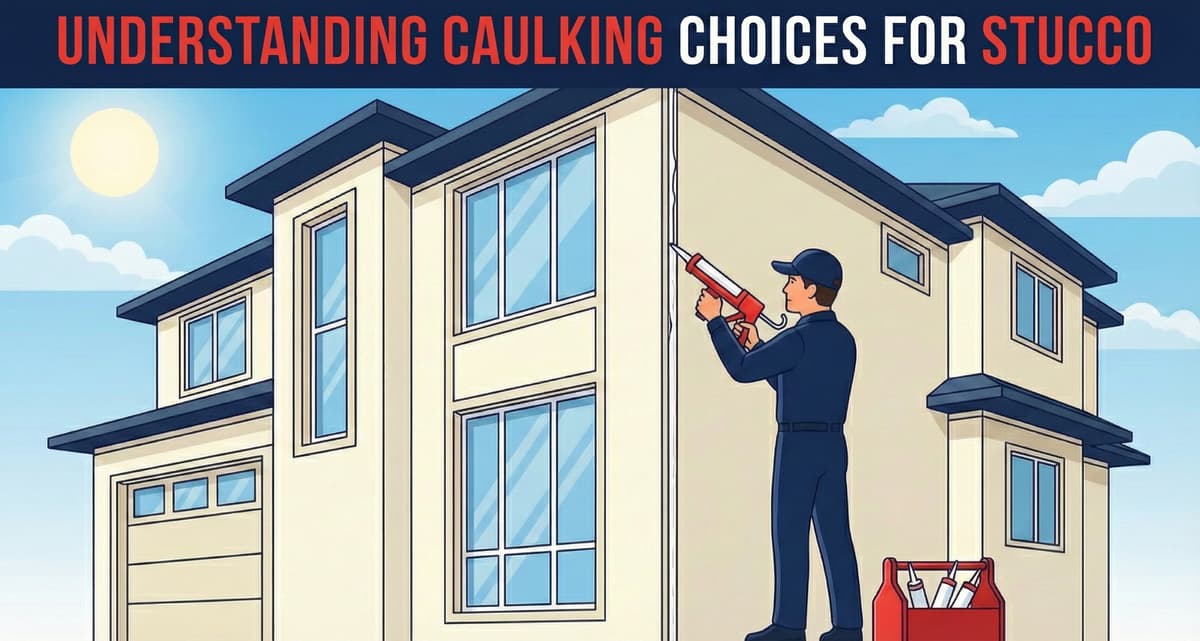
Understanding Caulking Choices for Stucco: A Chemical Guide
Written by Stucco Champions — Southern California’s Authority on Exterior Plastering.
Understanding Caulking Choices for Stucco: A Chemical Guide
In exterior plastering, caulking is not merely a "gap filler"—it acts as a dynamic expansion joint. Stucco is a rigid cementitious plane, but the underlying wood framing constantly expands and contracts due to thermal and moisture fluctuations. If the specified sealant lacks the required elongation properties, it will tear, creating a direct entry point for bulk water.
Selecting the correct sealant chemistry is critical. Utilizing the wrong tube from the hardware store can ruin a paint application, degrade the substrate, and trap moisture in the wall cavity. This guide breaks down the chemical families of sealants utilized in professional stucco assemblies under ASTM C920 standards.
Free Assessment
Noticing Stucco Damage?
Get a free on-site assessment from a licensed contractor. $0 deposit, no obligation.
GET FREE ASSESSMENT1. Polyurethane: The Structural Waterproofer
Best For: High-movement joints where stucco terminates against dissimilar materials (e.g., vinyl window frames, aluminum door frames, and wood trim).
Polyurethane is the heavy-duty standard for commercial waterproofing. It adheres aggressively to masonry, concrete, and metals, remaining highly flexible for decades without shrinking or UV degradation.
- The Pros: Exceptional adhesion and durability; creates a permanent, watertight joint.
- The Cons: Highly viscous and difficult to tool smoothly; requires 4 to 7 days to fully off-gas and cure before it can be painted.
- Compliance: Must meet or exceed ASTM C920 (Class 25 or higher) specifications.
- Industry Standard: Sikaflex-1a or MasterSeal NP1.
2. Sanded Elastomeric Acrylic: The Cosmetic Repair
Best For: Hairline surface cracks (under 1/16 inch) in the field of a stucco wall.
Standard smooth painter's caulk fails cosmetically on stucco because it dries to a flat, glossy line that flashes visibly against the rough plaster. Instead, a Textured Elastomeric Acrylic sealant is required. These formulations suspend fine silica sand aggregate within the acrylic resin to visually match the stucco matrix.
- The Pros: Blends seamlessly with the wall texture; easy water clean-up; rapidly paintable (typically in 2 to 4 hours).
- The Cons: Lower overall movement capability than polyurethane; suited strictly for cosmetic crack bridging rather than deep structural expansion joints.
- Industry Standard: Mor-Flexx (Sashco) or Tower Tech 2.
3. The Forbidden Material: 100% Silicone
While silicone is an exceptional waterproofer for glass and tile, it is a catastrophic error for exterior plaster. Paint, mineral coatings, and new cement patches cannot chemically adhere to silicone. If applied, subsequent paint coats will "fish-eye" and immediately peel. Remediating silicone contamination requires mechanically grinding the silicone—and the surrounding stucco—completely out of the wall.
4. Application Geometry: The Backer Rod Mandate
If an expansion gap is wider than 1/4 inch or deeper than 1/2 inch, it cannot be solid-filled with sealant. The massive volume of caulk will sag, shrink during curing, and ultimately fail.
The Fix: The Foam Backer Rod.
Under ASTM C1063 lathing standards, window and door casings must maintain a nominal 3/8-inch isolation gap from the cement. A closed-cell polyethylene foam backer rod is pressed into this gap first, leaving a sealant depth equal to exactly half the width of the joint.
This geometry ensures "Two-Point Adhesion" (the sealant bonds only to the window frame and the stucco edge, but not the back of the joint). This allows the sealant bead to stretch freely like a rubber band when the building moves, without tearing the bond line.
Conclusion: Chemistry Dictates Longevity
Specifying the correct sealant chemistry determines whether a waterproof repair lasts 6 months or 20 years. For critical perimeter waterproofing around windows and doors, mandate Polyurethane meeting ASTM C920. For visually blending cosmetic surface cracks, utilize Sanded Acrylic. And reserve silicone strictly for interior plumbing fixtures.
Frequently Asked Questions About Stucco
How much does stucco repair cost in Orange County and Los Angeles?+
Small stucco patches start at $650, larger repairs start at $1,200, and re-stucco of a single elevation up to about 400 sq ft runs about $1,400 - $5,900+. The exact cost depends on the damage type (hairline cracks, water damage, delamination, weep screed failure), the square footage involved, and whether the original three-coat or one-coat stucco system needs to be matched. Stucco Champions provides fixed-price written estimates after a free on-site assessment — no hourly billing, no surprise change orders. See our stucco repair cost guide for detailed pricing by repair type.
How long does stucco last in Southern California?+
Properly installed three-coat stucco lasts 50-80+ years in Southern California's climate. The most common failure points aren't the stucco itself — they're the supporting components: corroded weep screed, deteriorated building paper behind the stucco, and improperly sealed window flashing. Most "stucco failures" are actually moisture-intrusion failures that start at one of these points. Annual visual inspection catches problems before they spread, which is why we offer free weep screed assessments for homeowners in our service area.
Can I repair stucco myself, or do I need a contractor?+
Hairline cracks under 1/8 inch wide can be sealed with elastomeric caulk by a homeowner. Anything larger — pattern cracks, delamination (where stucco pulls away from the wall), water-damaged areas, or chimney/window leak repairs — requires a licensed contractor. Improper DIY repair on these is the #1 cause of repeat failures because the underlying cause (usually moisture) isn't addressed. California's CSLB requires a license for any stucco work over $500. Looking for a highly-rated stucco contractor in Southern California? We are a CSLB-licensed and insured team ready to help.
How do I know if I need stucco repair vs. full re-stucco?+
If less than 30% of an elevation has visible damage, repair is the right call. If you see large areas of cracking, multiple zones of delamination, or the underlying paper and lath have rotted across an entire wall, full re-stucco of that elevation is more cost-effective long-term. Our free assessment includes a moisture survey and lath inspection so you get a defensible recommendation either way — not just a quote pushing whichever option costs more.
Do you offer warranties on stucco work?+
Approved stucco repair work includes a 1-year written workmanship warranty. The applicable terms are documented with the approved scope. Stucco Champions is CSLB licensed and insured; verify license #1122006 through the official state lookup. Request a free estimate to review the scope and warranty terms before you sign.
How long does a stucco repair take?+
Most patch repairs are completed in 1-2 days, including a 24-hour cure time before texture matching and color application. Full re-stucco of a single elevation runs 5-7 working days because each coat (scratch, brown, finish) needs to cure properly before the next is applied. We schedule around weather — California stucco needs daytime temperatures above 50°F with no rain forecast for at least 24 hours after each coat. Our crew shows up on time, every time.
Stucco Diagnostics & Calculators
Diagnose specific wall damage symptoms or estimate job scope with our free guides and calculators.
Related Professional Services
A licensed assessment identifies the cause before the finish is opened or replaced.