Best Way to Apply Stucco Over Cinder Block Walls Guide
Written by Stucco Champions — Southern California’s Authority on Exterior Plastering.
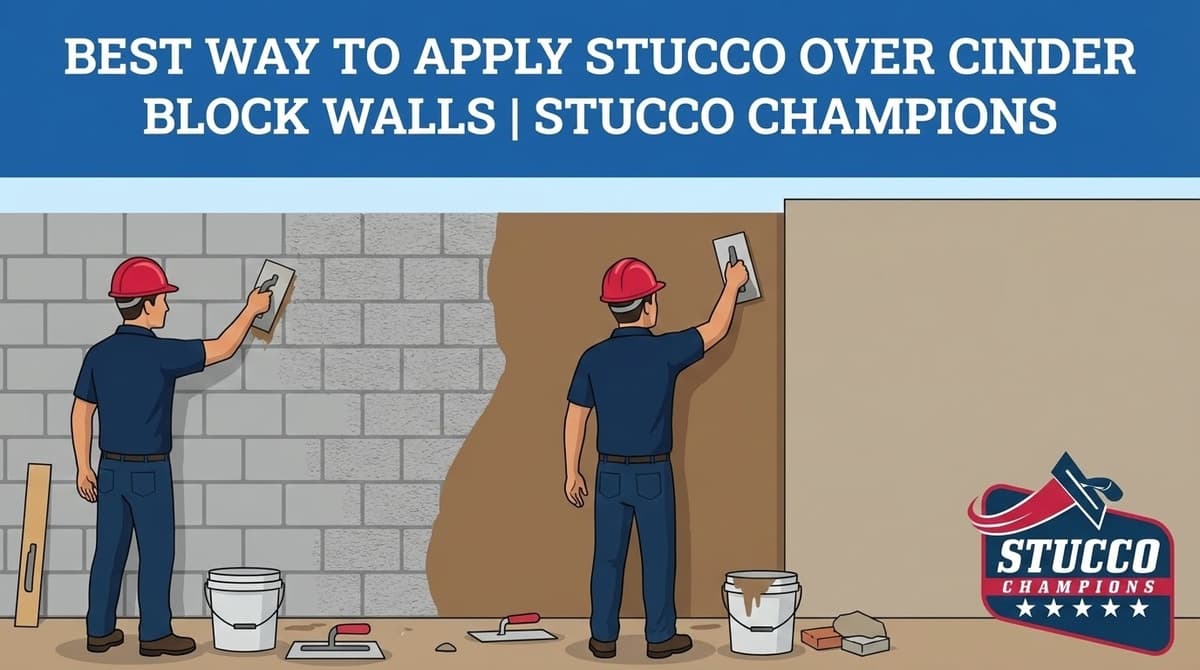
How to Stucco Over Cinder Block: The Direct-Apply Method
In Southern California construction, cinder block (CMU) walls are the standard for retaining walls, detached garages, and perimeter fencing. Because block is a masonry product, it makes an ideal substrate for stucco. Unlike wood framing, which requires lath and paper to manage movement, stucco can bond directly to block—if you prep it correctly.
The challenge with block isn't compatibility; it's adhesion. If the block is sealed, painted, or too dry, the stucco will delaminate (sheet off). This guide outlines the Bonding Agent Method, adhering to ASTM C926 standards for a two-coat application.
1. The Critical Diagnostic: Porosity
Before you buy a single bag of cement, you must determine if the block can accept a bond.
The Water Test: Splash a cup of water against the wall.
Result A: The water darkens the block and absorbs instantly. Verdict: Ready.
Result B: The water beads up or runs off without changing the color. Verdict: Sealed.
⚠️ Do Not Stucco Over Paint
You cannot apply stucco directly to painted or sealed block. The chemical bond will fail. You must either sandblast the paint off to expose the aggregate or mechanically attach metal lath over the paint to give the stucco something to grip.
Free Assessment
Noticing Stucco Damage?
Get a free on-site assessment from a licensed contractor. 0 deposit, no money upfront, progress payments only.
GET FREE ASSESSMENT2. Surface Preparation
Stucco will not stick to dust, moss, or efflorescence (white salts).
Pressure Wash: Use a minimum of 2,500 PSI to blast the pores clean. If mold is present, treat with a bleach solution first. Allow the wall to dry until it is damp but not saturated (Surface Saturated Dry).
3. The "Glue": Bonding Agents
While old-school masons relied on water alone, modern standards dictate the use of a Liquid Bonding Agent (like Weld-Crete or Quikrete Bonding Adhesive).
Application: Roll or brush the adhesive onto the block.
Note: Read the label. Some agents require the stucco to be applied while the glue is wet; others must dry to a tacky film first.
4. The Two-Coat Application Protocol
For block walls, we skip the traditional three-coat system and use a two-coat process.
Step A: The Base Coat (Leveling)
Material: We recommend a Fiber-Reinforced Stucco base. The fibers prevent the mortar joints of the block from "telegraphing" (showing through) the finish.
Thickness: Apply 3/8" to 1/2" thick.
Technique: Push hard. You need to force the material into the pores of the block.
Floating: Once the material is firm (thumb-print hard), use a green sponge float to bring the aggregate to the surface and erase tool marks.
Step B: The Cure
Hydration is Mandatory. Block walls are sponges; they suck water out of the stucco. If the stucco dries too fast, it cracks.
Mist the base coat with a garden hose twice a day for 48 hours. This allows the chemical bond to lock in.
Step C: The Finish Coat
Once the base is cured, apply your 1/8" color coat. Whether you choose a smooth Santa Barbara finish or a rough Sand finish, the base coat provides a flat, uniform canvas.
Conclusion: Bond is Everything
Stuccoing over block is one of the most durable finishes possible, provided you respect the chemistry of adhesion. Clean the wall, use a bonding agent, and keep it wet during the cure. Do this, and your block wall will look like a custom estate.
Related Resources
Last week, we shared Stucco Drying Times and Final Color Appearance. Learn what to expect as your new block wall cures.