Hidden Costs in Stucco Projects 2025
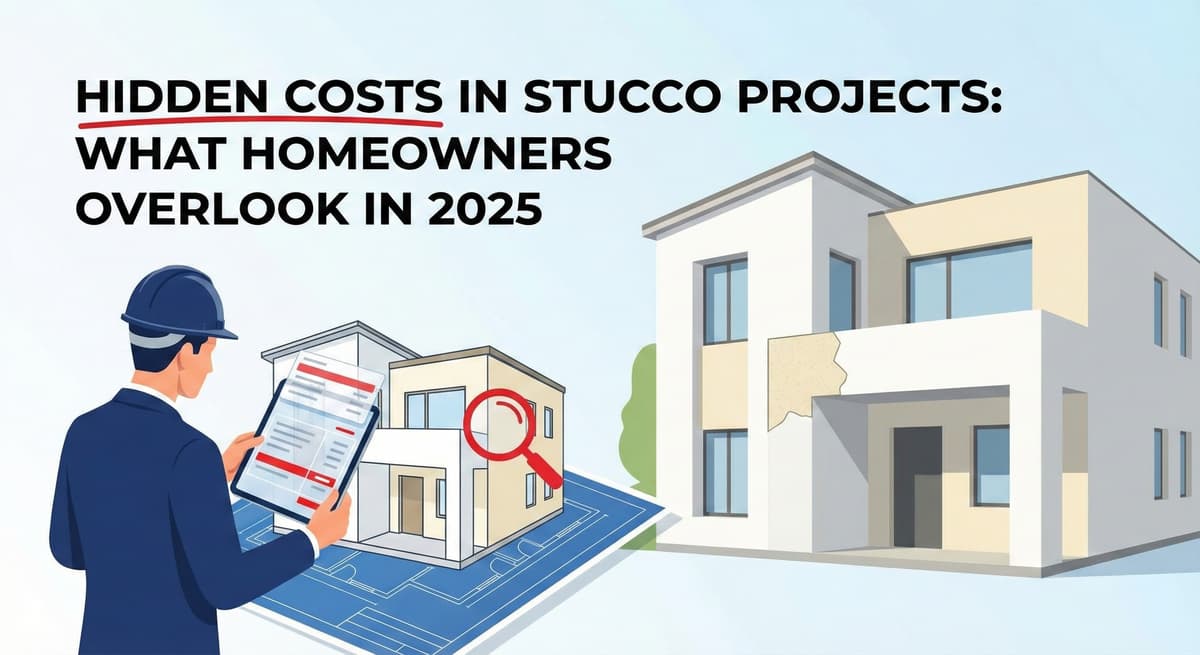
Written by Stucco Champions — Southern California’s Authority on Exterior Plastering.
Hidden Costs in Stucco Projects: What Homeowners Overlook in 2025
Stucco is the definitive choice for Southern California homes, offering fire resistance and thermal mass. However, the sticker price on a quote rarely tells the whole story. A low bid often excludes critical preparation steps mandated by **ASTM C926** (plastering) and **ASTM C1063** (lathing) standards, leading to expensive change orders later.
Budgeting for a re-stucco or new installation requires foresight. Beyond the basic square footage price, you must account for structural repairs, access logistics, and finish upgrades. This guide breaks down the financial variables that catch homeowners off guard.
Free Assessment
Noticing Stucco Damage?
Get a free on-site assessment from a licensed contractor. $0 deposit, no obligation.
GET FREE ASSESSMENT1. Surface Preparation: The "Demo" Factor
You cannot apply new stucco over a compromised substrate. If your home has old wood siding, peeling paint, or deteriorated cement, the prep work is extensive:
- Sandblasting: If your existing stucco is painted, we must sandblast it to remove the paint film and expose the porous plaster underneath to create a proper mechanical bond. Applying new stucco over paint without sandblasting or an **ASTM C932** bonding agent guarantees delamination.
- Demolition Disposal: Removing old siding or stone veneer generates tons of heavy debris. Landfill and heavy-hauling fees in California are high and often excluded from base estimates.
2. Structural Rot Repair
This is the most common "surprise." When we strip old stucco or siding, we often find dry rot or termite damage in the plywood sheathing or structural studs.
The Cost Reality: We cannot legally or ethically cover rotted wood. We must halt the project, replace the damaged framing, and install new sheathing before proceeding. A "simple re-stucco" can quickly turn into a structural envelope repair. When structural repairs are needed, integrating the double-layer Grade D WRB cleavage plane per **CRC Section R703.7.3** is crucial before installing new wire mesh (which must overlap by at least 2 inches under **ASTM C1063**).
Always budget an extra **10% to 15%** for unseen dry rot repairs, particularly around window sills, door pans, and the foundation mudsill line where water traps are most common.
3. Scaffolding & Access
If your home is two stories or sits on a hillside, labor costs climb significantly:
- OSHA Compliance: We cannot safely or legally work off ladders for a full re-stucco. We must erect full scaffold systems. This is a fixed cost that involves setup, rental time, and dismantling.
- Limited Access: If we cannot get a mixer truck or plaster pump to your backyard, materials must be hand-carried in buckets, increasing labor hours.
4. Material Upgrades: Acrylic vs. Cement
The type of finish you choose impacts the bottom line:
- Sand Finish (Cement): The traditional option. Lower material cost, but requires eventual painting or fog coating.
- Smooth Finish (Santa Barbara): Higher labor cost due to the intense skill and time required to trowel it to a flat, glass-like finish.
- Acrylic/Synthetic Finish: Higher material cost (buckets vs. bags), but offers superior elasticity (crack resistance) and color retention (no painting needed), keeping the wall low-maintenance.
5. Cost Breakdown Matrix (2025 Estimates)
Use this guide to evaluate competing bids. If a bid is missing these line items, ask why:
| Expense Category | Average Range | Why It Matters |
|---|---|---|
| Surface Prep | $1,000 – $5,000+ | Sandblasting ensures the new coat doesn't peel or delaminate. |
| Scaffolding | $1,500 – $3,500 | Mandatory for safety on multi-story homes. |
| Structural Repairs | $1,000 – $10,000+ | Fixing hidden framing rot and waterproofing. |
| Finish Upgrades | +$2 – $5 per sq. ft. | Acrylics and smooth Santa Barbara finishes cost more than standard lace. |
| Disposal Fees | $300 – $1,500 | Hauling away heavy concrete, wire, and lath debris. |
*For national averages (which differ from CA costs), you can cross-reference the HomeAdvisor Stucco Cost Guide.
Conclusion: The Transparent Quote
A cheap quote is usually an incomplete quote. At Stucco Champions, we provide itemized estimates that include prep, scaffolding, and cleanup. We believe you should know the real cost of the project upfront, not halfway through.
Read our comprehensive guide on How to Budget for a Stucco Project in 2025 to plan your financing and understand cost ranges.
A note on fog coat: Stucco Champions does not fog coat older or previously repaired walls. On aged stucco a fog coat telegraphs existing cracks, patch lines, and prior repairs, and it bonds poorly to a rough, chalky, or previously coated surface, so it can dust off or peel. Those walls get a fresh finish coat (re-stucco) instead.
Frequently Asked Questions About Stucco
How much does stucco repair cost in Orange County and Los Angeles?+
Small stucco patches start at $650, larger repairs start at $1,200, and re-stucco of a single elevation up to about 400 sq ft runs about $1,400 - $5,900+. The exact cost depends on the damage type (hairline cracks, water damage, delamination, weep screed failure), the square footage involved, and whether the original three-coat or one-coat stucco system needs to be matched. Stucco Champions provides fixed-price written estimates after a free on-site assessment — no hourly billing, no surprise change orders. See our stucco repair cost guide for detailed pricing by repair type.
How long does stucco last in Southern California?+
Properly installed three-coat stucco lasts 50-80+ years in Southern California's climate. The most common failure points aren't the stucco itself — they're the supporting components: corroded weep screed, deteriorated building paper behind the stucco, and improperly sealed window flashing. Most "stucco failures" are actually moisture-intrusion failures that start at one of these points. Annual visual inspection catches problems before they spread, which is why we offer free weep screed assessments for homeowners in our service area.
Can I repair stucco myself, or do I need a contractor?+
Hairline cracks under 1/8 inch wide can be sealed with elastomeric caulk by a homeowner. Anything larger — pattern cracks, delamination (where stucco pulls away from the wall), water-damaged areas, or chimney/window leak repairs — requires a licensed contractor. Improper DIY repair on these is the #1 cause of repeat failures because the underlying cause (usually moisture) isn't addressed. California's CSLB requires a license for any stucco work over $500. Looking for a highly-rated stucco contractor in Southern California? We are a CSLB-licensed and insured team ready to help.
How do I know if I need stucco repair vs. full re-stucco?+
If less than 30% of an elevation has visible damage, repair is the right call. If you see large areas of cracking, multiple zones of delamination, or the underlying paper and lath have rotted across an entire wall, full re-stucco of that elevation is more cost-effective long-term. Our free assessment includes a moisture survey and lath inspection so you get a defensible recommendation either way — not just a quote pushing whichever option costs more.
Do you offer warranties on stucco work?+
Approved stucco repair work includes a 1-year written workmanship warranty. The applicable terms are documented with the approved scope. Stucco Champions is CSLB licensed and insured; verify license #1122006 through the official state lookup. Request a free estimate to review the scope and warranty terms before you sign.
How long does a stucco repair take?+
Most patch repairs are completed in 1-2 days, including a 24-hour cure time before texture matching and color application. Full re-stucco of a single elevation runs 5-7 working days because each coat (scratch, brown, finish) needs to cure properly before the next is applied. We schedule around weather — California stucco needs daytime temperatures above 50°F with no rain forecast for at least 24 hours after each coat. Our crew shows up on time, every time.
Stucco Diagnostics & Calculators
Diagnose specific wall damage symptoms or estimate job scope with our free guides and calculators.
Related Professional Services
A licensed assessment identifies the cause before the finish is opened or replaced.