How to Identify Stucco Wall Thickness Before Repairs
How to Identify Stucco Wall Thickness Before Repairs
Before repairing stucco, you need to know what kind of wall assembly you are working on. A repair patch should match the existing stucco system, not just the surface texture. A traditional three-coat wall, a proprietary one-coat wall, and stucco over masonry can all look similar from the outside but require different repair assumptions.
Thickness matters because it affects lath embedment, accessory alignment, fire-rated assembly assumptions, texture matching, and how the patch bonds to the surrounding wall.
Free Assessment
Noticing Stucco Damage?
Get a free on-site assessment from a licensed contractor. $0 deposit, no obligation.
GET FREE ASSESSMENTStart With the Assembly, Not the Finish
The finish coat is only the visible surface. The important question is what sits behind it:
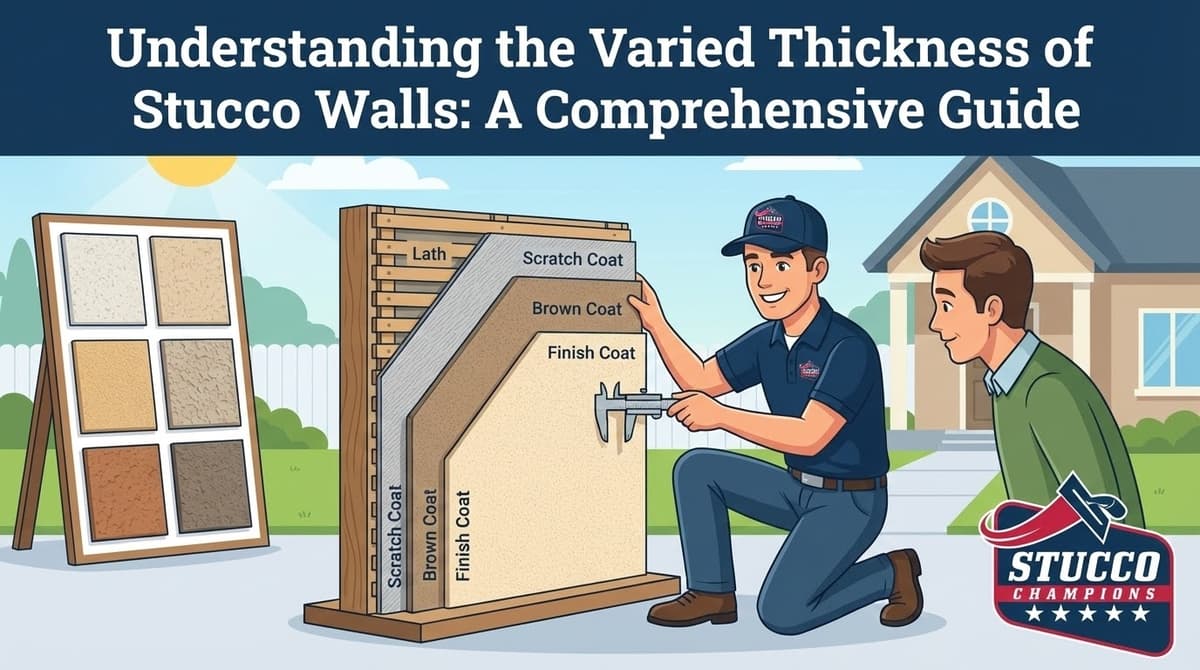
- Traditional three-coat stucco over framing: WRB, lath, scratch coat, brown coat, and finish coat.
- One-coat stucco: A proprietary basecoat and finish system installed according to the manufacturer’s evaluation report and instructions.
- Stucco over masonry or concrete: Usually a thinner plaster application over a solid base.
- Patch or re-stucco area: May include older repairs, paint, coatings, foam shapes, or irregular thickness.
Traditional Three-Coat Thickness
For framed walls, the common traditional three-coat stucco reference is about 7/8 inch total thickness. The scratch and brown coats form the base, and the finish coat adds the final color and texture. The PCA manual describes the two base coats as about 3/4 inch total, with the finish coat applied over the base.
This assembly is common on many older and custom homes. It is also the assembly people usually mean when they say “traditional stucco.”
One-Coat Stucco Is Manufacturer-Specific
One-coat stucco is not simply a thin version of three-coat stucco. The SMA guide describes it as a proprietary system using a basecoat and finish coat, with the basecoat approved for less than the conventional base-coat thickness. Some systems include foam, but foam is not what defines the system.
If you are repairing one-coat stucco, identify the system if possible and follow the manufacturer’s instructions. Do not assume a generic bag of material is acceptable for every one-coat repair.
Stucco Over Masonry or Concrete
Stucco over concrete block, brick, or cast concrete is usually thinner than three-coat stucco over framed walls because the solid base provides rigidity. Two-coat plaster is commonly associated with masonry or concrete bases.
The surface still has to be sound, clean, and suitable for plaster. Smooth concrete, painted masonry, contaminated surfaces, or out-of-plane walls may require special preparation or a different specification.
How to Measure Existing Stucco Thickness
For repairs, measure at a broken edge, access point, removed fixture, or existing opening. Do not include sheathing, foam trim, paint buildup, or the wall framing in the measurement.
Look for:
- Total plaster depth: From the WRB or substrate to the outside face of the finish.
- Lath position: In framed wall assemblies, lath should be embedded in the base coat.
- Accessories: Weep screeds, casing beads, and grounds help establish plaster thickness.
- Foam layer: Foam may indicate a one-coat or continuous-insulation assembly, but confirm the system before assuming.
- Existing patch layers: Old patches may not represent the original wall thickness.
Why Matching Thickness Matters
A patch that is too shallow can leave lath poorly embedded, create weak edges, or telegraph through the finish. A patch that is too thick can shrink, crack, slump, or stand proud of the surrounding wall. Feather-edging cementitious plaster to nothing is also unreliable because the edge can break down.
For durable repairs, the damaged material should be cut back to sound edges, the WRB and flashing should be restored if damaged, lath should be replaced where needed, and the base coats should be rebuilt before the finish is matched.
Finish Coat Thickness Is Not the Same as Wall Thickness
The finish coat is normally only a small part of the total thickness. For standard portland cement plaster finishes, the finish coat is commonly about 1/8 inch thick. Heavier specialty textures can build more surface profile, but they do not replace the structural role of the base coats.
Repair Checklist
- Identify whether the wall is three-coat, one-coat, masonry, concrete, or a prior patch.
- Measure existing plaster depth at a reliable exposed edge.
- Confirm whether WRB, flashing, or lath has been damaged.
- Use materials compatible with the existing system.
- Rebuild base coats before applying finish texture.
- Match texture and color from a sample area, not from memory.
Bottom Line
Do not choose stucco repair material by appearance alone. Identify the assembly, measure the existing thickness, restore the hidden water-management and lath layers where needed, and then match the finish. That approach produces a repair that looks right and performs like the surrounding wall.
Frequently Asked Questions About Stucco
How much does stucco repair cost in Orange County and Los Angeles?+
Small stucco patches start at $650, larger repairs start at $1,200, and re-stucco of a single elevation up to about 400 sq ft runs about $1,400 - $5,900+. The exact cost depends on the damage type (hairline cracks, water damage, delamination, weep screed failure), the square footage involved, and whether the original three-coat or one-coat stucco system needs to be matched. Stucco Champions provides fixed-price written estimates after a free on-site assessment — no hourly billing, no surprise change orders. See our stucco repair cost guide for detailed pricing by repair type.
How long does stucco last in Southern California?+
Properly installed three-coat stucco lasts 50-80+ years in Southern California's climate. The most common failure points aren't the stucco itself — they're the supporting components: corroded weep screed, deteriorated building paper behind the stucco, and improperly sealed window flashing. Most "stucco failures" are actually moisture-intrusion failures that start at one of these points. Annual visual inspection catches problems before they spread, which is why we offer free weep screed assessments for homeowners in our service area.
Can I repair stucco myself, or do I need a contractor?+
Hairline cracks under 1/8 inch wide can be sealed with elastomeric caulk by a homeowner. Anything larger — pattern cracks, delamination (where stucco pulls away from the wall), water-damaged areas, or chimney/window leak repairs — requires a licensed contractor. Improper DIY repair on these is the #1 cause of repeat failures because the underlying cause (usually moisture) isn't addressed. California's CSLB requires a license for any stucco work over $500. Looking for a highly-rated stucco contractor in Southern California? We are a CSLB-licensed and insured team ready to help.
How do I know if I need stucco repair vs. full re-stucco?+
If less than 30% of an elevation has visible damage, repair is the right call. If you see large areas of cracking, multiple zones of delamination, or the underlying paper and lath have rotted across an entire wall, full re-stucco of that elevation is more cost-effective long-term. Our free assessment includes a moisture survey and lath inspection so you get a defensible recommendation either way — not just a quote pushing whichever option costs more.
Do you offer warranties on stucco work?+
Approved stucco repair work includes a 1-year written workmanship warranty. The applicable terms are documented with the approved scope. Stucco Champions is CSLB licensed and insured; verify license #1122006 through the official state lookup. Request a free estimate to review the scope and warranty terms before you sign.
How long does a stucco repair take?+
Most patch repairs are completed in 1-2 days, including a 24-hour cure time before texture matching and color application. Full re-stucco of a single elevation runs 5-7 working days because each coat (scratch, brown, finish) needs to cure properly before the next is applied. We schedule around weather — California stucco needs daytime temperatures above 50°F with no rain forecast for at least 24 hours after each coat. Our crew shows up on time, every time.
Stucco Diagnostics & Calculators
Diagnose specific wall damage symptoms or estimate job scope with our free guides and calculators.
Related Professional Services
A licensed assessment identifies the cause before the finish is opened or replaced.