Stucco Patch Materials: What Actually Works
Written by Stucco Champions — Southern California’s Authority on Exterior Plastering.
Stucco Patch Materials: What Actually Works
Walk down the masonry aisle of any big-box hardware store, and you will encounter dozens of tubs, bags, and boxes broadly labeled "Stucco Patch." For a homeowner, the selection is overwhelming. For a professional plasterer, the difference between these products dictates the difference between a permanent structural repair and a patch that pops out of the wall in six months.
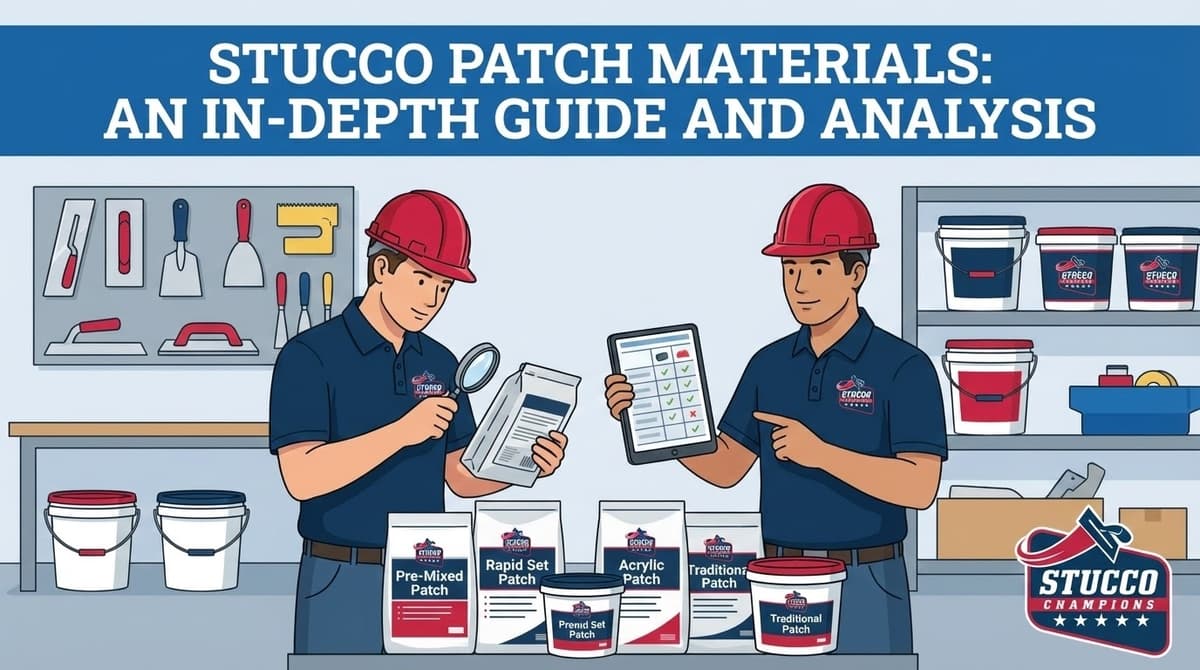
Not all patching materials are created equal. Some are essentially "exterior spackle" designed for cosmetics, while others are advanced hydraulic cements engineered to bear structural loads. This guide breaks down the chemistry of the four most common materials and dictates exactly when to use them.
Free Assessment
Noticing Stucco Damage?
Get a free on-site assessment from a licensed contractor. $0 deposit, no obligation.
GET FREE ASSESSMENT1. The "Tub" Products (Acrylic Premix)
Composition: These pre-mixed tubs consist of acrylic polymers, fine sand, and water. They contain absolutely no Portland cement.
Best For: Minor cosmetic flaws, nail holes, and dormant hairline cracks under 1/16 of an inch wide.
Do not use "Tub Patch" for deep holes or structural cracks. Because it cures via water evaporation (rather than a chemical hydration reaction), applying it thickly causes it to shrink aggressively and crack as it dries. It also entirely lacks the compressive strength of true cement.
2. Rapid-Set Cements (The Fast Structural Fix)
Common Brands: Rapid Set Stucco Patch, Eisenwall.
Composition: Specially formulated hydraulic cement that achieves structural set in 20 to 30 minutes.
Best For: Deep structural repairs (spalling, impact damage) where project time is critical.
The Verdict: It cures extremely hard, bonds tenaciously, and allows you to paint the patch the very same day. However, it sets so rapidly that inexperienced users will find the material hardening on their trowel before they can smooth it into the wall.
3. The "Finish" Bags (The Color Match)
Common Brands: LaHabra Color Patch, Omega ColorTek.
Composition: A blend of Portland cement, hydrated lime, precisely graded sand, and iron oxide pigment.
Best For: The final 1/8-inch surface layer (The "Beauty Coat").
The Strategy: These premium products should only be utilized for the top aesthetic layer to match the texture and color of your home. Do not waste expensive color patch material attempting to fill a deep hole; it lacks the necessary aggregate structure and will sag under its own weight.
4. Fiber-Reinforced Base Coats (The Heavy Workhorse)
Common Brands: Quikrete Fiberglass Reinforced Stucco, Omega One-Coat.
Composition: Heavy Portland cement heavily intermixed with chopped fiberglass strands.
Best For: Large volumetric patches (over 1 sq. ft.), window infills, and repairing deep water damage where the wire lath is exposed.
Why We Use It: The embedded fiberglass strands act identically to millions of microscopic rebar rods. They tie the cement matrix together, drastically increasing tensile strength and preventing the patch from cracking during future seismic activity.
5. The Mandatory Step: Bonding Agents
Regardless of which advanced material you select, wet cement inherently struggles to bond to old, dry, dusty cement. To ensure failure-free adhesion, you must utilize a Bonding Agent.
- Liquid Bond (e.g., Weld-Crete): A blue liquid painted directly onto the old, prepared surface like glue before troweling the new patch.
- Acrylic Admixture: A milky liquid mixed directly into the dry patch material (replacing a portion of the gauging water) to substantially increase adhesion, flexibility, and cure strength.
Conclusion
Repairing stucco requires you to choose the material based on the depth of the damage. If the hole is deep and exposes the wire, utilize a Fiber-Reinforced Base Coat. If you are merely skimming the surface to hide a blemish, utilize a Finish Patch. Avoid the pre-mixed tubs for anything larger than a golf ball. Engineering your repair ensures the patch moves with your house, not away from it.
Frequently Asked Questions About Stucco
How much does stucco repair cost in Orange County and Los Angeles?+
Stucco repair typically ranges from $500 for minor crack patching to $5,000+ for full re-stucco of a single elevation. The exact cost depends on the damage type (hairline cracks, water damage, delamination, weep screed failure), the square footage involved, and whether the original three-coat or one-coat stucco system needs to be matched. Stucco Champions provides fixed-price written estimates after a free on-site assessment — no hourly billing, no surprise change orders. See our stucco repair cost guide for detailed pricing by repair type.
How long does stucco last in Southern California?+
Properly installed three-coat stucco lasts 50-80+ years in Southern California's climate. The most common failure points aren't the stucco itself — they're the supporting components: corroded weep screed, deteriorated building paper behind the stucco, and improperly sealed window flashing. Most "stucco failures" are actually moisture-intrusion failures that start at one of these points. Annual visual inspection catches problems before they spread, which is why we offer free weep screed assessments for homeowners in our service area.
Can I repair stucco myself, or do I need a contractor?+
Hairline cracks under 1/8 inch wide can be sealed with elastomeric caulk by a homeowner. Anything larger — pattern cracks, delamination (where stucco pulls away from the wall), water-damaged areas, or chimney/window leak repairs — requires a licensed contractor. Improper DIY repair on these is the #1 cause of repeat failures because the underlying cause (usually moisture) isn't addressed. California's CSLB requires a license for any stucco work over $500. Looking for a highly-rated stucco contractor in Southern California? We are a CSLB-licensed and insured team ready to help.
How do I know if I need stucco repair vs. full re-stucco?+
If less than 30% of an elevation has visible damage, repair is the right call. If you see large areas of cracking, multiple zones of delamination, or the underlying paper and lath have rotted across an entire wall, full re-stucco of that elevation is more cost-effective long-term. Our free assessment includes a moisture survey and lath inspection so you get a defensible recommendation either way — not just a quote pushing whichever option costs more.
Do you offer warranties on stucco work?+
Approved stucco repair work includes a 1-year written workmanship warranty. The applicable terms are documented with the approved scope. Stucco Champions is CSLB licensed and insured; verify license #1122006 through the official state lookup. Request a free estimate to review the scope and warranty terms before you sign.
How long does a stucco repair take?+
Most patch repairs are completed in 1-2 days, including a 24-hour cure time before texture matching and color application. Full re-stucco of a single elevation runs 5-7 working days because each coat (scratch, brown, finish) needs to cure properly before the next is applied. We schedule around weather — California stucco needs daytime temperatures above 50°F with no rain forecast for at least 24 hours after each coat. Our crew shows up on time, every time.
Stucco Diagnostics & Calculators
Diagnose specific wall damage symptoms or estimate job scope with our free guides and calculators.
Related Professional Services
A licensed assessment identifies the cause before the finish is opened or replaced.