Spraying Stucco vs. Hand Spreading: The Professional Difference
Written by Stucco Champions — Southern California’s Authority on Exterior Plastering.
Spraying Stucco vs. Hand Spreading: The Professional Difference
In the exterior plastering trade, there is an ongoing technical debate: is it structurally superior to spray the cement onto the wall, or to apply it entirely by hand? For homeowners in Southern California, this isn't just a trivial detail—the application method directly affects the density, speed, cost, and final aesthetic of the project.
The reality is that modern, commercial-grade stucco application is rarely 100% one method or the other. It is almost always a hybrid process. We utilize high-pressure pumps to deliver the material efficiently, and skilled artisans to tool it to perfection. This guide breaks down the engineering behind both methods.
Free Assessment
Noticing Stucco Damage?
Get a free on-site assessment from a licensed contractor. $0 deposit, no obligation.
GET FREE ASSESSMENT1. The Hand-Spreading Method (Traditional Plastering)
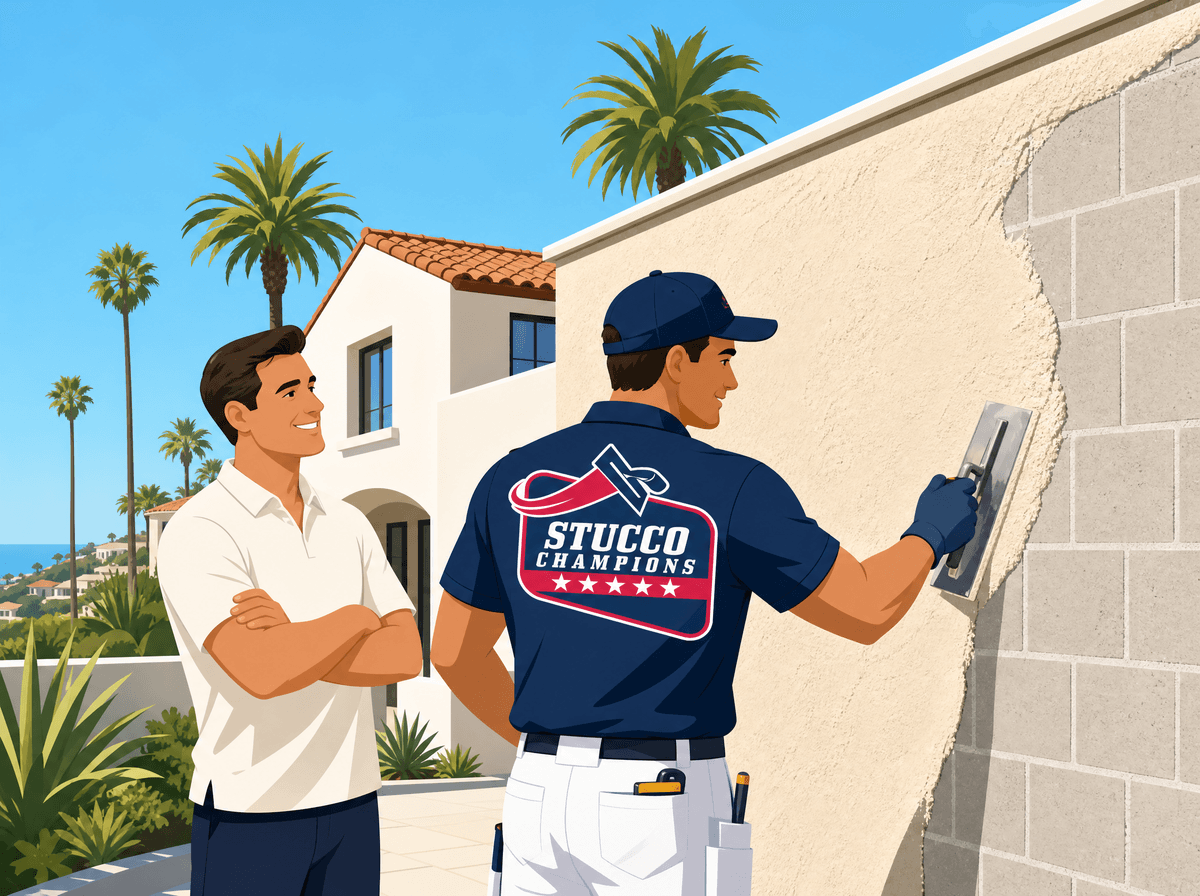
This is the centuries-old, "Old World" technique. An artisan scoops wet mortar from a handheld hawk onto a steel trowel and physically presses it against the wall.
- Best For: Small patches, tight architectural detail work (cornices/moldings), and ultra-smooth (Santa Barbara) finishes.
- The Advantage: Extreme precision. The plasterer can literally "feel" the wall through the trowel, allowing them to correct microscopic high and low spots instantly. This tactile feedback is mandatory for achieving a glass-smooth finish.
- The Disadvantage: It is exceptionally slow and physically exhausting. On a massive elevation, human fatigue sets in, which can lead to inconsistent material thickness late in the day. It is highly labor-intensive.
2. The Spraying Method (Pneumatic Delivery)
On large projects, professionals utilize high-powered, diesel-driven pumps (such as a Putzmeister or Mayco) to blast the wet mix through a heavy hose and pneumatic nozzle directly onto the wall.
- Best For: Large custom homes, commercial buildings, and applying thick structural base coats (the Scratch and Brown coats).
- The Advantage (Compaction): Speed is a benefit, but compaction is the engineering goal. The sheer kinetic force of the pneumatic spray drives the heavy cement deep behind and around the wire lath, creating a vastly superior mechanical bond compared to hand pressure alone.
- The Disadvantage: It is messy. Spraying requires extensive masking of windows, doors, and adjacent properties to protect against aggressive overspray. It also requires a coordinated 4-to-5 man crew (mixer, pump operator, hose man, and spreaders).
3. The Hybrid Approach: "Gun and Spread"
On 90% of our new construction and re-stucco projects, we combine both methods for maximum efficiency and structural integrity.
The Process:
- The pump crew sprays the wet material onto the wall to achieve the bulk structural thickness (7/8") rapidly and with maximum lath compaction.
- Immediately behind the hose operator, a team of plasterers utilizes darbies and rods (long aluminum straightedges) to aggressively hand-level the wet material, shaving off high spots and filling low spots.
This hybrid approach delivers the structural density of a machine pump combined with the laser-flat precision of hand-tooling.
Ultimately, the final decorative texture you select dictates the final application tool:
- Smooth Finishes: Must be hand-troweled. You cannot spray a perfectly smooth finish.
- Dash or Knockdown Finishes: Must be sprayed. You cannot flick a brush or sponge fast enough by hand to replicate the uniform, stippled consistency of a pneumatic dash gun.
Conclusion
Do not be concerned with how the "mud" gets onto the wall; be concerned with how it is compacted and finished. At Stucco Champions, we rely on high-pressure pumps for structural strength and the skilled hands of our artisans for aesthetic perfection.
Frequently Asked Questions About Stucco
How much does stucco repair cost in Orange County and Los Angeles?+
Stucco repair typically ranges from $500 for minor crack patching to $5,000+ for full re-stucco of a single elevation. The exact cost depends on the damage type (hairline cracks, water damage, delamination, weep screed failure), the square footage involved, and whether the original three-coat or one-coat stucco system needs to be matched. Stucco Champions provides fixed-price written estimates after a free on-site assessment — no hourly billing, no surprise change orders. See our stucco repair cost guide for detailed pricing by repair type.
How long does stucco last in Southern California?+
Properly installed three-coat stucco lasts 50-80+ years in Southern California's climate. The most common failure points aren't the stucco itself — they're the supporting components: corroded weep screed, deteriorated building paper behind the stucco, and improperly sealed window flashing. Most "stucco failures" are actually moisture-intrusion failures that start at one of these points. Annual visual inspection catches problems before they spread, which is why we offer free weep screed assessments for homeowners in our service area.
Can I repair stucco myself, or do I need a contractor?+
Hairline cracks under 1/8 inch wide can be sealed with elastomeric caulk by a homeowner. Anything larger — pattern cracks, delamination (where stucco pulls away from the wall), water-damaged areas, or chimney/window leak repairs — requires a licensed contractor. Improper DIY repair on these is the #1 cause of repeat failures because the underlying cause (usually moisture) isn't addressed. California's CSLB requires a license for any stucco work over $500. Looking for a highly-rated stucco contractor in Southern California? We are a CSLB-licensed and insured team ready to help.
How do I know if I need stucco repair vs. full re-stucco?+
If less than 30% of an elevation has visible damage, repair is the right call. If you see large areas of cracking, multiple zones of delamination, or the underlying paper and lath have rotted across an entire wall, full re-stucco of that elevation is more cost-effective long-term. Our free assessment includes a moisture survey and lath inspection so you get a defensible recommendation either way — not just a quote pushing whichever option costs more.
Do you offer warranties on stucco work?+
Approved stucco repair work includes a 1-year written workmanship warranty. The applicable terms are documented with the approved scope. Stucco Champions is CSLB licensed and insured; verify license #1122006 through the official state lookup. Request a free estimate to review the scope and warranty terms before you sign.
How long does a stucco repair take?+
Most patch repairs are completed in 1-2 days, including a 24-hour cure time before texture matching and color application. Full re-stucco of a single elevation runs 5-7 working days because each coat (scratch, brown, finish) needs to cure properly before the next is applied. We schedule around weather — California stucco needs daytime temperatures above 50°F with no rain forecast for at least 24 hours after each coat. Our crew shows up on time, every time.
Stucco Diagnostics & Calculators
Diagnose specific wall damage symptoms or estimate job scope with our free guides and calculators.
Related Professional Services
A licensed assessment identifies the cause before the finish is opened or replaced.