Restucco Your Home the Right Way: Prep Guide Inside
Written by Stucco Champions — Southern California’s Authority on Exterior Plastering.
Essential Checklist: Preparing Your Home for a Stucco Project
A stucco project involves heavy machinery, scaffolding, sandblasting, and wet cement. It is a major construction event. While our crews take every precaution to protect your property, the work zone is dynamic and messy by nature.
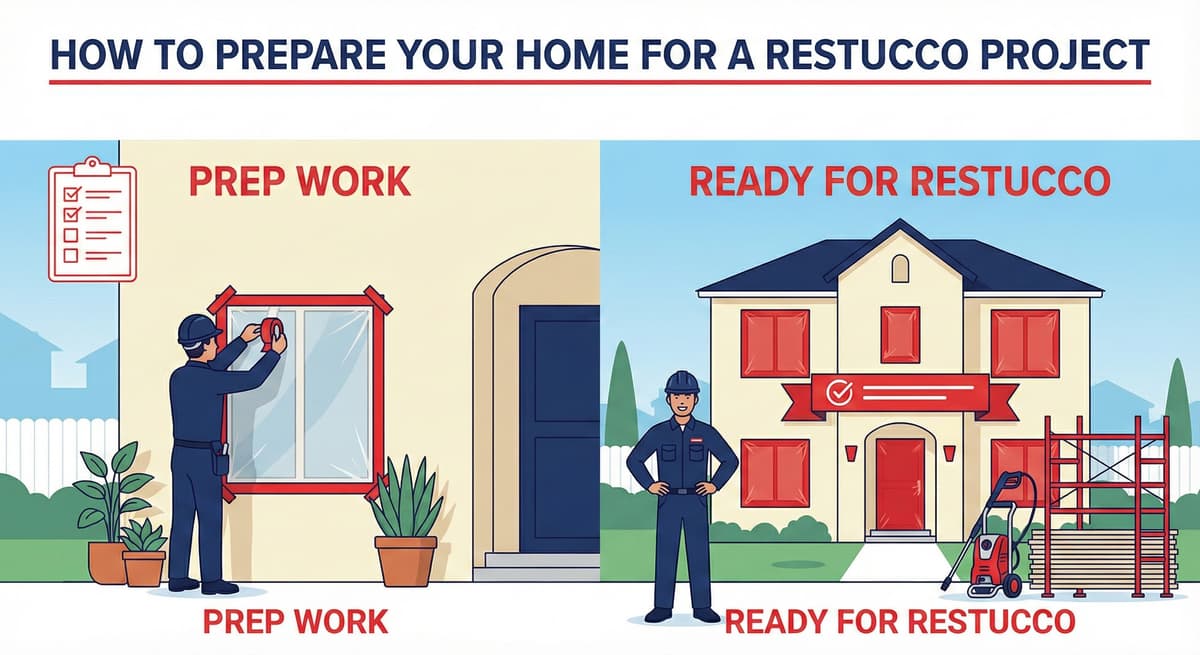
To ensure the project runs safely and the finish cures without defects, homeowners must prepare the site before we arrive. This guide outlines the logistical requirements for a successful restucco.
Free Assessment
Noticing Stucco Damage?
Get a free on-site assessment from a licensed contractor. $0 deposit, no obligation.
GET FREE ASSESSMENT1. The Perimeter Clearance Rule
Stucco application requires full access to the wall, from the roofline down to the foundation.
Scaffolding Requirements: If your home is two stories, we must erect OSHA-compliant scaffolding. This requires a 3 to 4-foot clearance around the entire perimeter.
- Hardscape: Move patio furniture, BBQs, and potted plants at least 10 feet away from the walls to avoid dust and overspray.
- Storage: Clear side yards of trash bins, bikes, or kayaks. If we can't walk through, we can't lathe the wall.
2. Landscaping: The "Cut Back"
Plants touching the wall are the enemy of a good finish.
The Risk: If a branch rubs against wet stucco, it ruins the texture. If vines are left attached, they rot under the new paper.
The Action: Trim all trees and shrubs back at least 18 to 24 inches from the wall. This allows our crew to apply the paper and wire without obstruction.
Turn off your automated sprinklers 24 hours before we start.
Wet walls cannot be waterproofed. If sprinklers hit the fresh brown coat, they will wash out the cement paste, weakening the bond. Keep them off until the finish coat is fully cured (approx. 48 hours after completion).
3. Vibration Control: Interior Safety
The most overlooked aspect of stucco work is Vibration.
Sandblasting & Lathing: These processes vibrate the framing of the house.
The Consequence: Pictures can walk off the walls. Plates can rattle off shelves.
The Fix: Remove all unsecured wall hangings, mirrors, and fragile items from interior shelves, especially on exterior-facing walls.
4. Window & Door Protocols
We mask all windows with heavy poly-sheeting and tape, but dust is insidious.
Lock It Up: Ensure all windows are fully closed and locked. A cracked window will allow silica dust to enter the home during sandblasting.
Access: We rarely need inside the house, but we need access to the electrical panel (for mixers) and a hose bib (for water).
5. The Weep Screed Excavation
If you have an older home with stucco buried in the dirt, we may need to trench the perimeter.
Why? Code standards under **ASTM C1063** and **CRC R703.7.2.1** require the weep screed to remain clear: at least 4 inches above raw earth/soil and at least 2 inches above concrete/paved surfaces. Burying the weep screed traps moisture behind the wall, rotting the sill plate and inviting termites.
Prep: Pull back mulch or decorative rock 6-8 inches from the foundation to allow us to install the new drainage flashing correctly.
Conclusion: A Partnership in Prep
A successful stucco job is a partnership. You clear the path, and we execute the work. By handling vegetation and perimeter clearance proactively, you eliminate delays and ensure our crew can focus entirely on the craftsmanship of your new exterior.
Last week, we shared The Complete Homeowner’s Guide to Restuccoing. Understand the full process timeline here.
Frequently Asked Questions About Stucco
How much does stucco repair cost in Orange County and Los Angeles?+
Small stucco patches start at $650, larger repairs start at $1,200, and re-stucco of a single elevation up to about 400 sq ft runs about $1,400 - $5,900+. The exact cost depends on the damage type (hairline cracks, water damage, delamination, weep screed failure), the square footage involved, and whether the original three-coat or one-coat stucco system needs to be matched. Stucco Champions provides fixed-price written estimates after a free on-site assessment — no hourly billing, no surprise change orders. See our stucco repair cost guide for detailed pricing by repair type.
How long does stucco last in Southern California?+
Properly installed three-coat stucco lasts 50-80+ years in Southern California's climate. The most common failure points aren't the stucco itself — they're the supporting components: corroded weep screed, deteriorated building paper behind the stucco, and improperly sealed window flashing. Most "stucco failures" are actually moisture-intrusion failures that start at one of these points. Annual visual inspection catches problems before they spread, which is why we offer free weep screed assessments for homeowners in our service area.
Can I repair stucco myself, or do I need a contractor?+
Hairline cracks under 1/8 inch wide can be sealed with elastomeric caulk by a homeowner. Anything larger — pattern cracks, delamination (where stucco pulls away from the wall), water-damaged areas, or chimney/window leak repairs — requires a licensed contractor. Improper DIY repair on these is the #1 cause of repeat failures because the underlying cause (usually moisture) isn't addressed. California's CSLB requires a license for any stucco work over $500. Looking for a highly-rated stucco contractor in Southern California? We are a CSLB-licensed and insured team ready to help.
How do I know if I need stucco repair vs. full re-stucco?+
If less than 30% of an elevation has visible damage, repair is the right call. If you see large areas of cracking, multiple zones of delamination, or the underlying paper and lath have rotted across an entire wall, full re-stucco of that elevation is more cost-effective long-term. Our free assessment includes a moisture survey and lath inspection so you get a defensible recommendation either way — not just a quote pushing whichever option costs more.
Do you offer warranties on stucco work?+
Approved stucco repair work includes a 1-year written workmanship warranty. The applicable terms are documented with the approved scope. Stucco Champions is CSLB licensed and insured; verify license #1122006 through the official state lookup. Request a free estimate to review the scope and warranty terms before you sign.
How long does a stucco repair take?+
Most patch repairs are completed in 1-2 days, including a 24-hour cure time before texture matching and color application. Full re-stucco of a single elevation runs 5-7 working days because each coat (scratch, brown, finish) needs to cure properly before the next is applied. We schedule around weather — California stucco needs daytime temperatures above 50°F with no rain forecast for at least 24 hours after each coat. Our crew shows up on time, every time.
Stucco Diagnostics & Tools
Diagnose specific wall damage symptoms or estimate job scope with our free guides and calculators.
Related Professional Services
A licensed assessment identifies the cause before the finish is opened or replaced.