The Homeowner's Guide to Choosing the Right Stucco Finish
Written by Stucco Champions — Southern California’s Authority on Exterior Plastering.
Choosing a stucco finish is more than just an aesthetic preference; it is a critical functional decision that directly impacts the maintenance requirements, weather resistance, and long-term durability of your home. The texture you select determines how rainwater sheds off the wall, how much atmospheric dust accumulates, and how easily the surface can be patched or blended during future repairs.
In Southern California, we see a wide spectrum of stucco finishes, from the sleek, minimalist "Santa Barbara" smooth coat to the rugged, traditional "Spanish Lace." This guide breaks down the technical pros, cons, and material behaviors of each texture to help you select the ideal finish for your property.
1. The Big Three: Popular Stucco Textures Explained
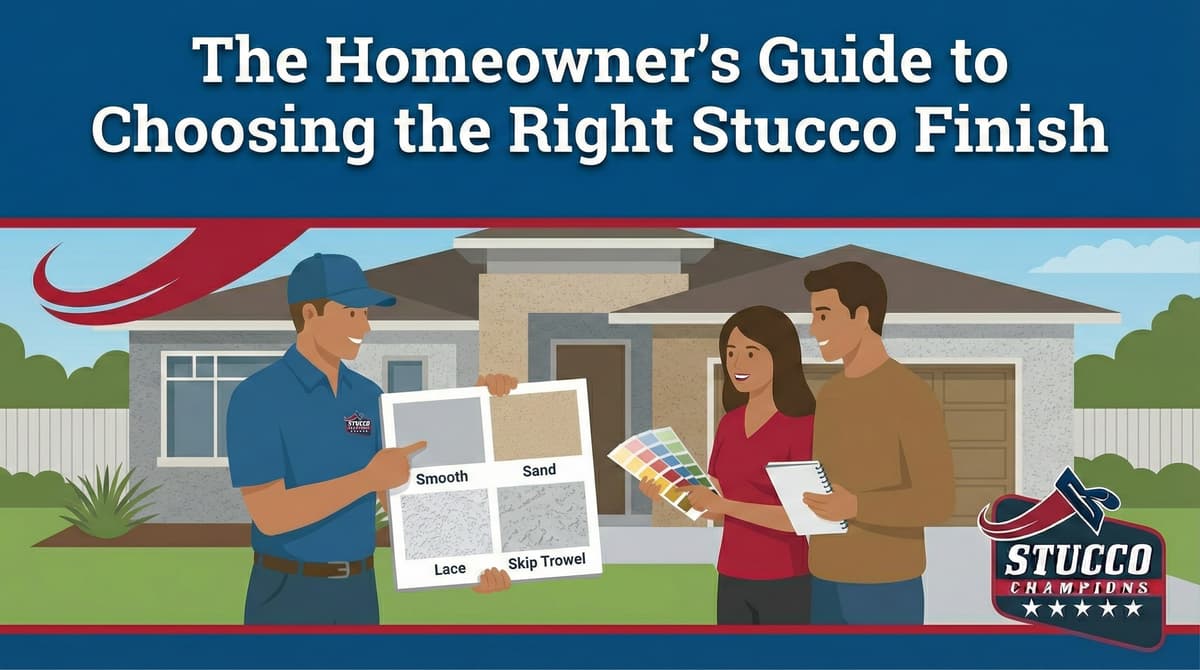
While plasterers can create custom hand-applied finishes, the vast majority of residential homes in Los Angeles and Orange Counties utilize one of these three standard textures:
| Finish & Texture Type | Technical Description | Maintenance & Repair Outlook |
|---|---|---|
| Smooth (Santa Barbara) | A glassy, undulating surface mimicking historic adobe. Requires expert troweling and a fine aggregate mix (using No. 30 or finer sand). | High: Shows dirt, staining, and hairline cracking easily. Highly difficult to patch seamlessly. |
| Sand (Float Finish) | A uniform, grit-like texture resembling sandpaper. Achieved by floating the wet color coat with a carpet float to expose the aggregate. | Low: Resists dirt accumulation, easy to wash, and relatively straightforward to repair or blend. |
| Lace (Skip Trowel) | A texture consisting of knocked-down "islands" over a rougher background. Highly traditional, classic Mediterranean look. | Medium: Excellent at hiding minor cracks and framing imperfections; highly forgiving during patch repairs. |

Free Assessment
Noticing Stucco Damage?
Get a free on-site assessment from a licensed contractor. $0 deposit, no obligation.
GET FREE ASSESSMENT2. Architectural Compatibility and Design
Your stucco finish should align with the architectural style of your home. A mismatch in texture can look historically and visually incorrect:
- Modern & Contemporary: Best suited for a **Smooth Santa Barbara** or **Fine Sand** finish. Modern architecture demands clean lines and flat surfaces to highlight geometric forms.
- Spanish Colonial, Mission, & Mediterranean: Typically uses a **Cat Face** finish (a smooth surface with occasional rough, un-troweled inclusions) or a **Heavy Lace** texture to simulate aged, historic plaster.
- Ranch & Tract Homes: Usually finished with a **Medium Sand** or **Dash** (sprayed-on) texture. These uniform textures are highly effective at masking the minor framing crownings and substrate movements common in tract housing.
3. The "Crack Factor" in Smooth Stucco
The choice between smooth and textured stucco is often a conversation about crack tolerance. Smooth cement finishes are highly prone to hairline cracks.
Traditional cement-based smooth finishes (like a Santa Barbara smooth coat) do not contain coarse sand aggregates to distribute drying stresses. As a result, when the home undergoes minor seismic shifting, thermal expansion, or wood framing shrinkage, hairline checking cracks will appear. While considered "authentic character" on a Spanish Revival home, it is often viewed as a defect on modern homes.
To achieve a smooth look with reduced cracking risk, you must use an Acrylic (Synthetic) Finish or install a polymer-modified base coat reinforced with fiberglass mesh (crack-isolation system) beneath the color coat.
Read More: A Deep Dive into Smooth Stucco Options & Clearances
4. Acrylic vs. Traditional Cement-Based Finishes
The material binder you select dictates the physical limits and color performance of the finish coat:
Traditional Cement-Based Finish (e.g., Omega ColorTek)
A factory-prepared blend of Portland cement, hydrated lime, aggregates conforming to **ASTM C897**, and mineral pigments.
- Pros: Excellent vapor permeability (high breathability), economical, and achieves authentic Old World textures.
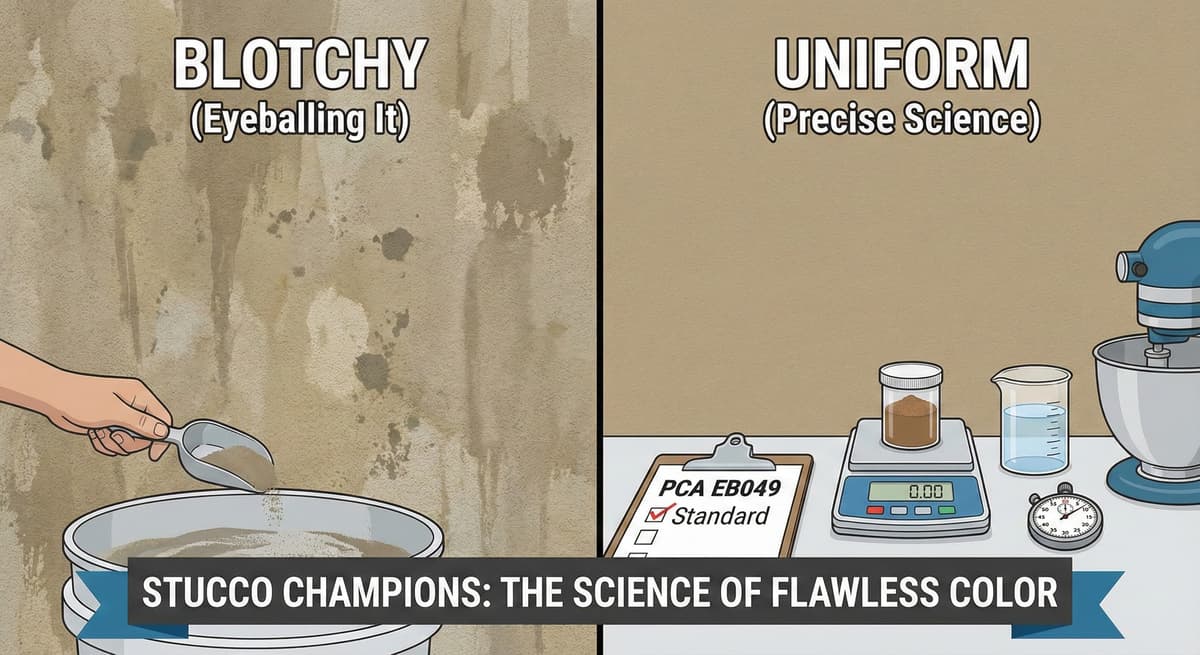
- Cons: Dark colors will mottle and fade over time due to efflorescence (calcium hydroxide migrating to the surface during curing). Prone to hairline checking.
Acrylic Finish (e.g., OmegaFlex)
A 100% acrylic polymer-based finish using Dirt Pick-up Resistance (DPR) technology.
- Pros: Highly flexible (bridges hairline cracks), holds dark colors without fading, and resists water penetration.
- Cons: Lower vapor permeability than cement; more expensive. *Critical field warning:* Diluting acrylic finish with excess water to make it trowel easier degrades the acrylic binders, leading to blistering and eventual peeling.
5. Changing Your Finish: The Remediation Process
Homeowners frequently ask: "Can I change my home's rough lace or dash texture to a smooth finish?"
The technical answer: Yes, but it requires significant surface preparation. You cannot simply apply a thin smooth color coat directly over a rough texture, as the high spots will telegraph through the new layer. The process involves either grinding down the existing texture or applying a leveling coat—a polymer-modified base coat (e.g., Omega Styrocrete) reinforced with fiberglass mesh—to create a flat plane before applying the new smooth finish.
Conclusion: Balance Aesthetics and Maintenance
The right stucco finish balances your design goals with maintenance realities. If your property is near a busy coastal road, a smooth or sand finish is easier to wash than a rough lace texture that traps salt and soot. If you are budget-conscious, a Sand or Lace finish is much more forgiving and requires less specialized labor than a Santa Barbara smooth coat.
At Stucco Champions, we provide physical 2'x2' sample boards on-site so you can evaluate the texture and color under the actual lighting of your home before making a final decision.
Related Resources:
- Read our guide on Exploring Stucco Textures and Finishes for photo comparisons of different styles.
- To consult with a plastering specialist or schedule a free estimate, contact Stucco Champions today.
Frequently Asked Questions About Stucco
How much does stucco repair cost in Orange County and Los Angeles?+
Small stucco patches start at $650, larger repairs start at $1,200, and re-stucco of a single elevation up to about 400 sq ft runs about $1,400 - $5,900+. The exact cost depends on the damage type (hairline cracks, water damage, delamination, weep screed failure), the square footage involved, and whether the original three-coat or one-coat stucco system needs to be matched. Stucco Champions provides fixed-price written estimates after a free on-site assessment — no hourly billing, no surprise change orders. See our stucco repair cost guide for detailed pricing by repair type.
How long does stucco last in Southern California?+
Properly installed three-coat stucco lasts 50-80+ years in Southern California's climate. The most common failure points aren't the stucco itself — they're the supporting components: corroded weep screed, deteriorated building paper behind the stucco, and improperly sealed window flashing. Most "stucco failures" are actually moisture-intrusion failures that start at one of these points. Annual visual inspection catches problems before they spread, which is why we offer free weep screed assessments for homeowners in our service area.
Can I repair stucco myself, or do I need a contractor?+
Hairline cracks under 1/8 inch wide can be sealed with elastomeric caulk by a homeowner. Anything larger — pattern cracks, delamination (where stucco pulls away from the wall), water-damaged areas, or chimney/window leak repairs — requires a licensed contractor. Improper DIY repair on these is the #1 cause of repeat failures because the underlying cause (usually moisture) isn't addressed. California's CSLB requires a license for any stucco work over $500. Looking for a highly-rated stucco contractor in Southern California? We are a CSLB-licensed and insured team ready to help.
How do I know if I need stucco repair vs. full re-stucco?+
If less than 30% of an elevation has visible damage, repair is the right call. If you see large areas of cracking, multiple zones of delamination, or the underlying paper and lath have rotted across an entire wall, full re-stucco of that elevation is more cost-effective long-term. Our free assessment includes a moisture survey and lath inspection so you get a defensible recommendation either way — not just a quote pushing whichever option costs more.
Do you offer warranties on stucco work?+
Approved stucco repair work includes a 1-year written workmanship warranty. The applicable terms are documented with the approved scope. Stucco Champions is CSLB licensed and insured; verify license #1122006 through the official state lookup. Request a free estimate to review the scope and warranty terms before you sign.
How long does a stucco repair take?+
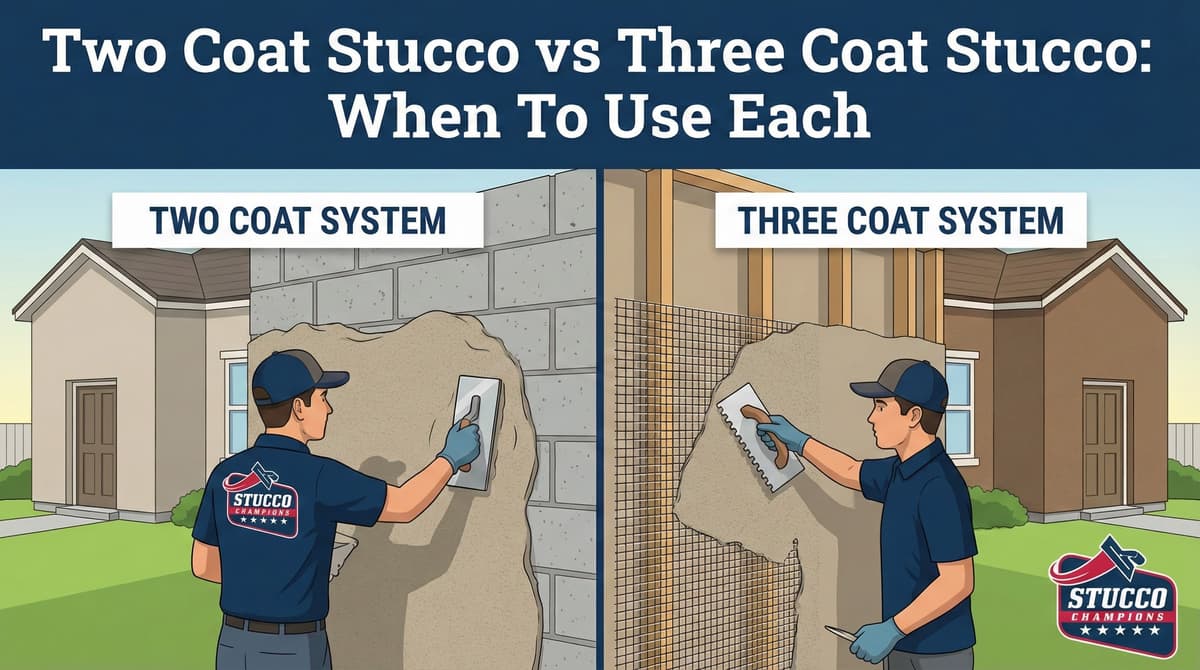
Most patch repairs are completed in 1-2 days, including a 24-hour cure time before texture matching and color application. Full re-stucco of a single elevation runs 5-7 working days because each coat (scratch, brown, finish) needs to cure properly before the next is applied. We schedule around weather — California stucco needs daytime temperatures above 50°F with no rain forecast for at least 24 hours after each coat. Our crew shows up on time, every time.
Stucco Diagnostics & Calculators
Diagnose specific wall damage symptoms or estimate job scope with our free guides and calculators.
Related Professional Services
A licensed assessment identifies the cause before the finish is opened or replaced.