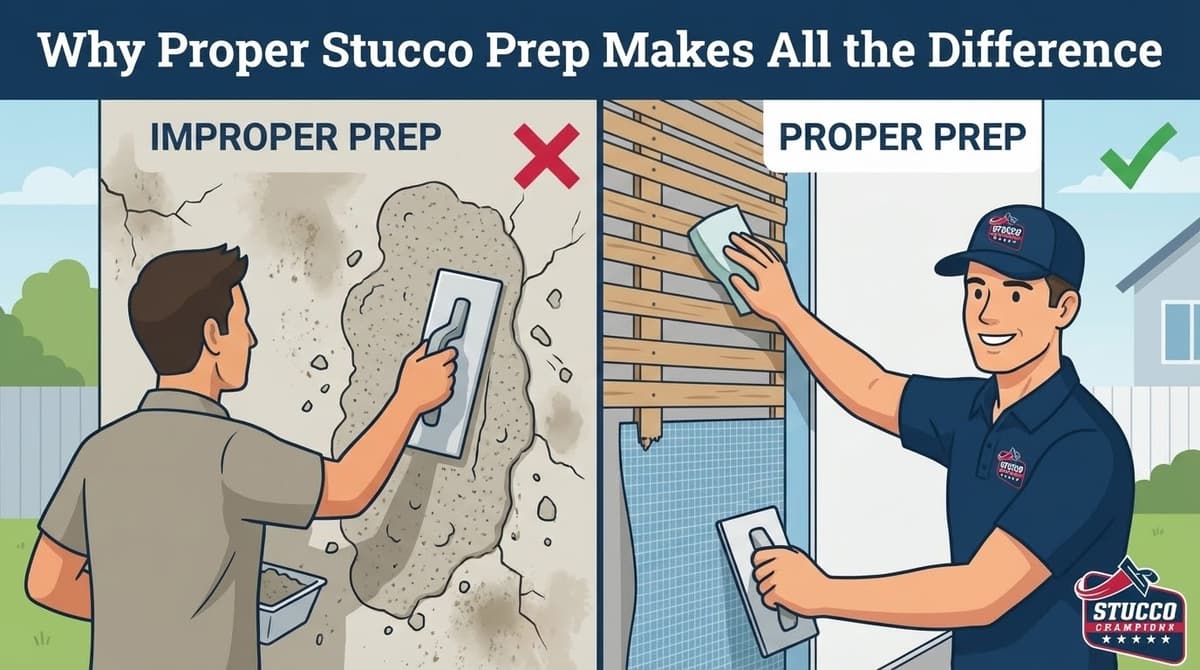
Why Proper Stucco Prep Makes All the Difference
Written by Stucco Champions — Southern California’s Authority on Exterior Plastering.
When it comes to stucco work, what lies underneath matters more than the finish itself. At Stucco Champions, we know that 90% of stucco failures—cracking, bubbling, and delamination—are caused by poor surface preparation, not the finish coat.
The new coat is only as strong as the bond it creates with the old wall. If that bond fails, gravity wins. This guide explains the science of adhesion, chemical vs. mechanical bonding, and the strict protocols we follow to ensure your exterior lasts for decades.
1. The Science of the "Bond"
Stucco is a heavy masonry cladding (roughly 10 lbs per square foot). To stay on your wall, it needs one of two things:
- A Mechanical Bond: The new stucco physically locks into the rough, open pores of the old surface. This requires a clean, raw cementitious substrate.
- A Chemical Bond: A liquid bonding agent (conforming to ASTM C932 for exterior plastering) glues the two layers together. This is crucial for transitions and skim coats.
Most older homes have been painted. Paint seals the pores of the stucco and creates a non-porous barrier. If a contractor applies new stucco directly over painted stucco, there is zero mechanical bond. The new cement is only sticking to a thin layer of paint. If the paint fails or the wall expands, the heavy new stucco pulls the paint off, causing large sheets to peel and delaminate.
Free Assessment
Noticing Stucco Damage?
Get a free on-site assessment from a licensed contractor. $0 deposit, no obligation.
GET FREE ASSESSMENT2. The Stucco Champions Prep Protocol
We don't just "wash" the wall. We aggressively prepare the substrate to ensure a permanent lock.
Handling Painted Surfaces (Sandblasting)
If your home has been painted, simple pressure washing is not enough. We mandate Sandblasting (or Hydro-blasting at 3,000+ PSI).
- Why: This strips away the old layers of paint and the soft, crumbling top layer of the old stucco.
- The Result: It exposes the hard, rough aggregate underneath, creating a "tooth" for the new stucco to bite into. This restores the Mechanical Bond.
Crack Reinforcement (The "Mesh" Step)
Simply filling a crack with mortar is a temporary fix. As your house expands and contracts with the weather, that crack will open up again and "telegraph" through your new finish.
Our Method: We embed fiberglass mesh tape into a polymer-modified base coat over existing cracks. This acts like rebar in concrete, distributing the stress so the crack doesn't return.
Delamination Repair
Before we start, we "sound" the walls (tapping them to hear hollow spots). A hollow sound means the old stucco has already separated from the lath.
The Fix: We cut out these loose sections entirely, down to the studs, and rebuild them from the studs up. Putting new stucco over loose old stucco is a guarantee of failure.
The Bonding Agent (ASTM C932)
Once the surface is scarified (roughed up) and clean, we apply a professional-grade Exterior Bonding Agent (complying with ASTM C932 standards). This ensures that even microscopic dust doesn't interfere with the adhesion of the new coat.
3. Built to Code (ASTM Standards)
We don't guess; we follow the book. The ASTM (American Society for Testing and Materials) sets the gold standard for our industry.
- ASTM C926: Dictates the proper thickness and curing times for stucco layers. We ensure proper thickness (7/8" for 3-coat) and mandatory moist curing between coats.
- ASTM C1063: Dictates how lath and accessories (like weep screeds) must be attached. Clearance at the bottom must be maintained: 4" above soil, 2" above concrete.
By adhering to these strict standards, we ensure your warranty remains valid and your home remains watertight.
4. Signs Your Home Needs "Heavy Prep"
If you see these signs, a simple "skim coat" is not enough. You need professional prep:
- Hollow Sounds: If you tap the wall and it sounds like a drum.
- Efflorescence: White, chalky powder appearing on the wall (indicates moisture is trapped behind the stucco).
- Spiderweb Cracking: A network of fine cracks usually caused by the previous coat drying too fast.
- Peeling Paint: New stucco cannot stick to peeling paint.
Conclusion: Structural Integrity
When you hire Stucco Champions, you aren't just paying for a color change; you are paying for structural integrity. We protect your windows and landscape, perform heavy prep, and leave you with a finish that is bonded for life. Don't let a contractor cover up problems with a fresh coat—fix the foundation of the finish first.
Related Resources
Last week, we shared Stucco Problems and How to Prevent Them. Learn more about avoiding future damage.
Looking for local assistance? Contact our estimate stucco repair in Anaheim today.
Frequently Asked Questions About Stucco
How much does stucco repair cost in Orange County and Los Angeles?+
Stucco repair typically ranges from $500 for minor crack patching to $5,000+ for full re-stucco of a single elevation. The exact cost depends on the damage type (hairline cracks, water damage, delamination, weep screed failure), the square footage involved, and whether the original three-coat or one-coat stucco system needs to be matched. Stucco Champions provides fixed-price written estimates after a free on-site assessment — no hourly billing, no surprise change orders. See our stucco repair cost guide for detailed pricing by repair type.
How long does stucco last in Southern California?+
Properly installed three-coat stucco lasts 50-80+ years in Southern California's climate. The most common failure points aren't the stucco itself — they're the supporting components: corroded weep screed, deteriorated building paper behind the stucco, and improperly sealed window flashing. Most "stucco failures" are actually moisture-intrusion failures that start at one of these points. Annual visual inspection catches problems before they spread, which is why we offer free weep screed assessments for homeowners in our service area.
Can I repair stucco myself, or do I need a contractor?+
Hairline cracks under 1/8 inch wide can be sealed with elastomeric caulk by a homeowner. Anything larger — pattern cracks, delamination (where stucco pulls away from the wall), water-damaged areas, or chimney/window leak repairs — requires a licensed contractor. Improper DIY repair on these is the #1 cause of repeat failures because the underlying cause (usually moisture) isn't addressed. California's CSLB requires a license for any stucco work over $500. Looking for a highly-rated stucco contractor in Southern California? We are a CSLB-licensed and insured team ready to help.
How do I know if I need stucco repair vs. full re-stucco?+
If less than 30% of an elevation has visible damage, repair is the right call. If you see large areas of cracking, multiple zones of delamination, or the underlying paper and lath have rotted across an entire wall, full re-stucco of that elevation is more cost-effective long-term. Our free assessment includes a moisture survey and lath inspection so you get a defensible recommendation either way — not just a quote pushing whichever option costs more.
Do you offer warranties on stucco work?+
Approved stucco repair work includes a 1-year written workmanship warranty. The applicable terms are documented with the approved scope. Stucco Champions is CSLB licensed and insured; verify license #1122006 through the official state lookup. Request a free estimate to review the scope and warranty terms before you sign.
How long does a stucco repair take?+
Most patch repairs are completed in 1-2 days, including a 24-hour cure time before texture matching and color application. Full re-stucco of a single elevation runs 5-7 working days because each coat (scratch, brown, finish) needs to cure properly before the next is applied. We schedule around weather — California stucco needs daytime temperatures above 50°F with no rain forecast for at least 24 hours after each coat. Our crew shows up on time, every time.
Stucco Diagnostics & Calculators
Diagnose specific wall damage symptoms or estimate job scope with our free guides and calculators.
Related Professional Services
A licensed assessment identifies the cause before the finish is opened or replaced.