Restuccoing 101: Expert Tips for Homeowners
Written by Stucco Champions — Southern California’s Authority on Exterior Plastering.
The Complete Homeowner’s Guide to Restuccoing: Process, Costs, and Technical Details
If your home's exterior is showing signs of aging—spiderweb cracking, oxidation (fading), or delamination—restuccoing is more than just a facelift; it is a structural reset for your building envelope. A fresh stucco application reinforces weather resistance and extends the life of your home by decades.
At Stucco Champions, we specialize in full-service resurfacing throughout Southern California. This guide moves beyond the basics to explain the technical requirements of a proper restucco, from sandblasting protocols to ASTM-compliant finish applications.
1. What Is Restuccoing?
Restuccoing (or Resurfacing) involves mechanically bonding a new layer of cementitious material over the existing stucco system. Unlike patching, which breaks the envelope, restuccoing creates a monolithic (continuous) seal that waterproofs the entire structure.
Free Assessment
Noticing Stucco Damage?
Get a free on-site assessment from a licensed contractor. $0 deposit, no obligation.
GET FREE ASSESSMENT2. Diagnostic Matrix: Do You Need It?
Use this guide to determine if your home needs a cosmetic touch-up or a full structural resurface.
| Symptom | Technical Cause | Solution |
|---|---|---|
| Cracks / Flaking | Substrate movement or aging cement matrix. | Re-Stucco with mesh reinforcement. |
| Fading / Staining | UV degradation of pigment or efflorescence. | Fog Coat or Acrylic Finish. |
| Chipping at Corners | Impact damage or rusting corner beads. | Patch & Re-Stucco to blend. |
| Mold / Dark Spots | Trapped moisture due to lack of drainage. | Leak Repair then Re-Stucco. |
3. The Step-by-Step Technical Process
A professional restucco isn't just "putting mud on the wall." It follows a strict sequence to ensure adhesion.
Step 1: Surface Preparation (Sandblasting)
⚠️ Critical RequirementIf your home has been painted, we must remove the paint. Stucco will not bond to paint. We use sandblasting or hydro-blasting (3,000+ PSI) to strip the surface down to the raw, open-pore cement. This creates the "mechanical key" needed for the new coat to stick.
Step 2: Crack Isolation
We identify existing stress cracks and embed fiberglass mesh tape into a polymer-modified base coat. This acts as a shock absorber, preventing the old cracks from telegraphing through the new finish.
Step 3: The Bonding Agent
We apply a liquid bonding agent (glue) to the entire surface to ensure uniform suction and adhesion.
Step 4: The Finish Coat
We apply the final texture coat (1/8" thick) to your specifications.
4. Finish Options & Cost Breakdown
The cost of restuccoing varies based on the complexity of the finish and the prep work required. (Prices are estimates for Southern California market).
| Finish Type | Appearance | Maintenance | Est. Cost (Per Sq. Ft.) |
|---|---|---|---|
| Sand Finish | Uniform grit (modern) | Low | $11 – $15 |
| Lace / Skip | Traditional / Rustic | Medium | $11 – $14 |
| Dash (Heavy) | Rough / Pebbled | Low | $11 – $14 |
| Smooth | Sleek / Adobe | High | $16 – $19+ |
5. Timeline: What to Expect
A full restucco is a major renovation.
Prep Phase (1-2 Days): Masking windows, trenching weep screeds, sandblasting.
Application Phase (2-4 Days): Applying base coats and finish coats.
Curing/Cleanup (1 Day): Final wash down and scaffolding removal.
Note: Weather (rain or extreme heat) can extend cure times.
6. Vetting Your Contractor
Don't get caught by a low bid that skips the sandblasting. Ask these questions:
- Licensure: Are you a C-35 Lathing & Plastering contractor? (Check License Here).
- Prep: How do you handle existing paint? (If they say "just go over it," run).
- Materials: Do you use factory-blended color or field-mixed? (Factory is superior for consistency).
Conclusion: The Ultimate Upgrade
Restuccoing is the most effective way to increase property value and seal your home against the elements. By removing the old, failing surface and applying a new, code-compliant system, you ensure your home is protected for the next 20-30 years.
Related ResourcesLast week, we shared Stucco Problems and How to Prevent Them. Learn why maintenance matters.
Frequently Asked Questions About Stucco
How much does stucco repair cost in Orange County and Los Angeles?+
Stucco repair typically ranges from $500 for minor crack patching to $5,000+ for full re-stucco of a single elevation. The exact cost depends on the damage type (hairline cracks, water damage, delamination, weep screed failure), the square footage involved, and whether the original three-coat or one-coat stucco system needs to be matched. Stucco Champions provides fixed-price written estimates after a free on-site assessment — no hourly billing, no surprise change orders. See our stucco repair cost guide for detailed pricing by repair type.
How long does stucco last in Southern California?+
Properly installed three-coat stucco lasts 50-80+ years in Southern California's climate. The most common failure points aren't the stucco itself — they're the supporting components: corroded weep screed, deteriorated building paper behind the stucco, and improperly sealed window flashing. Most "stucco failures" are actually moisture-intrusion failures that start at one of these points. Annual visual inspection catches problems before they spread, which is why we offer free weep screed assessments for homeowners in our service area.
Can I repair stucco myself, or do I need a contractor?+
Hairline cracks under 1/8 inch wide can be sealed with elastomeric caulk by a homeowner. Anything larger — pattern cracks, delamination (where stucco pulls away from the wall), water-damaged areas, or chimney/window leak repairs — requires a licensed contractor. Improper DIY repair on these is the #1 cause of repeat failures because the underlying cause (usually moisture) isn't addressed. California's CSLB requires a license for any stucco work over $500. We're a CSLB-licensed and insured contractor — see our contractor team for credentials.
How do I know if I need stucco repair vs. full re-stucco?+
If less than 30% of an elevation has visible damage, repair is the right call. If you see large areas of cracking, multiple zones of delamination, or the underlying paper and lath have rotted across an entire wall, full re-stucco of that elevation is more cost-effective long-term. Our free assessment includes a moisture survey and lath inspection so you get a defensible recommendation either way — not just a quote pushing whichever option costs more.
Do you offer warranties on stucco work?+
Yes. Stucco Champions provides a written 5-year workmanship warranty on all stucco repairs and a 10-year warranty on full re-stucco. We're a CSLB-licensed and insured contractor (license #1122006 — verifiable at cslb.ca.gov), which means our work is backed by California's contractor licensing board, not just our own promise. Request a free estimate to see the warranty terms in writing before you sign anything.
How long does a stucco repair take?+
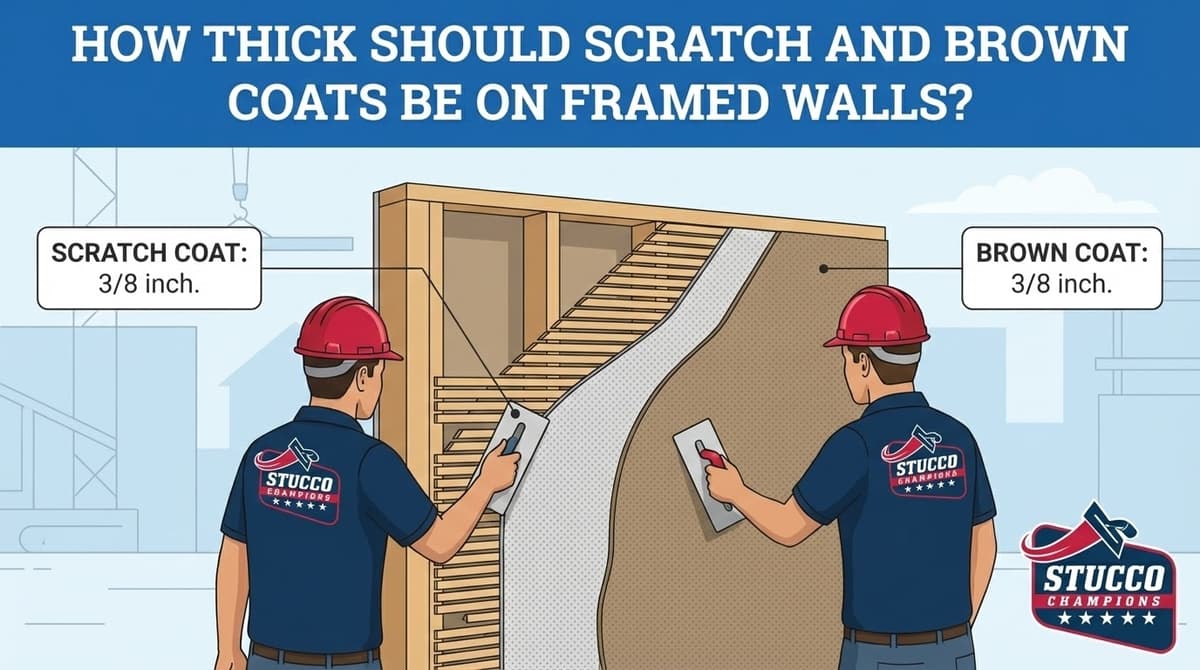
Most patch repairs are completed in 1-2 days, including a 24-hour cure time before texture matching and color application. Full re-stucco of a single elevation runs 5-7 working days because each coat (scratch, brown, finish) needs to cure properly before the next is applied. We schedule around weather — California stucco needs daytime temperatures above 50°F with no rain forecast for at least 24 hours after each coat. Our crew shows up on time, every time.