Navigating the World of Colored Stucco: A Comprehensive Guide

Written by Stucco Champions — Southern California’s Authority on Exterior Plastering.
Beyond Beige: Navigating the World of Colored Stucco
For decades, "stucco color" meant one thing: standard grey cement painted over with beige latex. Today, the technology has evolved. Modern stucco systems utilize Integral Color, where high-grade iron oxide pigments are blended directly into the cement mix.
This creates a finish that is vibrant, permanent, and chip-resistant. However, choosing a stucco color is not like picking a paint chip at a hardware store. Cement is an organic material, and understanding its limitations is the key to loving your home’s exterior.
1. Integral Color vs. Painting
Why choose colored stucco over painting?
- Durability: If you chip painted stucco, you see the grey concrete underneath. If you chip Integral Color stucco, you see more of the same color. The color goes all the way through the finish coat.
- Maintenance: Integral color does not peel, flake, or blister because there is no film on the surface. It is virtually maintenance-free, requiring only a periodic rinse with a garden hose.
- Breathability: Because it isn't sealed with paint, the wall can "breathe," allowing trapped moisture vapor to escape, which prevents rot in your framing.
Free Assessment
Noticing Stucco Damage?
Get a free on-site assessment from a licensed contractor. $0 deposit, no obligation.
GET FREE ASSESSMENT2. The "Mottling" Factor: Feature or Flaw?
This is the most critical concept for homeowners to understand. Traditional cement stucco is not uniform. It is designed to look earthen, natural, and variegated.
Depending on the humidity, the suction of the wall, and the troweling technique, the color will dry with light and dark shadings. This is called "mottling."
Decision Guide
You want Old World Charm: Choose Traditional Cement (LaHabra/Omega). The mottling adds depth and character, perfect for Spanish, Tuscan, or Santa Barbara styles.
You want Uniform Perfection: Choose Acrylic Finish. If you hate variation and want the wall to look exactly like the paint chip, you must use a synthetic Acrylic finish.
3. The Dark Color Dilemma in SoCal
We all love the look of a deep "Midnight Blue" or "Charcoal" modern farmhouse. However, achieving these colors with traditional cement is risky.
- Fading: Cement pigments are mineral-based. Dark organic pigments break down rapidly under our intense UV exposure, turning black walls grey within a few years.
- Efflorescence: Dark colors highlight the natural white salt deposits (efflorescence) that leach out of cement, making the wall look chalky.
The Solution: If you want a dark color, we strictly recommend Acrylic Finish. Acrylics encapsulate the pigment in a polymer, locking in the color and preventing fade.
4. How Texture Alters Color
Be aware that the texture you choose changes how the color is perceived.
Smooth Finish: Reflects more light, making the color appear lighter.
Rough Finish (Sand/Lace): Creates thousands of tiny shadows. This absorbs light and makes the exact same color mix appear darker and richer.
⚠️ The Wet/Dry Rule
Stucco is cement. When we apply it wet, it will look 3 to 4 shades darker than the sample. As the water evaporates (cures) over the next 48 hours, it will lighten significantly. Do not judge the color until the wall is bone dry.
5. Restoring Color: The Fog Coat
What happens if your integral color stucco fades after 15 years? Do not paint it!
The correct maintenance method is Fog Coating. This involves spraying a mixture of cement, lime, and pigment onto the wall. It bonds to the existing pores, restoring the original vibrant color without sealing the surface. It is cheaper than painting and lasts longer.
6. Premixed vs. Field Mixed
At Stucco Champions, we only use Factory Premixed Bags (like LaHabra Platinum or Omega ColorTek).
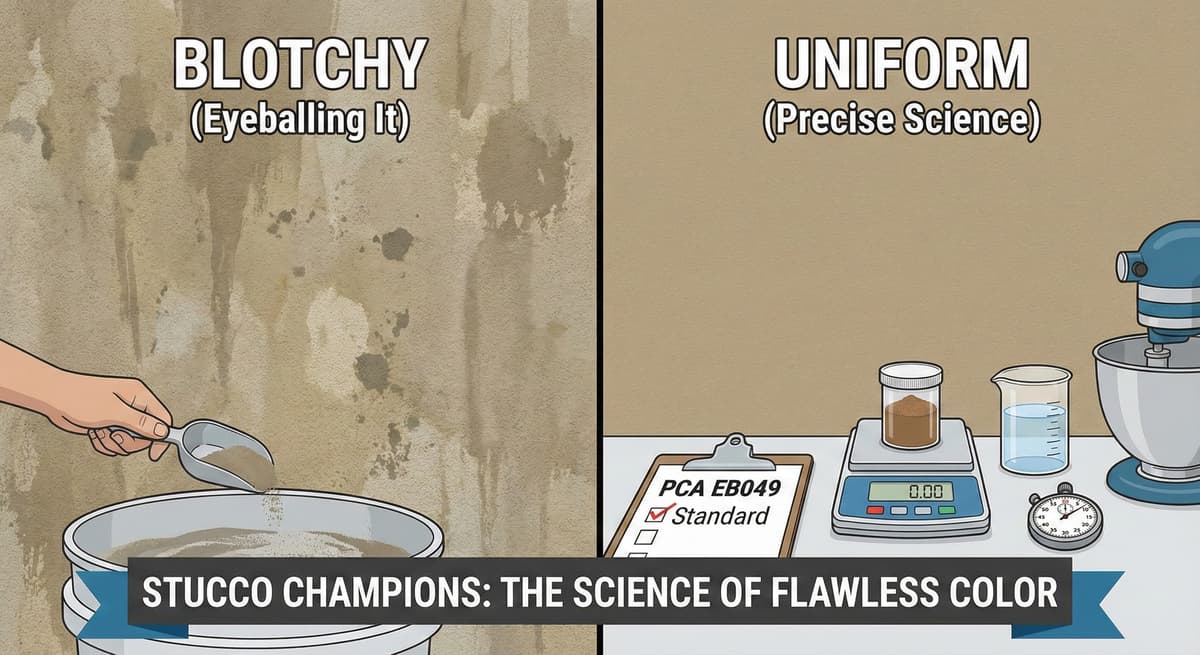
Some contractors buy plain grey cement and squirt liquid color bottles into the mixer on-site. This leads to "batch-to-batch" inconsistency, where the south wall is a different shade than the north wall. Factory blending ensures every bag is identical.
Related Resources
Trying to match an existing color? Read our guide on How to Match Stucco Color and Texture.
Confused about texture options? Check out The Comprehensive Guide to Stucco Textures.