How to Match an Existing Stucco Color: The Expert Guide

Written by Stucco Champions — Southern California’s Authority on Exterior Plastering.
How to Match an Existing Stucco Color: The Expert Guide
Matching an existing stucco finish is widely considered the most difficult aesthetic task in exterior construction. Unlike paint—which is a thin surface coating that can be computer-matched at a hardware store in minutes—stucco is a cement-based material. Its final appearance is dictated by hydration rates, sand aggregate size, and decades of UV exposure.
If you are remodeling an addition or patching an old window removal, you cannot simply buy a bag of "Mesa Tan" off the shelf and expect it to blend. The bag color is brand new; your house is old. This guide explains the forensic process required to achieve an invisible match.
Free Assessment
Noticing Stucco Damage?
Get a free on-site assessment from a licensed contractor. $0 deposit, no obligation.
GET FREE ASSESSMENT1. The Problem: Why Old Stucco Doesn't Match New Stucco
Even if you know the exact brand and original color name used by the builder 20 years ago, a new bag of that exact color will not match your wall. There are three primary reasons:
- UV Degradation: The intense Southern California sun physically bleaches the iron oxide and organic pigments over time, causing the color to fade.
- Oxidation: Decades of airborne dirt, smog, and pollution create a microscopic grey/brown film over the original color matrix.
- Absorption: Old stucco is highly porous and "thirsty." When a wet patch is applied next to it, the old wall rapidly sucks the moisture out of the new stucco, changing how the new patch cures.
2. The Solution: Custom Lab Matching
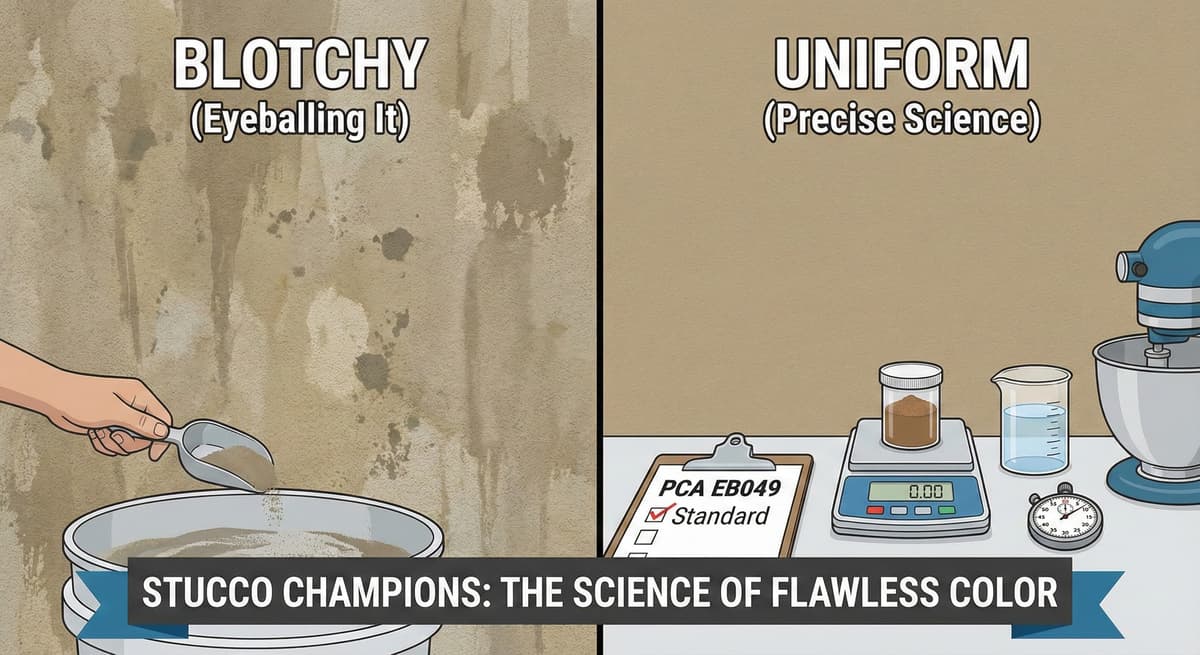
Do not rely on a contractor "eyeballing" the color with a paper chart in the sun. The human eye is subjective; chemistry is not.
- Harvest a Sample: We use a chisel to carefully chip a 2-inch piece of stucco from an inconspicuous area of the home (usually near the foundation weep screed).
- Lab Analysis: We send this physical sample directly to the manufacturer’s laboratory (e.g., Omega or LaHabra).
- Custom Formulation: Their chemists analyze the faded pigment and create a custom "Lab Match" bag that replicates the current, faded color of your home, not the original factory color.
3. The Aggregate Rule: Texture is 50% of the Color
This is the engineering secret most homeowners miss: Texture physically alters human color perception.
Rough textures cast millions of microscopic shadows, making the color appear darker. Smooth textures reflect light, making the identical color appear lighter. If the new patch uses a different sand size than the existing wall, the color will look wrong even if the pigment formulation is absolutely perfect.
The Rule: We must meticulously match the Mesh Size of the sand (e.g., coarse 16/20 vs fine 20/30) and the trowel technique to ensure the sunlight hits the patch exactly the same way it hits the surrounding wall.
4. The "Dirty Wall" Variable
You cannot match a dirty wall. Before we harvest a sample or apply a patch, we must clean the surrounding elevation.
The Method: We utilize "Soft Washing" (low-pressure water with a mild detergent) to remove the layer of oxidation. Frequently, "faded" stucco is simply dirty stucco. Once the wall is clean, the true color reveals itself, making the lab matching process significantly more accurate.
5. The Final Blend: Fog Coating
Occasionally, even a perfect lab match isn't 100% invisible due to the vast age difference in the cement.
The Fix: For seamless restorations, we apply a Fog Coat. This is a breathable, cementitious stain sprayed over the entire architectural section (from corner to corner). It dyes the new patch and the old wall into one monolithic, uniform color while maintaining the permeability of the system. It is the industry standard for high-end exterior restoration.
Conclusion
Color matching is an exercise in chemistry, not an art project. Do not allow a contractor to guess with a standard bag of mix. Insist on a physical sample harvest, a laboratory match, and proper texture blending to ensure your repair looks like it was always part of the original home.
A note on fog coat: Stucco Champions does not fog coat older or previously repaired walls. On aged stucco a fog coat telegraphs existing cracks, patch lines, and prior repairs, and it bonds poorly to a rough, chalky, or previously coated surface, so it can dust off or peel. Those walls get a fresh finish coat (re-stucco) instead.
Frequently Asked Questions About Stucco
How much does stucco repair cost in Orange County and Los Angeles?+
Stucco repair typically ranges from $500 for minor crack patching to $5,000+ for full re-stucco of a single elevation. The exact cost depends on the damage type (hairline cracks, water damage, delamination, weep screed failure), the square footage involved, and whether the original three-coat or one-coat stucco system needs to be matched. Stucco Champions provides fixed-price written estimates after a free on-site assessment — no hourly billing, no surprise change orders. See our stucco repair cost guide for detailed pricing by repair type.
How long does stucco last in Southern California?+
Properly installed three-coat stucco lasts 50-80+ years in Southern California's climate. The most common failure points aren't the stucco itself — they're the supporting components: corroded weep screed, deteriorated building paper behind the stucco, and improperly sealed window flashing. Most "stucco failures" are actually moisture-intrusion failures that start at one of these points. Annual visual inspection catches problems before they spread, which is why we offer free weep screed assessments for homeowners in our service area.
Can I repair stucco myself, or do I need a contractor?+
Hairline cracks under 1/8 inch wide can be sealed with elastomeric caulk by a homeowner. Anything larger — pattern cracks, delamination (where stucco pulls away from the wall), water-damaged areas, or chimney/window leak repairs — requires a licensed contractor. Improper DIY repair on these is the #1 cause of repeat failures because the underlying cause (usually moisture) isn't addressed. California's CSLB requires a license for any stucco work over $500. Looking for a highly-rated stucco contractor in Southern California? We are a CSLB-licensed and insured team ready to help.
How do I know if I need stucco repair vs. full re-stucco?+
If less than 30% of an elevation has visible damage, repair is the right call. If you see large areas of cracking, multiple zones of delamination, or the underlying paper and lath have rotted across an entire wall, full re-stucco of that elevation is more cost-effective long-term. Our free assessment includes a moisture survey and lath inspection so you get a defensible recommendation either way — not just a quote pushing whichever option costs more.
Do you offer warranties on stucco work?+
Approved stucco repair work includes a 1-year written workmanship warranty. The applicable terms are documented with the approved scope. Stucco Champions is CSLB licensed and insured; verify license #1122006 through the official state lookup. Request a free estimate to review the scope and warranty terms before you sign.
How long does a stucco repair take?+
Most patch repairs are completed in 1-2 days, including a 24-hour cure time before texture matching and color application. Full re-stucco of a single elevation runs 5-7 working days because each coat (scratch, brown, finish) needs to cure properly before the next is applied. We schedule around weather — California stucco needs daytime temperatures above 50°F with no rain forecast for at least 24 hours after each coat. Our crew shows up on time, every time.
Stucco Diagnostics & Calculators
Diagnose specific wall damage symptoms or estimate job scope with our free guides and calculators.
Related Professional Services
A licensed assessment identifies the cause before the finish is opened or replaced.