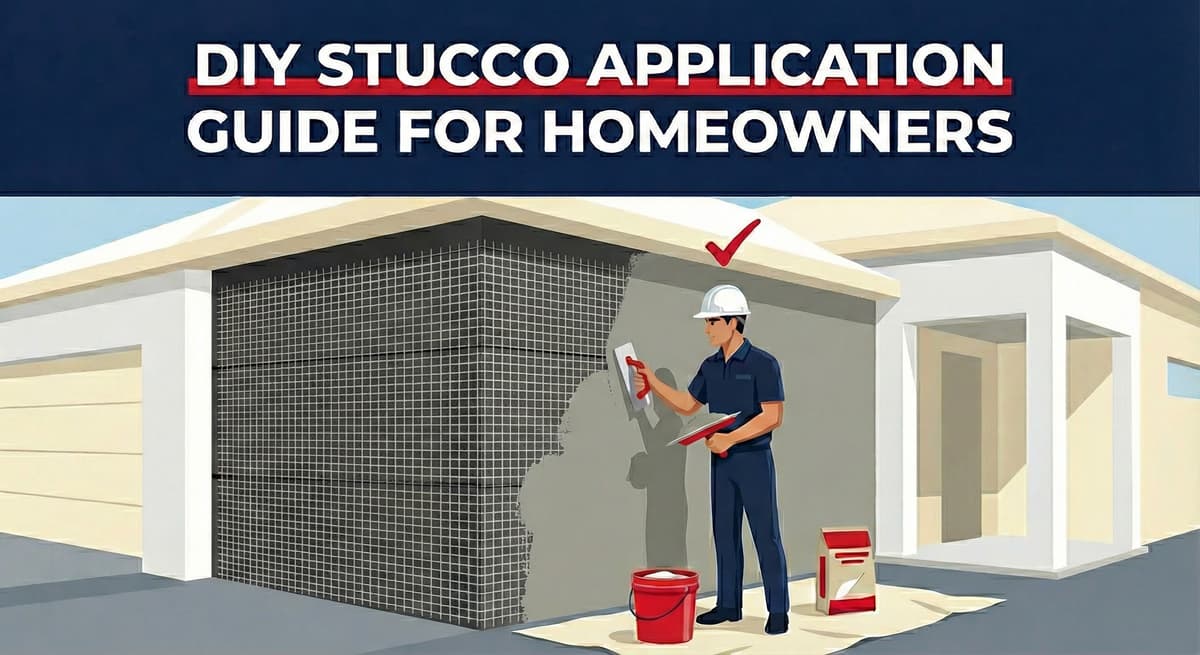
DIY Stucco Application Guide for Homeowners
Written by Stucco Champions — Southern California’s Authority on Exterior Plastering.
Tackling a stucco project on your own can be immensely rewarding, but it is also one of the most physically and technically demanding DIY tasks. Stucco isn't just "mud on a wall"; it is a multi-layered system that relies on precise chemistry, timing, and muscle memory.
If you are a hands-on homeowner planning a garden wall or a small patch repair, this guide breaks down the professional protocol for mixing and applying traditional three-coat stucco. We’ll cover the tools you need, the steps to follow, and the critical mistakes that can turn a weekend project into a structural failure.
1. The "System" Approach: Tools & Materials
Before you mix your first batch, you need the right setup. Using the wrong tool (like a flat shovel instead of a hawk) will make the job impossible.
- Tools: Magnesium Hawk, Pool Trowel, Scarifier (Scratcher), Sponge Float, Masonry Hoe or Drill Mixer.
- Lath Materials: 2 Layers of Grade D Paper, 17-Gauge Wire Mesh, Galvanized Staples, weep screed.
- Cement: Plastic Cement (for Scratch/Brown) and Finish Coat Stucco.
Free Assessment
Noticing Stucco Damage?
Get a free on-site assessment from a licensed contractor. $0 deposit, no obligation.
GET FREE ASSESSMENT2. Step 1: The Waterproof Foundation (Lath)
Do not skip this step. Stucco absorbs water. If you apply it directly to wood sheathing, the sheathing will rot.
- Paper (CRC Section R703.7.3): Install two layers of Grade D building paper (or ASTM D226 asphalt-saturated felt / ASTM E2556 wraps), lapped "shingle fashion" (bottom to top).
- weep screed (ASTM C1063): Install the metal screed at the base of the wall, ensuring it is 4 inches above raw earth/soil and 2 inches above paved concrete.
- Wire Mesh: Staple galvanized wire lath over the paper. Ensure the wire is "furred out" (held slightly off the wall) so the cement can get behind it.
3. Step 2: The Scratch Coat (3/8")
This is the structural layer.
Application: Push the cement hard into the wire mesh. You want full embedment. The mix must meet **ASTM C926** proportion specifications.
Texture: While the cement is wet, use a Scarifier to cut horizontal grooves across the entire surface. These grooves act like Velcro for the next layer.
Cure: Let it sit for 48 hours. Mist it with water (moist curing) to prevent cracking.
4. Step 3: The Brown Coat (3/8")
This is the leveling layer.
Application: Apply another layer of cement over the scratch coat to bring the wall to a total thickness of 3/4".
Technique: Use a "Rod" or straightedge to shave the wall flat. Then, use a float to create a uniform, sandy texture.
Cure: This needs to cure for 7 to 14 days under **ASTM C926** to allow structural shrinkage. If you rush this, your finish coat will crack.
5. Step 4: The Finish Coat (1/8")
This is the beauty layer.
Application: Apply a thin layer of colored stucco.
Texturing: Use a sponge float for a "Sand Finish" or a trowel for a "Spanish Lace" look. Work in the shade if possible; if the finish dries too fast ("flash drying"), it will blotch and flake.
- Over-Watering: If the mix is "soupy," it will shrink and crack. Aim for a "stiff peanut butter" consistency.
- Ignoring Control Joints: Large walls need expansion joints (per ASTM C1063) to handle movement. Without them, the stucco will create its own cracks.
- Rushing the Cure: Stucco gains strength over time. If you paint it or seal it too soon (before 28 days), you will trap moisture and cause failure.
Conclusion: Know Your Limits
DIY stucco is feasible for garden walls, BBQs, and small patches. However, for a full house re-stucco or structural water damage repair, the risks are high. Uneven mixing, poor lathing, or improper waterproofing can devalue your home. If the project involves waterproofing a living space, we highly recommend consulting a CSLB-licensed professional.
Related Resources
Last week, we shared How To Mix Stucco Base Coat. If you are mixing your own mud, get the recipe right.
Frequently Asked Questions About Stucco
How much does stucco repair cost in Orange County and Los Angeles?+
Stucco repair typically ranges from $500 for minor crack patching to $5,000+ for full re-stucco of a single elevation. The exact cost depends on the damage type (hairline cracks, water damage, delamination, weep screed failure), the square footage involved, and whether the original three-coat or one-coat stucco system needs to be matched. Stucco Champions provides fixed-price written estimates after a free on-site assessment — no hourly billing, no surprise change orders. See our stucco repair cost guide for detailed pricing by repair type.
How long does stucco last in Southern California?+
Properly installed three-coat stucco lasts 50-80+ years in Southern California's climate. The most common failure points aren't the stucco itself — they're the supporting components: corroded weep screed, deteriorated building paper behind the stucco, and improperly sealed window flashing. Most "stucco failures" are actually moisture-intrusion failures that start at one of these points. Annual visual inspection catches problems before they spread, which is why we offer free weep screed assessments for homeowners in our service area.
Can I repair stucco myself, or do I need a contractor?+
Hairline cracks under 1/8 inch wide can be sealed with elastomeric caulk by a homeowner. Anything larger — pattern cracks, delamination (where stucco pulls away from the wall), water-damaged areas, or chimney/window leak repairs — requires a licensed contractor. Improper DIY repair on these is the #1 cause of repeat failures because the underlying cause (usually moisture) isn't addressed. California's CSLB requires a license for any stucco work over $500. Looking for a highly-rated stucco contractor in Southern California? We are a CSLB-licensed and insured team ready to help.
How do I know if I need stucco repair vs. full re-stucco?+
If less than 30% of an elevation has visible damage, repair is the right call. If you see large areas of cracking, multiple zones of delamination, or the underlying paper and lath have rotted across an entire wall, full re-stucco of that elevation is more cost-effective long-term. Our free assessment includes a moisture survey and lath inspection so you get a defensible recommendation either way — not just a quote pushing whichever option costs more.
Do you offer warranties on stucco work?+
Approved stucco repair work includes a 1-year written workmanship warranty. The applicable terms are documented with the approved scope. Stucco Champions is CSLB licensed and insured; verify license #1122006 through the official state lookup. Request a free estimate to review the scope and warranty terms before you sign.
How long does a stucco repair take?+
Most patch repairs are completed in 1-2 days, including a 24-hour cure time before texture matching and color application. Full re-stucco of a single elevation runs 5-7 working days because each coat (scratch, brown, finish) needs to cure properly before the next is applied. We schedule around weather — California stucco needs daytime temperatures above 50°F with no rain forecast for at least 24 hours after each coat. Our crew shows up on time, every time.
Stucco Diagnostics & Calculators
Diagnose specific wall damage symptoms or estimate job scope with our free guides and calculators.
Related Professional Services
A licensed assessment identifies the cause before the finish is opened or replaced.