Stucco Exterior Maintenance Guide for Homeowners
Written by Stucco Champions — Southern California’s Authority on Exterior Plastering.
Stucco Exterior Maintenance: Protecting Your Investment in Southern California
Stucco is the dominant exterior finish in Southern California for a reason: it is fire-resistant, durable, and handles our heat waves better than vinyl or wood. However, "low maintenance" does not mean "no maintenance."
Between the coastal salt air behind many Newport Beach stucco repair calls, the seismic shifting in Mission Viejo, and the relentless UV exposure, your stucco needs proactive care. Without it, minor hairline cracks can turn into major water intrusion issues. This guide outlines the professional strategies to extend the life of your exterior envelope.
Free Assessment
Noticing Stucco Damage?
Get a free on-site assessment from a licensed contractor. $0 deposit, no obligation.
GET FREE ASSESSMENT1. Seasonal Inspections: The "Walk-Around"
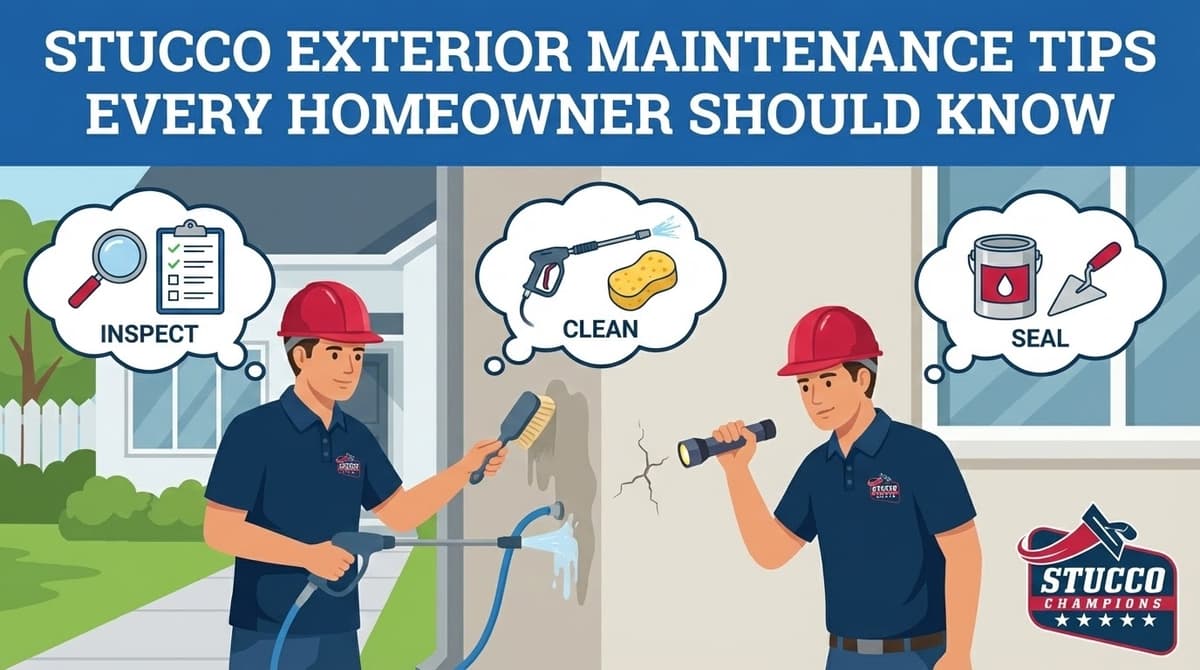
We recommend walking the perimeter of your home at least twice a year (Spring and Fall). You are looking for subtle changes in the surface that indicate stress:
- Hairline Cracks: Common and often cosmetic.
- Efflorescence: White, chalky powder indicating moisture is moving through the wall.
- Bubbling/Bulging: A sign that the stucco has delaminated (detached) from the lath due to trapped water.
Note: In coastal zones, inspect every 3–4 months. Salt accumulation accelerates corrosion of the underlying wire lath.
When was your last stucco checkup? Our free Health Assessment takes 60 seconds.
2. Cleaning Protocols: The "No Pressure" Rule
The most common mistake homeowners make is attacking their stucco with a high-pressure power washer. Do not do this. High pressure (3,000+ PSI) can blast the finish coat off the wall and force water through the porous cement, soaking the paper barrier underneath.
Tools: Garden hose with a spray nozzle and a soft-bristle automotive brush.
Solution: Warm water mixed with a mild dish soap. For green algae or mildew (common on north-facing walls), use a specialized masonry cleaner. Avoid straight bleach, as it can discolor the cement pigments.
3. Crack Management
Stucco is rigid; it will crack. The key is managing the width:
- Hairline (< 1/16"): Seal with a high-quality textured acrylic caulk to prevent moisture entry.
- Structural (> 1/8"): If a crack is wide enough to insert a credit card, do not just patch it. This requires a professional assessment to check for lath failure or foundation settling under **ASTM C1063**.
4. Landscaping and Weep Screeds
The number one cause of stucco rot is improper landscaping.
You must maintain a clearance between the earth and the metal weep screed at the bottom of your wall:
Soil/Mulch: 4 inches minimum clearance.
Paving/Concrete: 2 inches minimum clearance.
Blocking this screed traps moisture inside the wall assembly, causing dry rot in the framing and providing a direct path for termites.
5. Sprinkler Audit
Check your irrigation. Sprinklers should never spray directly onto the stucco. Constant wetting and drying cycles break down the waterproof paper and cause efflorescence staining.
6. Coatings: Paint vs. Fog Coat
If your stucco looks faded, choosing the right coating is critical for maintaining breathability. Traditional stucco is vapor-permeable, allowing moisture to escape the building envelope.
- Fog Coat (Omega SuperFog): For unpainted, traditional stucco. This cement-based finish absorbs directly into the plaster, restoring original color while keeping 100% of the natural breathability.
- Vapor-Permeable Coatings: If the stucco has already been painted, or if you choose to coat it, use high-perm (high permeability) acrylic or elastomeric coatings. **Never use standard latex paint** on raw, unpainted stucco, as it traps moisture behind the paint film, leading to blistering, delamination, and lath rot.
Stucco Maintenance Checklist
| Task | Frequency | Notes |
|---|---|---|
| Visual Inspection | Twice per year | Look for cracks, rust stains, and soft spots. Check weep screed flow. |
| Gentle Cleaning | Annually | Use low-pressure hose and mild detergent. |
| Crack Sealing | As needed | Use textured acrylic caulk for hairline cracks. |
| Window/Door Caulking | Annually | Replace deteriorated sealant with high-performance **ASTM C920** polyurethane sealant to prevent leaks. |
| Weep Screed Clearance | Ongoing | Keep soil 4" below the metal flashing, and concrete paving 2" below. |
| Repainting/Refinishing | Every 7–10 years | Use breathable, stucco-safe coatings (fog coat or high-perm acrylic/elastomeric). |
Conclusion: Proactive Care Saves Money
Stucco is built to last, but only if you treat it right. By keeping the weep screeds clear, washing gently, and sealing cracks early, you can extend the life of your exterior indefinitely. If you spot structural issues, call a professional immediately to prevent dry rot.
Explore our Stucco Repair Services to learn how we restore damaged exteriors.
Learn more from the California Contractors State License Board about proper home maintenance standards.
Time for a Stucco Checkup?
Our free interactive assessments catch problems before they become expensive repairs.
A note on fog coat: Stucco Champions does not fog coat older or previously repaired walls. On aged stucco a fog coat telegraphs existing cracks, patch lines, and prior repairs, and it bonds poorly to a rough, chalky, or previously coated surface, so it can dust off or peel. Those walls get a fresh finish coat (re-stucco) instead.
Frequently Asked Questions About Stucco
How much does stucco repair cost in Orange County and Los Angeles?+
Small stucco patches start at $650, larger repairs start at $1,200, and re-stucco of a single elevation up to about 400 sq ft runs about $1,400 - $5,900+. The exact cost depends on the damage type (hairline cracks, water damage, delamination, weep screed failure), the square footage involved, and whether the original three-coat or one-coat stucco system needs to be matched. Stucco Champions provides fixed-price written estimates after a free on-site assessment — no hourly billing, no surprise change orders. See our stucco repair cost guide for detailed pricing by repair type.
How long does stucco last in Southern California?+
Properly installed three-coat stucco lasts 50-80+ years in Southern California's climate. The most common failure points aren't the stucco itself — they're the supporting components: corroded weep screed, deteriorated building paper behind the stucco, and improperly sealed window flashing. Most "stucco failures" are actually moisture-intrusion failures that start at one of these points. Annual visual inspection catches problems before they spread, which is why we offer free weep screed assessments for homeowners in our service area.
Can I repair stucco myself, or do I need a contractor?+
Hairline cracks under 1/8 inch wide can be sealed with elastomeric caulk by a homeowner. Anything larger — pattern cracks, delamination (where stucco pulls away from the wall), water-damaged areas, or chimney/window leak repairs — requires a licensed contractor. Improper DIY repair on these is the #1 cause of repeat failures because the underlying cause (usually moisture) isn't addressed. California's CSLB requires a license for any stucco work over $500. Looking for a highly-rated stucco contractor in Southern California? We are a CSLB-licensed and insured team ready to help.
How do I know if I need stucco repair vs. full re-stucco?+
If less than 30% of an elevation has visible damage, repair is the right call. If you see large areas of cracking, multiple zones of delamination, or the underlying paper and lath have rotted across an entire wall, full re-stucco of that elevation is more cost-effective long-term. Our free assessment includes a moisture survey and lath inspection so you get a defensible recommendation either way — not just a quote pushing whichever option costs more.
Do you offer warranties on stucco work?+
Approved stucco repair work includes a 1-year written workmanship warranty. The applicable terms are documented with the approved scope. Stucco Champions is CSLB licensed and insured; verify license #1122006 through the official state lookup. Request a free estimate to review the scope and warranty terms before you sign.
How long does a stucco repair take?+
Most patch repairs are completed in 1-2 days, including a 24-hour cure time before texture matching and color application. Full re-stucco of a single elevation runs 5-7 working days because each coat (scratch, brown, finish) needs to cure properly before the next is applied. We schedule around weather — California stucco needs daytime temperatures above 50°F with no rain forecast for at least 24 hours after each coat. Our crew shows up on time, every time.
Stucco Diagnostics & Calculators
Diagnose specific wall damage symptoms or estimate job scope with our free guides and calculators.
Related Professional Services
A licensed assessment identifies the cause before the finish is opened or replaced.