Grade D Building Paper for Stucco: Code Requirements and Benefits
Written by Stucco Champions — Southern California’s Authority on Exterior Plastering.
Grade D Building Paper: The Code-Compliant Shield Behind Your Stucco
When you admire a stucco home, you are looking at the armor. But the armor is porous. Stucco absorbs water by design. The real hero protecting your wood framing from rot is the invisible layer underneath: Grade D Building Paper.
Also known as the Weather-Resistive Barrier (WRB), this humble asphalt-impregnated paper is the subject of strict building codes (CRC R703.2). Why? Because if it fails, the house rots from the inside out. This guide explains the difference between "10-Minute" and "60-Minute" paper and why the Two-Layer Rule is non-negotiable.
1. What is Grade D Paper?
Grade D paper is a kraft paper saturated with asphalt. It is engineered to perform a specific balancing act:
- Water Resistance: It repels bulk liquid water that soaks through the stucco during a rainstorm.
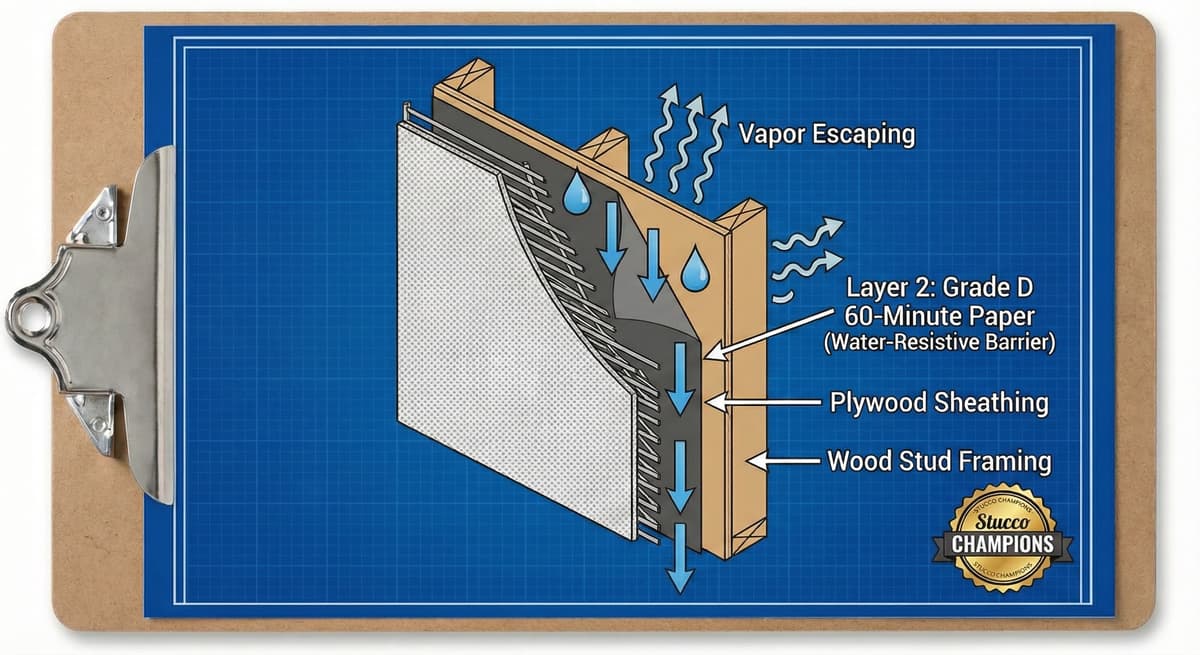
- Vapor Permeability: Unlike plastic sheeting, it allows water vapor (humidity) from inside the house to escape outward. This prevents condensation from getting trapped in the wall cavity ("Sweating").
Free Assessment
Noticing Stucco Damage?
Get a free on-site assessment from a licensed contractor. $0 deposit, no obligation.
GET FREE ASSESSMENT2. The "Two-Layer" Code Requirement
In California, applying stucco over wood sheathing requires two layers of WRB. This isn't just for extra thickness; it's for physics.
The Bond Breaker PrincipleLayer 1 (Outer): Bonds to the wet stucco. It essentially becomes part of the cladding.
Layer 2 (Inner): Remains separate. Because the outer layer is stuck to the cement, this inner layer creates a tiny air gap or "drainage plane."
The Result: Water that penetrates the stucco hits this gap and drains down to the weep screed by gravity, never touching the wood.
3. 10-Minute vs. 60-Minute Paper
The rating (e.g., "60-Minute") refers to the ASTM D779 Boat Test, which measures how long the paper can float on water before moisture soaks through.
10-Minute Paper (The Minimum)
This is the legal bare minimum. It is thin and tears easily during lath installation. While code-compliant, it offers a very small margin of error.
60-Minute Paper (The "Super Jumbo Tex" Standard)
This is the professional choice. It is significantly thicker, resists tearing when stapled, and offers 6x the water hold-out time.
Our Policy: At Stucco Champions, we default to Two-Ply 60-Minute Paper. It is cheap insurance against water intrusion.
4. Paper vs. Housewrap (Tyvek)
Homeowners often ask: "Can I just use Tyvek?"
The Answer: Not alone.
Standard housewraps are flat plastic. If you apply stucco directly to them, the cement bonds to the wrap, eliminating the drainage plane. Furthermore, the surfactants (soaps) in wet cement can degrade certain plastic wraps.
The Hybrid Solution: The gold standard is applying a layer of Tyvek (for air sealing) against the wood, followed by a layer of 60-Minute Paper (as a bond breaker) against the stucco.
5. Installation: The Shingle Lap
Even the best paper fails if installed backward.
The Rule: All layers must overlap "Shingle Fashion."
1. Start at the bottom.
2. The upper sheet overlaps the lower sheet by at least 2 inches.
3. Vertical seams overlap by 6 inches.
4. The bottom edge must lap over the Weep Screed flange.
Conclusion: Don't Skimp on the Hidden Layer
Once the stucco is on, you cannot change the paper without tearing the house down. Upgrading from 10-minute paper to 60-minute paper costs pennies per square foot but adds decades to the lifespan of your waterproofing system.
Related ResourcesLast week, we shared Weather Resistant Building Paper Guide. Dive deeper into the ASTM standards.