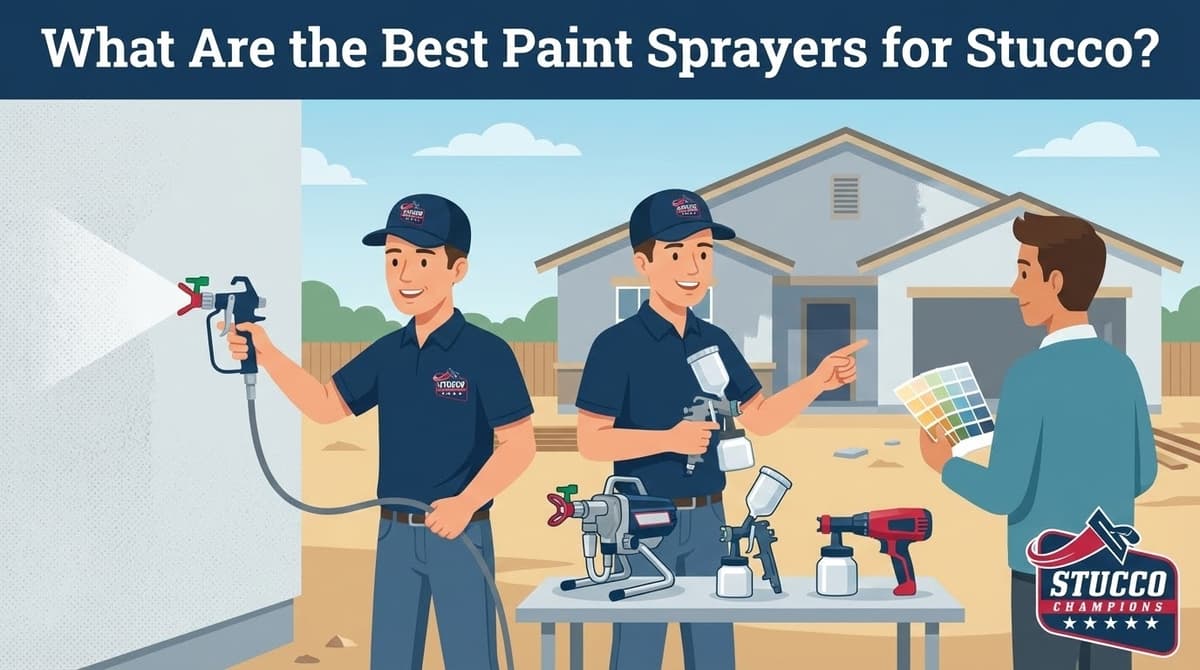
What Are the Best Paint Sprayers for Stucco?
Written by Stucco Champions — Southern California’s Authority on Exterior Plastering.
The Heavy Duty Guide: Selecting Paint Sprayers for Stucco
Painting stucco is one of the most demanding tasks for a homeowner or professional. Stucco is thirsty, abrasive, and textured. If you try to paint a stucco home with a standard interior sprayer or rollers alone, you will face endless clogs, poor coverage, and physical exhaustion.
Unlike smooth drywall, stucco requires equipment that can push heavy-bodied masonry paints into deep crevices. This guide evaluates the machinery required to handle the viscosity and volume of stucco painting projects.
1. The Critical Spec: GPM (Gallons Per Minute)
When selecting a sprayer for stucco, ignore the PSI (Pressure). Focus on GPM (Gallons Per Minute) and Tip Size.
Stucco paint (especially Elastomeric) is thick. To push it through a hose without burning out the motor, you generally need a sprayer rated for at least 0.30 GPM.
Free Assessment
Noticing Stucco Damage?
Get a free on-site assessment from a licensed contractor. $0 deposit, no obligation.
GET FREE ASSESSMENT2. Professional Recommendations (The Workhorses)
These are the machines we see on job sites because they last.
Graco Magnum X7 (The Pro-Sumer Choice)
Best For: DIYers painting their own home.
Why: It supports a .017 tip, which is the minimum size for most exterior acrylics. It has a flexible suction tube to draw directly from 5-gallon buckets, saving refill time.
Limitation: Not rated for heavy Elastomeric coatings.
Titan ControlMax 1900 (High Efficiency)
Best For: Precision work with less overspray.
Why: Uses HEA (High Efficiency Airless) technology to reduce overspray by up to 55%. This is critical when painting near windows or neighbors' property.
Limitation: Slightly lower GPM output compared to the Graco equivalents.
Graco Pro 210ES (Commercial Grade)
Best For: Large estates or multi-unit projects.
Why: Can handle up to 0.47 GPM and support a .021 tip. This machine can spray thicker Elastomeric waterproof coatings that cheaper models cannot pump.
3. Tip Sizing for Stucco
The tip controls the fan width and the volume of paint. For stucco, you need a larger orifice to prevent clogging.
Tip Size Guide
- 515 or 517 Tip: Good for standard Acrylic Exterior Paint (Low Viscosity).
- 519 or 521 Tip: Required for Elastomeric or High-Build Masonry Paint (High Viscosity).
4. The "Back-Roll" Mandate
Even the best sprayer is not enough.
Why? A sprayer lays paint on the surface of the texture. It does not push it into the pinholes.
The Technique: You must "Spray and Back-Roll." One person sprays, and a second person follows immediately with a thick-nap roller to force the paint into the voids. This is the only way to get a watertight seal.
5. Hose Length & Pressure Drop
Most units come with 25 or 50 feet of hose.
Warning: If you add extra hose to reach a second story, you lose pressure. For every 50 feet of hose, you lose significant PSI. Ensure your pump is powerful enough to push thick paint up 20 feet vertically.
Conclusion: Buy for the Coating, Not the Price
If you plan to use high-quality, thick masonry paint, you cannot use a $150 handheld sprayer. Invest in a cart-mounted airless sprayer that draws from a 5-gallon bucket. It will save you hours of unclogging tips and refilling cups.
Related Resources
Last week, we shared Scratch Coating Cinder Block Walls. If you are applying stucco before painting, read this guide first.