Will My Stucco Color Fade or Streak? (The Truth About Integral Color)
Written by Stucco Champions — Southern California’s Authority on Exterior Plastering.
Why Stucco Color Consistency Fails: The Science of Mixing
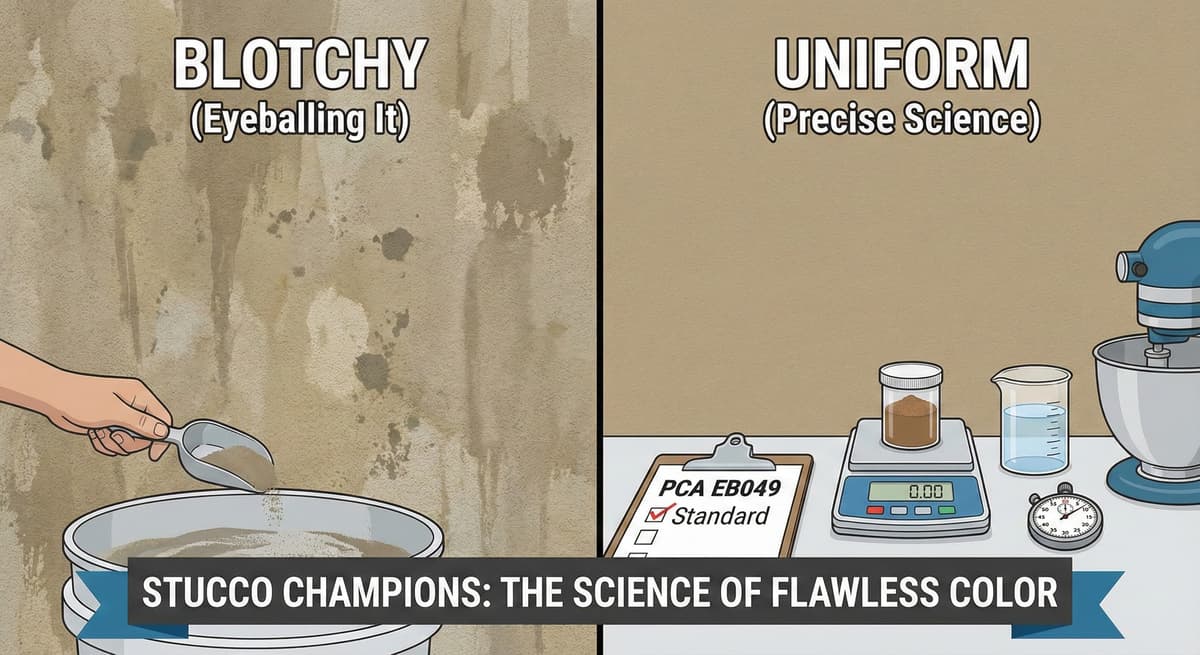
Nothing kills the curb appeal of a beautiful home faster than "blotchy" stucco. You have seen it before in your neighborhood: one wall looks slightly darker than the other, or weird streaks appear when the sun hits the texture just right.
Many homeowners assume this is just "how stucco looks" or bad luck with the weather. It is neither. Inconsistent color is almost always a failure of precision. It happens when contractors treat stucco like mixing mud rather than chemistry. At Stucco Champions, we follow the strict industry standards set by the Portland Cement Association (PCA Manual EB049) to ensure your home looks uniform, rich, and professionally finished.
Free Assessment
Noticing Stucco Damage?
Get a free on-site assessment from a licensed contractor. $0 deposit, no obligation.
GET FREE ASSESSMENT1. The "Scoop Count" Myth: Why Precision Matters
Color uniformity depends entirely on consistency. If one batch of stucco is mixed with slightly more water than the next, it will dry to a different shade—even if the pigment amount is identical.
This is why "counting scoops" of sand or pigment isn't good enough for a finish coat. Manufacturers and industry standards recommend pre-weighing sufficient coloring for individual plaster mixes to ensure absolute uniformity from batch to batch.
We don't guess. We use calibrated containers and strict measurements to ensure the mix that goes on the north wall matches the mix on the south wall.
2. The "Sandwich" Mixing Protocol
Most crews toss ingredients into the mixer in whatever order is fastest. This creates "hot spots" of pigment that streak across your wall. To get a perfectly uniform blend, we follow the accepted PCA procedure for every single batch:
- Water First: We add the majority of the mix water to the drum.
- Sand Base: We add exactly one-half of the sand.
- The Binder & Color: We add the cement and the pre-weighed color pigment.
- Sand Cap: The rest of the sand goes on top.
- The Timer: We add the final water to reach the right consistency and mix for exactly 3 to 5 minutes.
By "sandwiching" the pigment and cement between layers of sand, we force the mixer to disperse the color evenly, eliminating those ugly streaks.
3. The 10% Rule: Protecting Your Home's Structure
You might think adding more dye makes a color richer, but there is a dangerous limit. Industry specifications strictly limit mineral oxide pigments to no more than 10% by weight of the cement.
Exceeding these limits interferes with how the cement hardens (hydration). A contractor who adds too much dye to force a color match is actually weakening the structural integrity of your stucco. We never sacrifice your home's strength for a shortcut.
4. The "No Water" Rule
Once the finish coat is mixed, that is it. If a crew member tries to add water to a batch that is getting stiff (a process called "retempering"), they are destroying the color consistency. Retempering finish coat plaster is not permitted.
Furthermore, we never "dash" water onto the wall while troweling to make the work easier. Adding water to the surface changes the water-to-cement ratio and "bleaches" the color, leaving you with blotchy, uneven spots.
5. Troubleshooting: What We Watch For
We monitor the job site rigorously to prevent these common amateur errors:
| If you see this... | It was caused by... | The Solution |
|---|---|---|
| Blistering | The mix was too rich or the crew over-troweled it. | We adjust the mix and use proper finishing timing. |
| Spotty/Uneven Color | Someone sprayed water on the wall while finishing. | We control suction by dampening the base coat, never the finish. |
| Streaks | Pigment wasn't mixed thoroughly. | We follow the strict 3-5 minute mixing time and batching sequence. |
Conclusion: Chemistry over Guesswork
Achieving integral color is harder than painting. Once it is on the wall, you can't just "touch it up" without it showing. You need a contractor who respects the chemistry of the material. Stucco Champions is licensed, insured, and obsessed with the details that protect your home.
Related Resources
Last week, we shared How to Match Stucco Color and Texture. If you are trying to match an existing wall, read this guide.
Frequently Asked Questions About Stucco
How much does stucco repair cost in Orange County and Los Angeles?+
Stucco repair typically ranges from $500 for minor crack patching to $5,000+ for full re-stucco of a single elevation. The exact cost depends on the damage type (hairline cracks, water damage, delamination, weep screed failure), the square footage involved, and whether the original three-coat or one-coat stucco system needs to be matched. Stucco Champions provides fixed-price written estimates after a free on-site assessment — no hourly billing, no surprise change orders. See our stucco repair cost guide for detailed pricing by repair type.
How long does stucco last in Southern California?+
Properly installed three-coat stucco lasts 50-80+ years in Southern California's climate. The most common failure points aren't the stucco itself — they're the supporting components: corroded weep screed, deteriorated building paper behind the stucco, and improperly sealed window flashing. Most "stucco failures" are actually moisture-intrusion failures that start at one of these points. Annual visual inspection catches problems before they spread, which is why we offer free weep screed assessments for homeowners in our service area.
Can I repair stucco myself, or do I need a contractor?+
Hairline cracks under 1/8 inch wide can be sealed with elastomeric caulk by a homeowner. Anything larger — pattern cracks, delamination (where stucco pulls away from the wall), water-damaged areas, or chimney/window leak repairs — requires a licensed contractor. Improper DIY repair on these is the #1 cause of repeat failures because the underlying cause (usually moisture) isn't addressed. California's CSLB requires a license for any stucco work over $500. Looking for a highly-rated stucco contractor in Southern California? We are a CSLB-licensed and insured team ready to help.
How do I know if I need stucco repair vs. full re-stucco?+
If less than 30% of an elevation has visible damage, repair is the right call. If you see large areas of cracking, multiple zones of delamination, or the underlying paper and lath have rotted across an entire wall, full re-stucco of that elevation is more cost-effective long-term. Our free assessment includes a moisture survey and lath inspection so you get a defensible recommendation either way — not just a quote pushing whichever option costs more.
Do you offer warranties on stucco work?+
Yes. Stucco Champions provides a written 5-year workmanship warranty on all stucco repairs and a 10-year warranty on full re-stucco. We're a CSLB-licensed and insured contractor (license #1122006 — verifiable at cslb.ca.gov), which means our work is backed by California's contractor licensing board, not just our own promise. Request a free estimate to see the warranty terms in writing before you sign anything.
How long does a stucco repair take?+
Most patch repairs are completed in 1-2 days, including a 24-hour cure time before texture matching and color application. Full re-stucco of a single elevation runs 5-7 working days because each coat (scratch, brown, finish) needs to cure properly before the next is applied. We schedule around weather — California stucco needs daytime temperatures above 50°F with no rain forecast for at least 24 hours after each coat. Our crew shows up on time, every time.