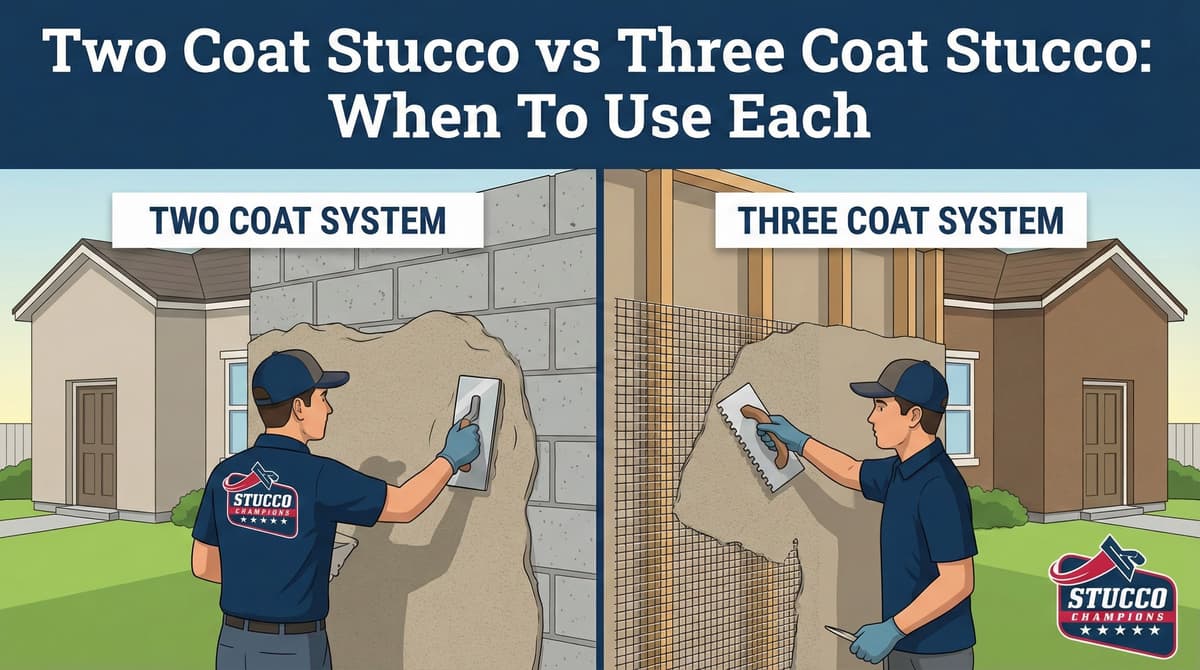
Two Coat Stucco vs Three Coat Stucco When To Use Each
Written by Stucco Champions — Southern California’s Authority on Exterior Plastering.
Two-Coat vs. Three-Coat Stucco: Selecting the Right System
In the world of plastering, contractors often throw around terms like "Two-Coat" and "Three-Coat" interchangeably. For a homeowner, this is confusing. Is one cheaper? Is one better? The answer depends entirely on what lies beneath the surface.
If you are stuccoing a wood-framed house, you need Three Coats. If you are surfacing a concrete block wall, you need Two Coats. This guide explains the engineering reasons why you cannot simply pick one over the other—the substrate dictates the system.
1. The Three-Coat System (For Wood Framing)
This is the standard for residential homes in California. Because wood walls are flexible and hollow, they require a thick, reinforced shell to stand up.
The Anatomy
- Lath: Metal wire reinforcement.
- 1. Scratch Coat: Embeds the wire.
- 2. Brown Coat: Levels the wall.
- 3. Finish Coat: Texture and color.
Why it’s required: The combined thickness (7/8") provides the necessary mass for fire resistance (1-hour rating) and impact strength over hollow studs.
Free Assessment
Noticing Stucco Damage?
Get a free on-site assessment from a licensed contractor. $0 deposit, no obligation.
GET FREE ASSESSMENT2. The Two-Coat System (For Masonry)
This system is used exclusively over Solid Masonry (Concrete Block, Tilt-Up, or Poured Concrete). Because the substrate is already solid and fire-resistant, you don't need the lath or the extra bulk of a scratch coat.
The Anatomy
- Bonding Agent: Liquid glue or dash coat.
- 1. Base Coat: Leveling layer (approx 3/8").
- 2. Finish Coat: Texture and color (approx 1/8").
Why it works: The cement bonds directly to the masonry. Since the wall doesn't flex like wood, a thinner (1/2" total) application is sufficient.
3. Field Test: Which One Do I Need?
Before you start, perform a simple check:
- Knock on the wall. Does it sound hollow? Use Three-Coat.
- Spray water on it. Does it absorb? Use Two-Coat. If it repels water (sealed concrete), you must sandblast first, then use Two-Coat.
- Is there paint? You must sandblast paint off masonry before using Two-Coat, or install metal lath and use Three-Coat.
4. Comparison Matrix
| Feature | Two-Coat System | Three-Coat System |
|---|---|---|
| Substrate | Solid Masonry / Concrete | Wood / Metal Framing |
| Thickness | Approx 1/2 Inch | Approx 7/8 Inch |
| Lath Required? | No (Direct Bond) | Yes (Wire Mesh) |
| Cost | Lower (Less material/labor) | Higher |
Conclusion: Don't Force It
You cannot apply a Two-Coat system over wood; it will crack and fall off. You can apply a Three-Coat system over masonry (if the masonry is painted/damaged), but it is overkill for clean block. Let the wall tell you what it needs.
Related Resources
Last week, we shared Scratch Coating Cinder Block Walls. This is the classic example of a Two-Coat application.