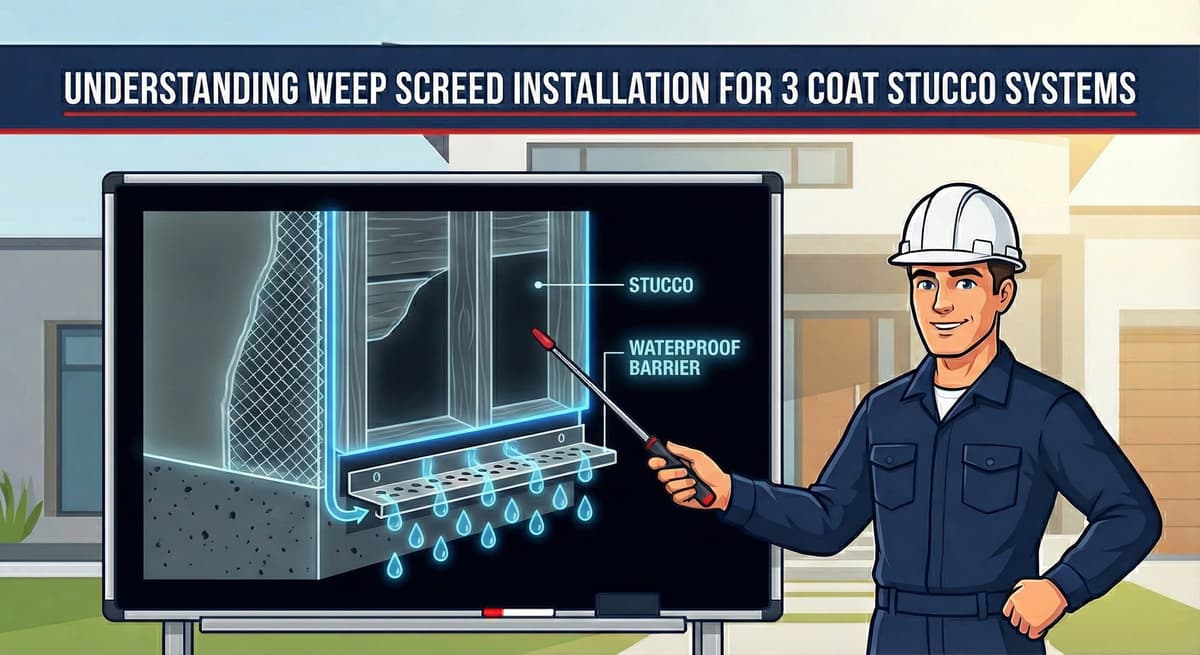
Understanding Weep Screed Installation for 3 Coat Stucco Systems
Written by Stucco Champions — Southern California’s Authority on Exterior Plastering.
Understanding Weep Screed Installation for 3-Coat Stucco Systems
In a traditional Three-Coat Stucco assembly, the weep screed is the first and most critical component installed. It sets the depth gauge for the entire wall (7/8") and serves as the primary exit door for moisture.
If this metal is installed crooked or the corners are cut incorrectly, the entire drainage plane fails. Water will bypass the screed and rot the mudsill plate. This guide explains the precise fabrication techniques required to create a watertight base for your home.
1. The Profile: Why #7 is Standard
For a 3-coat system, we use the #7 Foundation Weep Screed.
The Geometry: It has a 3.5-inch vertical nailing flange and a V-shaped bottom leg that projects 7/8" from the wall.
The Holes: Punched holes in the bottom leg allow water to escape.
The Function: It holds the heavy cement off the ground while allowing gravity to drain the wall cavity.
Free Assessment
Noticing Stucco Damage?
Get a free on-site assessment from a licensed contractor. $0 deposit, no obligation.
GET FREE ASSESSMENT2. Fabrication: Cutting Perfect Corners
The most common DIY mistake is butting two square-cut pieces together at a corner. This leaves a gap. You must miter the metal.
Outside Corners (The 45-Degree Fold)
- Measure: Mark the nailing flange 7/8" back from the end of the screed.
- The Cut: Using aviation snips, cut a 45-degree line from that mark away from the corner, down to the nose.
- The Nose: Snip the bottom drip edge vertically.
- Result: When joined with the adjacent piece, the flanges overlap flat against the framing, creating a sharp, closed 90-degree metal corner.
Inside Corners (The Reverse Lap)
- Measure: Mark 7/8" along the front nose of the screed.
- The Cut: Draw a 45-degree line back towards the flange. Cut along this line.
- Result: The noses meet tight in the corner, while the back flanges overlap on the wall surface.
3. The Installation Protocol
Weep screed must be level. If it waves, your stucco wall will wave.
- Placement: The bottom edge must be at least 1 inch below the sill plate (the connection between wood framing and concrete foundation). This ensures water drips onto concrete, not wood.
- Fastening: Use wide-crown staples or galvanized roofing nails. Place fasteners every 16 inches along the top edge of the flange.
- Clearance: Remember the code: 4 inches above earth, 2 inches above pavement.
⚠️ Splicing Joints
On long walls, you will join multiple 10-foot sticks. Never butt them.
Cut a small "V" notch in the nose of one piece and slide the next piece inside it by 2 inches. This telescoping joint keeps the screed straight and prevents water from leaking through the seam.
4. The "90-Degree" Bend
Sometimes you need to wrap a screed vertically (e.g., at a step in the foundation).
The Technique: Don't cut it all the way through. Snip the bottom V-leg only. This allows you to bend the flat nailing flange 90 degrees while keeping the metal continuous. This is far stronger than cutting and piecing it together.
Conclusion: The Foundation of the Finish
The weep screed dictates the quality of the entire stucco job. If it's straight and level, your plasterer has a perfect guide to work from. If it's loose or gapped, the finish will be wavy and the wall will leak. Take the time to cut, lap, and fasten it correctly.
Related Resources
Last week, we shared What Is Stucco Weep Screed & How Is It Used?. If you are unsure why you need this flashing, start there.