Stucco Finish Coats: Texture, Thickness & Application
Written by Stucco Champions — Southern California’s Authority on Exterior Plastering.
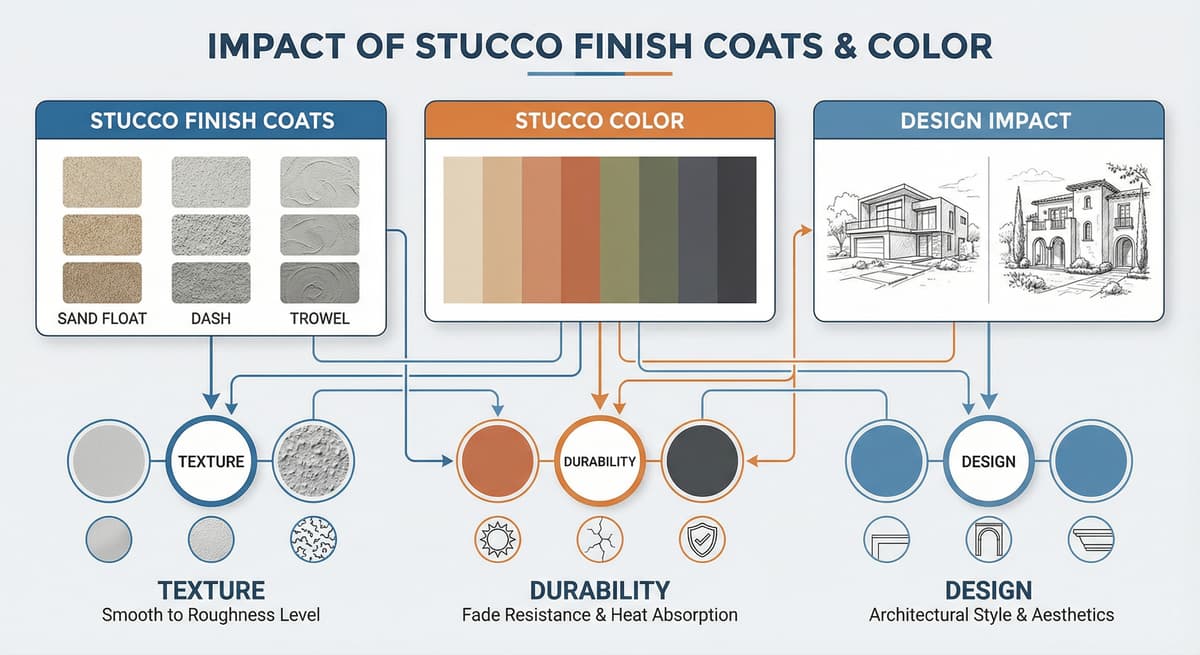
How Stucco Finish Coats and Stucco Color Impact Texture, Durability, and Design
The finish coat is the most visible layer of your home's exterior, yet it is also the thinnest. In a typical stucco assembly, the base coats provide the strength, but the finish coat (Color Coat) provides the water resistance and curb appeal. Getting this layer right requires a deep understanding of aggregate sizing and chemical composition.
At Stucco Champions, we don't just "spread mud." We engineer the finish thickness based on the specific material selected—Acrylic or Traditional—to ensure longevity in the Southern California climate. This guide breaks down the technical specifications of finish coat applications.
1. Understanding Stucco Thickness: The "Aggregate Rule"
A common misconception is that a thicker finish is better. This is false.
The Rule: The thickness of the finish coat is dictated by the size of the largest aggregate (sand/quartz) in the mix. You cannot trowel a finish thinner than its aggregate, or the tool will drag. You should not apply it thicker, or it will slump and crack.
According to ASTM C926 guidelines, finish coats typically range from 1/16" to 1/4", depending entirely on the texture selected.
Free Assessment
Noticing Stucco Damage?
Get a free on-site assessment from a licensed contractor. $0 deposit, no obligation.
GET FREE ASSESSMENT2. Acrylic Finish Coats (Synthetic)
Acrylic finishes are sold wet in buckets. They use crushed quartz aggregate rather than silica sand. Because they cure by evaporation (drying) rather than hydration, they are applied very thin.
| Texture Grade | Aggregate Size | Applied Thickness |
|---|---|---|
| Super Fine | 0.5 mm | 1/32" – 1/16" |
| Fine / Sand | 1.0 mm | 1/16" |
| Medium | 1.5 mm | 1/16" – 1/8" |
| Coarse / Swirl | 3.0 mm | 1/8" |
Because acrylics are factory-mixed, the viscosity is fixed. The plasterer cannot "water it down" to stretch coverage without ruining the chemical bond. The thickness is pre-determined by the bucket you buy.
3. Traditional Finish Coats (Cement-Based)
Traditional stucco is sold in dry bags and mixed on-site. It offers more flexibility in thickness but requires more skill to control.
- Fine Finishes (20/30 Sand): Applied approx 1/16" to 1/8" thick. Used for Santa Barbara Smooth finishes.
- Medium/Lace (16/20 Sand): Applied up to 3/16" thick. The extra bulk allows the plasterer to create "knockdown" textures.
- Coarse/Dash (16 Mesh): Can be built up to 1/4" or 5/16" using a sprayer.
Thicker is NOT better for cement. If a traditional finish coat is applied too thick (over 1/4"), the surface tension during curing will cause "Crazing" or spiderweb cracking. High lime content in the mix exacerbates this if the coat is heavy.
4. Pros and Cons of Thickness
Thick Coats (Rough Texture):
Pros: Excellent at hiding imperfections in the base coat (waviness).
Cons: Prone to shrinkage cracks; harder to clean due to deep crevices.
Thin Coats (Smooth/Fine):
Pros: Very durable and dense; easy to wash.
Cons: Unforgiving. Every flaw in the brown coat underneath will "telegraph" through. Requires expensive prep work to flatten the wall first.
5. Single vs. Double Pass Application
For premium finishes, we often use a "Double-Back" technique.
1. First Pass: A tight coat to cover the grey base and seal the wall.
2. Second Pass: Immediately applied to create the texture.
This ensures consistent color coverage and waterproofing without overloading the wall with one heavy, sagging layer.
Conclusion: Engineering the Aesthetic
The beauty of a stucco wall comes from the precision of the application. By matching the trowel pressure and material thickness to the specific aggregate size, Stucco Champions delivers a finish that is both visually stunning and structurally sound.
Related ResourcesLast week, we shared Understanding the Thickness of Stucco Color/Finish Coat. Dive deeper into the measurement specifics.