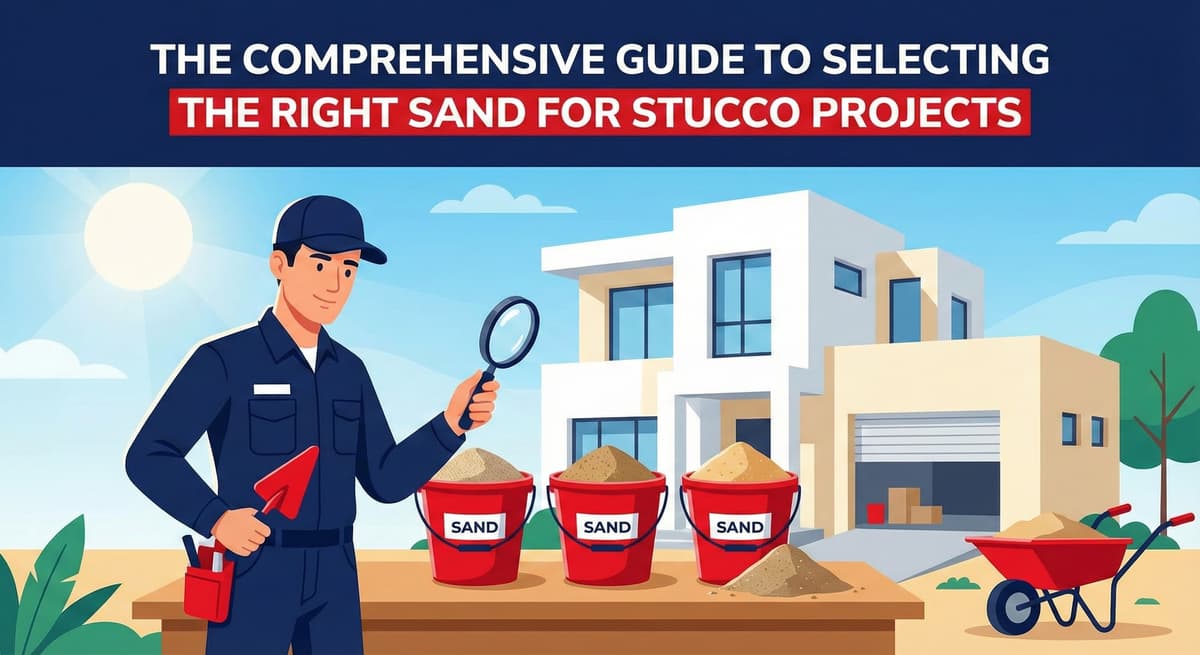
Selecting the Right Sand for Stucco Projects - A Comprehensive Guide
Written by Stucco Champions — Southern California’s Authority on Exterior Plastering.
The Gritty Truth: A Professional’s Guide to Selecting Stucco Sand
Sand is not just a filler; it makes up roughly 70% of the volume of your stucco wall. While contractors often obsess over the brand of cement (Omega vs. LaHabra), they frequently buy whatever sand is cheapest at the local yard.
This is a critical mistake. The wrong sand—specifically sand that is too fine or dirty—is the primary cause of excessive shrinkage, spiderweb cracking, and weak bonding. This guide breaks down the ASTM standards and why "dirt" is the enemy of durability.
1. The Standard: ASTM C897 vs. ASTM C144
If you check the building code (IBC/IRC), stucco aggregate is governed by ASTM C897. However, most material yards primarily stock ASTM C144 (Masonry Mortar Sand).
ASTM C897 (Plaster Sand)
This is coarser. It contains larger particles that create a strong, interlocking internal structure. Because the grains are bigger, they require less water to mix.
Result: Less water = Less evaporation = Less shrinkage cracking.
ASTM C144 (Mason Sand)
This is finer. It is designed for laying brick and block. The smaller particles have a higher surface area, demanding more water to make the mix workable.
Result: More water = More evaporation = Higher risk of crazing/cracking.
The Pro Rule: Always request Washed Plaster Sand for your Scratch and Brown coats. Using Mason sand for base coats is technically "acceptable" by some local codes, but it significantly increases your failure risk.
Free Assessment
Noticing Stucco Damage?
Get a free on-site assessment from a licensed contractor. $0 deposit, no obligation.
GET FREE ASSESSMENT2. The Three Grades of Sand
Not all piles at the supply yard are created equal.
A. Washed Plaster Sand (The Gold Standard)
Characteristics: Angular, jagged edges, and a mix of particle sizes (coarse to fine).
Why it works: The "angular" shape allows grains to lock together like puzzle pieces, providing high compressive strength. The "washed" designation means silt and clay have been removed.
Best Use: Scratch and Brown coats.
B. Masonry Sand (The "Smooth" Alternative)
Characteristics: Finer, often rounder grains.
The Trade-off: It creates a creamy mix that is easy to trowel, making it popular with plasterers who want an easy day. However, it lacks the structural "bite" of plaster sand.
Best Use: Finish coats (where tight texture is needed) or brick pointing.
C. Silica Sand (The High-End Option)
Characteristics: Manufactured, pure quartz sand. It is perfectly consistent, free of iron (no rust spots), and extremely hard.
Best Use: Acrylic finish coats and high-end "smooth" finishes (Santa Barbara). It is too expensive for base coats.
⚠️ The Forbidden Sand: Play Sand
Never use bagged "Play Sand" from a hardware store for stucco. It is composed of round, polished grains (like beach sand). Round grains roll over each other rather than locking together, resulting in zero structural integrity.
3. The "Washed" Factor: Why Clay Kills Adhesion
You must ensure your sand is "Washed." Unwashed sand (often called "bank run" or "pit sand") contains Clay and Silt.
The Physics: Clay coats the sand particles in a fine dust. This dust prevents the cement paste from actually bonding to the stone. It acts like a layer of flour on a piece of tape—the adhesive simply won't stick.
The Field Test: Grab a handful of moist sand and squeeze it tight. If it leaves a heavy, slimy residue on your palm or stains your skin significantly, it has too much clay. Good plaster sand should leave your hand relatively clean.
4. Summary: Matching Sand to the Coat
- Scratch Coat: Needs maximum strength and "keying" ability. Use ASTM C897 (Coarse).
- Brown Coat: Needs to be flat and strong. Use ASTM C897 (Coarse/Medium). Too much fine sand here causes check cracking.
- Finish Coat: Needs to be workable for texturing. Use ASTM C144 (Mason/Silica). Fine sand allows for detailed "float" or "smooth" finishes.
Conclusion: Grit is Good
If you see a pile of sand delivered that looks like fine powder or beach sand, send it back. For a durable, crack-resistant stucco wall, you need Washed Plaster Sand that feels gritty and jagged in your hand. The structural integrity of your home depends on it.
Related Resources
Last week, we shared Guide to Stucco Textures and Finishes. The sand you choose determines the texture you get.