Perfect Stucco Fog Coat Match: Avoid Costly Mistakes

Written by Stucco Champions — Southern California’s Authority on Exterior Plastering.
Matching Stucco Fog Coat: Why "Touch-Ups" Often Fail
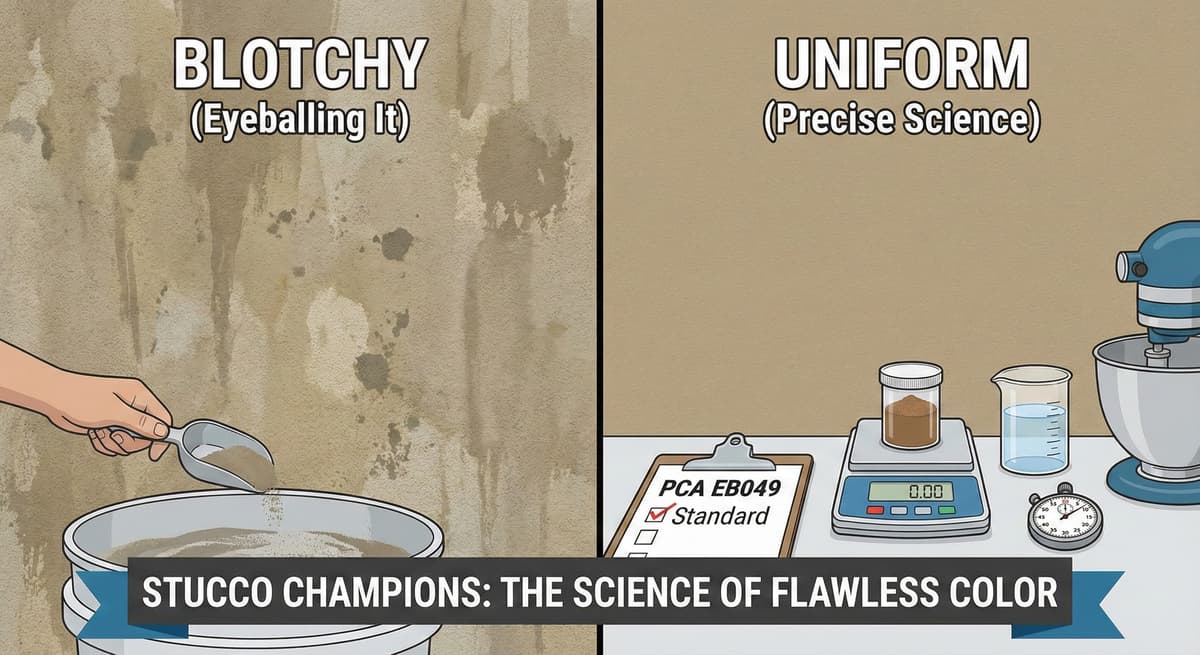
Fog coating is the industry standard for refreshing traditional stucco. It is a cement-based stain that absorbs into the porous wall, restoring color without sealing the surface like paint. However, homeowners often treat fog coat like a bottle of touch-up paint for a car. They apply it to a small spot and are shocked when it dries as a visible, dark blotch.
Matching an existing fog coat—especially if the original manufacturer (like BMI) is defunct or the wall has faded—is chemically complex. This guide explains the science of color matching and why the "Corner-to-Corner" rule is essential for a flawless finish.
1. The Chemistry of the Mismatch
Why is it so hard to match an old wall?
Oxidation & Fading: Even high-quality iron oxide pigments fade under the Southern California sun. A bag of "Mission Beige" bought today will be vibrant; the "Mission Beige" on your wall from 2010 is bleached.
Porosity Differences: New fog coat absorbs differently into a patch (new cement) than it does into an aged wall (old cement). This difference in absorption creates a "halo" effect around the repair.
Free Assessment
Noticing Stucco Damage?
Get a free on-site assessment from a licensed contractor. 0 deposit, no money upfront, progress payments only.
GET FREE ASSESSMENT2. The Matching Protocol: Custom vs. Off-the-Shelf
If you buy a standard bag from Home Depot, it will not match. Professional matching requires a lab.
Step A: The Harvest
We chisel a 2-inch sample of stucco from a discreet area (usually behind an AC unit or near the weep screed). This sample represents the current faded color of the home.
Step B: Lab Analysis
We take this sample to a major supplier like LaHabra or Omega. Their labs break down the pigment load and create a custom dry-mix formula to match the aged state of your wall.
Note: This process typically takes 3-5 business days.
3. The "Corner-to-Corner" Rule
Even with a custom lab match, a "spot touch-up" is risky. The human eye is incredibly good at detecting slight variations in texture and sheen in the middle of a flat wall.
The Professional StandardDo not stop in the middle of a wall.
We apply fog coat from one architectural break to another (e.g., from a corner to a window, or from a downspout to a door). By ending the application at a natural line, any microscopic color difference becomes invisible to the eye.
4. Application Technique: The Mist
Fog coat is not painted on; it is misted.
The Tool: We use a pneumatic sprayer or a high-quality garden sprayer.
The Method: Apply in light, overlapping passes. If you flood the wall, the cement will run and streak. The goal is to "stain" the stucco, not coat it like a thick paint.
5. When a Perfect Match is Impossible
Sometimes, a wall is too stained or mottled for a spot repair to work.
The Solution: Fog the entire elevation.
Fog coating is inexpensive compared to painting or re-stuccoing. If the touch-up area is large, it is often more cost-effective to quickly spray the whole wall, guaranteeing a 100% uniform finish that looks brand new.
Conclusion: Blend, Don't Blob
Fog coat is a forgiving material if used correctly, but it is unforgiving if you treat it like paint. Don't try to dab it on a dime-sized spot. Blend it out, use natural break lines, and always rely on a custom lab match rather than a color chart.
Related ResourcesLast week, we shared Understanding Stucco Fog Coating: A Comprehensive Guide. If you are new to this material, start here to understand the basics.