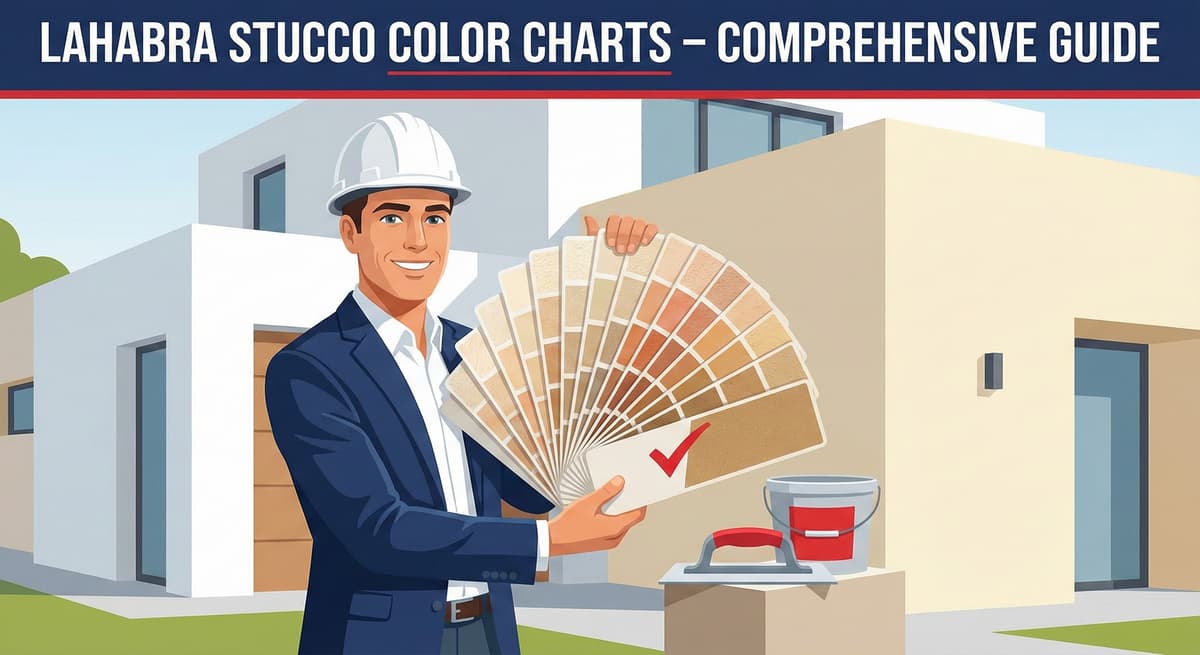
LaHabra Stucco Color Charts – Comprehensive Guide
Written by Stucco Champions — Southern California’s Authority on Exterior Plastering.
LaHabra Stucco Color Charts: A Comprehensive Technical Guide
In Southern California, LaHabra Stucco is synonymous with "The Stucco Look." Founded in Anaheim in 1926, they essentially invented the colored finish coat industry. However, navigating their color system can be confusing because not all colors are available in all materials.
If you pick a color from the "Standard" chart but want an Acrylic Finish, or choose a "Platinum" color for a traditional cement wall, you may be setting yourself up for a mismatch. This guide breaks down the specific collections and the chemistry behind them.
1. The "Standard" vs. "Lifestyle" Colors
LaHabra separates their palette based on pigment stability and cost.
Free Assessment
Noticing Stucco Damage?
Get a free on-site assessment from a licensed contractor. $0 deposit, no obligation.
GET FREE ASSESSMENTStandard Colors (The Basics)
These are the 30 most popular earth tones (e.g., "Mesa Tan," "Fallbrook," "Silverado").
Chemistry: These use basic Iron Oxide pigments. They are UV stable, cost-effective, and readily available in pre-mixed bags at most supply yards.
Best For: Traditional cement finishes where you want a classic, mottled Spanish look.
Lifestyle Colors (The Premium)
These are richer, deeper tones (e.g., "Basalt," "Midnight," "Trabuco").
Chemistry: These require higher pigment loads or specialized synthetic pigments.
Warning: Many of these darker colors are NOT recommended for traditional cement finishes because they will fade or show efflorescence (white salt stains). They are best suited for Acrylic Finishes which encapsulate the pigment.
2. LRV: The Most Important Number
Every color on the LaHabra chart has a number next to it called LRV (Light Reflectance Value). This measures how much heat the color absorbs.
Scale: 0 (Black) to 100 (White).
The Risk: If you choose a color with an LRV below 20 (very dark), the wall will absorb massive heat in the SoCal sun. This causes thermal expansion cracking. If choosing a low LRV color, you must use an Acrylic finish with fiber-mesh reinforcement.
3. Cement vs. Acrylic: Which Chart to Use?
Not all colors work in all buckets.
- Cement Finish (Dry Bag): Stick to the "Standard" chart. These are earthen pigments designed to mix with lime and sand. They will mottle naturally.
- Acrylic Finish (Wet Bucket): You can use the "Parex USA Color Collection." Because acrylic is synthetic, it can achieve vibrant reds, blues, and greens that cement cannot holding.
⚠️ The Digital Warning
Do not pick a color from your phone screen. Monitors are backlit; stucco is reflective. A color that looks "warm beige" on an iPhone may look "pink" on a wall in the sun.
The Solution: Always buy a physical "Wet Sample" or a small bag to test on a 2'x2' area of your actual wall. Let it cure for 48 hours before judging.
4. Platinum Plus: The "Crack Resistant" Option
LaHabra offers a premium line called Platinum Plus.
The Difference: It contains higher polymer content than standard cement. It is designed to bridge hairline cracks while maintaining the breathability of traditional stucco. It has its own specific color chart, though most Standard colors can be formulated for it.
Conclusion: Match Material to Color
Don't just pick a swatch; pick a system. If you love the deep "Dark Walnut" color, you are committing to an Acrylic system. If you love the soft, cloudy look of "Mission Mission," you are choosing Traditional Cement. At Stucco Champions, we ensure the material specifications match your aesthetic goals.
Related Resources
Last week, we shared Does Stucco Come in Different Colors? If you are new to integral color, start here.