10 Minute vs 60 Minute Stucco Paper: What Homeowners Should Know
Written by Stucco Champions — Southern California’s Authority on Exterior Plastering.
Understanding 10-Minute vs. 60-Minute Stucco Paper: What Homeowners Should Know
When investing in a stucco system, most homeowners focus on the final finish—whether it’s smooth, sand, or dash. But what truly determines how long your stucco holds up isn’t just how it looks; it’s what lies underneath. One of the most overlooked but essential components is the stucco paper, also technically known as the Weather-Resistive Barrier (WRB).
If you have heard your contractor mention "10-minute" or "60-minute" paper and you are unsure what that means, this guide breaks down the physics of waterproofing your home against the Southern California climate.
1. What Is Stucco Paper (Grade D)?
Stucco paper is a moisture-resistant, asphalt-impregnated kraft paper that sits between your home’s exterior sheathing (usually plywood or OSB) and the stucco layers. Its primary role is to:
- Block Water: Repel external moisture like rain, humidity, or sprinklers.
- Breathe: Allow interior moisture or vapor to escape through the walls (permeability).
- Drain: Act as a drainage plane to direct water down to the weep screed.
Free Assessment
Noticing Stucco Damage?
Get a free on-site assessment from a licensed contractor. $0 deposit, no obligation.
GET FREE ASSESSMENT2. The "Minute" Rating: ASTM D779
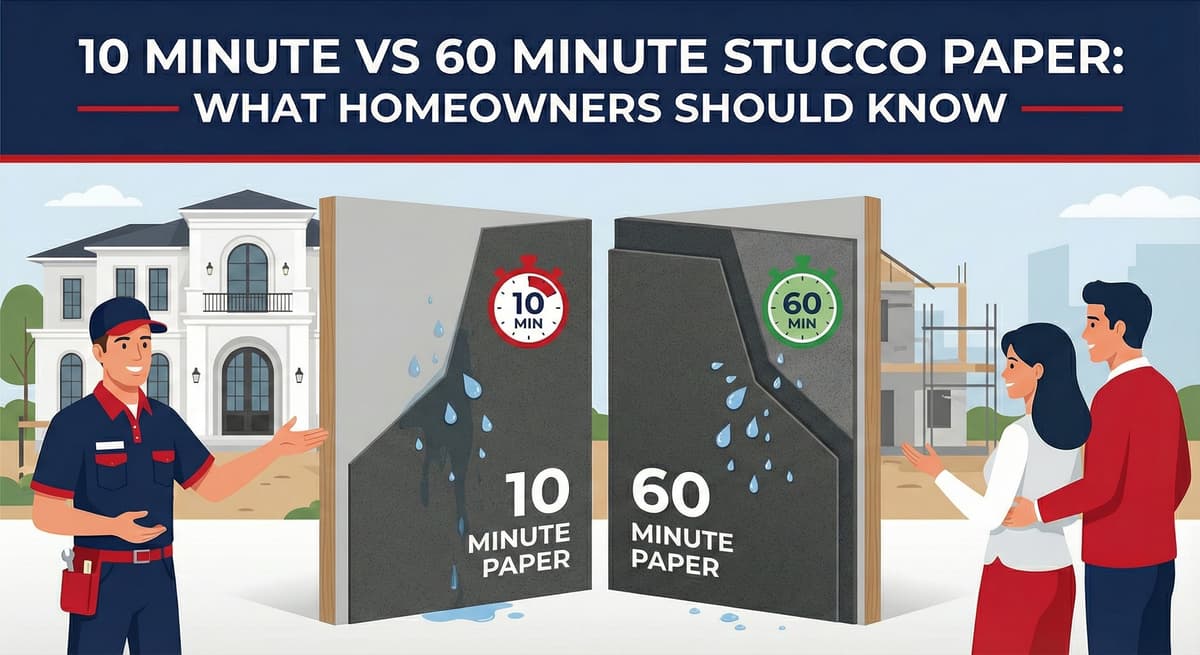
The "minute" rating does not refer to installation time. It refers to the ASTM D779 Standard Test Method (often called the "Boat Test"). It measures how long the paper can float on water before moisture penetrates through to the other side.
| Paper Type | Performance | Best Use Case |
|---|---|---|
| 10-Minute Grade D | Resists water for 10 minutes in lab tests. Thin and prone to tearing. | Temporary structures, sheds, or budget-constrained tract homes. |
| 60-Minute (Super Jumbo Tex) | Resists water for 60+ minutes. Heavy-duty, tear-resistant. | Custom homes, coastal properties, and high-quality residential builds. |
3. Why We Use 60-Minute Paper
At Stucco Champions, we prioritize longevity. That’s why we default to 60-Minute "Super Jumbo Tex" paper on our projects. Here is why the upgrade matters:
- Lathing Durability: During the installation of wire mesh (lath), thousands of staples are driven through the paper. 10-minute paper is thin and tears easily, creating leaks. 60-minute paper is robust and seals around the fastener.
- The "Reservoir" Effect: Stucco holds water. During a long rainstorm, the wet cement presses against the paper for hours. 10-minute paper can become saturated, transferring moisture to the wood framing. 60-minute paper holds the line.
4. The Two-Layer Rule: The "Bond Breaker"
Using the right paper is step one. Using the right amount is step two.
California code typically requires two layers of paper over plywood sheathing.
Layer 1 (Outer): Bonds to the wet stucco. It becomes a sacrificial layer.
Layer 2 (Inner): Remains separate from the stucco. This creates a "Bond Breaker" or air gap. Water that penetrates the first layer runs down this gap to the weep screed, keeping the wood dry.
5. Paper vs. Housewrap (Tyvek)
Can you just use Tyvek? Not by itself.
Stucco bonds to standard housewraps. If you use Tyvek, you must install a layer of Grade D paper over it to create the necessary bond break. We often use a "Hybrid System" of Tyvek (for air sealing) plus 60-Minute Paper (for drainage) on high-end projects.
Conclusion: It’s All in the Prep
The success of your stucco isn’t just about the finish coat. Long-term performance depends on the hidden layers. By using double-ply 60-minute paper, Stucco Champions ensures your home’s envelope is protected against rot, mold, and moisture for decades to come.
Related ResourcesLast week, we shared Weather-Resistant Building Paper Guide. Dive deeper into the installation protocols.