
Written by Stucco Champions — Southern California’s Authority on Exterior Plastering.
The Two-Layer Paper Method: How We Waterproof Your Home
There is an old saying in the lathing trade: "The paper is the house; the stucco is just the coat." Stucco is a porous material. It absorbs water like a sponge during a heavy rainstorm. The only thing standing between that wet cement and your dry wood framing is the Water-Resistive Barrier (WRB).
While building codes in some regions allow for a single layer of housewrap, California code (and common sense) dictates the use of the Two-Layer Grade D Paper System. This guide explains the physics behind why two layers are exponentially better than one.
1. The "Bond Breaker" Principle
Why do we need two layers?
When wet stucco is troweled onto a wall, it bonds aggressively to whatever it touches. If you only have one layer of paper, the stucco will fuse to it.
The Problem: Once fused, there is no space for water to drain. If the stucco cracks (and it will), water wicks through the crack, soaks the single paper layer, and rots the plywood.
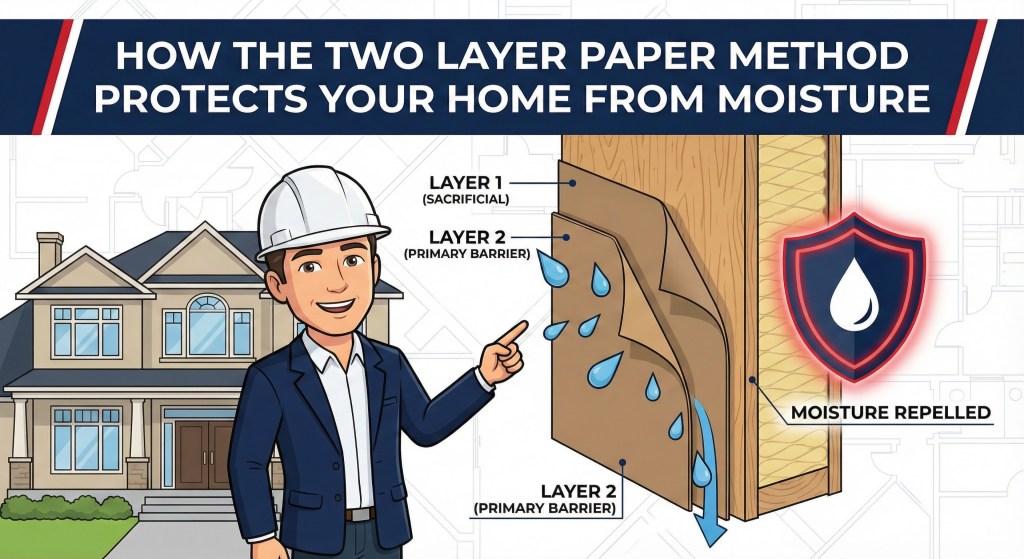
Layer 1 (Outer): This is the "Sacrificial Layer." It bonds to the wet stucco and becomes part of the cladding.
Layer 2 (Inner): This is the "Barrier Layer." It remains separate from the outer layer, creating a tiny air gap known as a Drainage Plane. Water that penetrates the stucco hits this second layer and runs down to the weep screed, never touching your wood.
2. Grade D Paper vs. Housewrap (Tyvek)
We specifically use Grade D Building Paper (Super Jumbo Tex) rather than plastic housewraps.
- Permeability: Grade D paper allows the wall to breathe. If moisture gets into the wall cavity from the inside (steam, cooking), the paper allows it to escape outward. Plastic wraps can trap this moisture, causing mold.
- Durability: Asphalt-impregnated paper swells slightly when wet, sealing around the thousands of staples used to attach the lath.
3. Integration with Flashings
The paper system is useless if it isn't integrated with the metal flashings. We follow the "Shingle Lap" rule:
- Bottom Up: Paper is installed starting at the foundation.
- The Overlap: Each upper sheet overlaps the lower sheet by a minimum of 2 inches.
- The Weep Screed: The bottom layer of paper must overlap the metal flange of the weep screed. This directs water out of the wall, not behind it.
The most critical junction is the window. We ensure the paper is tucked under the window flashing at the top (head) and over the flashing at the bottom (sill). This directs roof runoff away from the window opening.
4. Our Standard: Super Jumbo Tex
We don't use generic "rag felt." We use 60-Minute Grade D Paper (often called Super Jumbo Tex).
Why 60-Minute? The "minute" rating refers to how long the paper can hold back standing water in a lab test. Standard code is 10-minute paper. We use 60-minute paper because it is thicker, tougher, and provides a 600% safety margin over the minimum code requirement.
Conclusion: Cheap Insurance
The cost difference between a single layer of cheap paper and a double layer of 60-minute paper is negligible in the scope of a project, but the performance difference is massive. At Stucco Champions, we view the Two-Layer System as non-negotiable insurance for your home.
Last week, we shared Grade D Building Paper for Stucco. Dive deeper into the code requirements.