Architectural Stucco Quoin Designs: From Gibbs to Rusticated
Written by Stucco Champions — Southern California’s Authority on Exterior Plastering.
Architectural Stucco Quoin Designs: From Gibbs to Rusticated
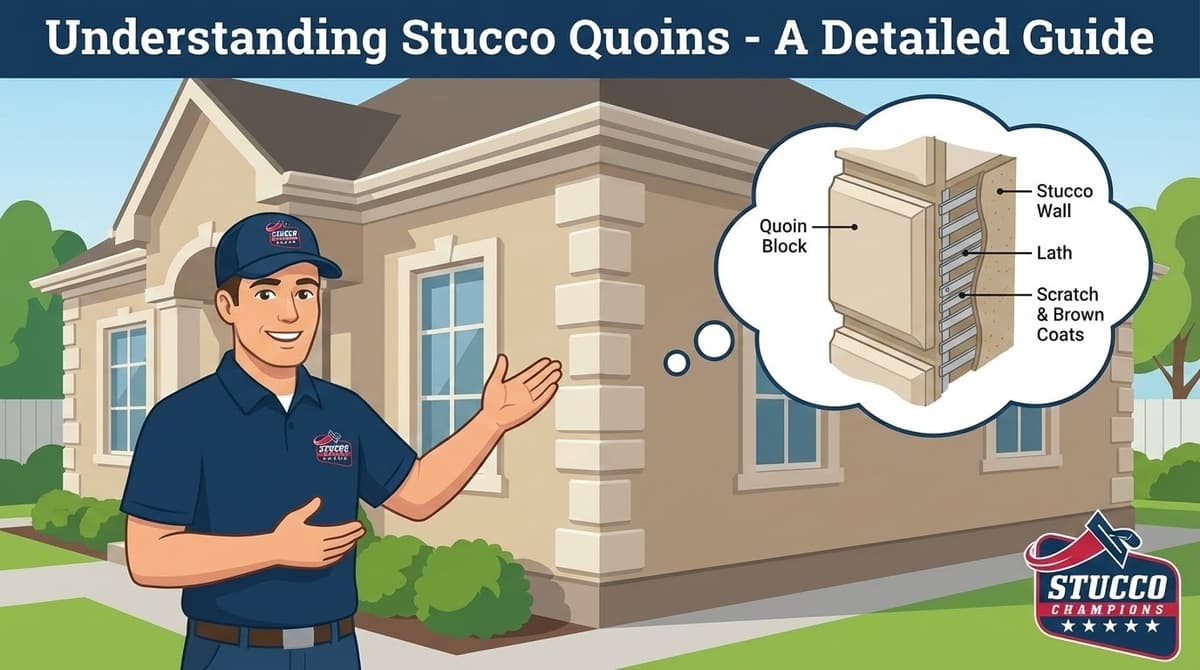
While the structural engineering of modern EPS foam quoins ensures longevity, the true value of quoins lies in their aesthetic impact. Originally utilized as load-bearing cornerstones in traditional masonry, quoins are now the premier architectural detail for framing an elevation and establishing a home's specific historical style.
Selecting the correct layout, profile, and texture for your quoins is critical. Installing an Art Deco quoin on a French Country estate creates immediate architectural dissonance. This guide details the primary design options available for modern stucco exteriors.
Free Assessment
Noticing Stucco Damage?
Get a free on-site assessment from a licensed contractor. $0 deposit, no obligation.
GET FREE ASSESSMENT1. Layout Configurations
The pattern in which the blocks are arranged is the most defining characteristic of the quoin system.
The Gibbs Surround (Staggered)
Named after the influential 18th-century British architect James Gibbs, this is the classic "alternating" pattern. The blocks alternate between a long block wrapping the corner and a short block abutting it.
- Architectural Pairing: Mandatory for Georgian, Colonial, French Country, and traditional English Manor aesthetics.
- Visual Effect: It breaks up the vertical line of the house, creating a jagged, "toothed" edge that feels anchored and historic.
The Stacked Column (Uniform)
In this configuration, every block is identical in size and perfectly stacked vertically, resembling an engineered pillar at the corner of the home.
- Architectural Pairing: Ideal for Mediterranean, Art Deco, and Modern Transitional styles.
- Visual Effect: It creates a formal, rigid vertical line that emphasizes height and geometric precision.
2. Edge Profiles
Because modern quoins are laser-cut from high-density EPS foam, the edge profiles can be milled to exact specifications before the cement base coat is applied.
- Square Edge: The block has a sharp 90-degree corner. This creates a bold, blocky appearance, often used in commercial applications or severe modern designs.
- Chamfered Edge (Beveled): The edges of the block are cut at a 45-degree angle. This is the industry standard for high-end residential work. The bevel creates a distinct "V-groove" shadow line between each block, deeply emphasizing the separation and making the foam look like massive, individual blocks of cut limestone.
- Radiused Edge (Bullnose): The edges are rounded. This softens the appearance and is occasionally used in specific Southwestern or Adobe-style architecture.
3. Texture and Finish Contrasts
A quoin should not visually disappear into the wall; it must contrast with the primary field stucco to be effective.
We typically utilize two methods to ensure the quoins stand out:
- Color Contrast: Painting or fog-coating the quoins a few shades lighter or darker than the main wall. White quoins on a grey wall provide a crisp, formal frame.
- Textural Contrast (Rustication): If the main house has a heavy Spanish Lace texture, we often apply a "Santa Barbara Smooth" finish to the quoins to mimic cut limestone. Conversely, if the house is smooth, applying a heavy, rough "Rusticated" texture to the quoins gives them the appearance of raw, unpolished stone.
Conclusion
Stucco quoins are architectural jewelry. By carefully selecting between a staggered Gibbs layout or a formal stacked column, and pairing it with the correct chamfered edge and textural contrast, you can fundamentally elevate the curb appeal and historical accuracy of your home.
A note on fog coat: Stucco Champions does not fog coat older or previously repaired walls. On aged stucco a fog coat telegraphs existing cracks, patch lines, and prior repairs, and it bonds poorly to a rough, chalky, or previously coated surface, so it can dust off or peel. Those walls get a fresh finish coat (re-stucco) instead.
Frequently Asked Questions About Stucco
How much does stucco repair cost in Orange County and Los Angeles?+
Stucco repair typically ranges from $500 for minor crack patching to $5,000+ for full re-stucco of a single elevation. The exact cost depends on the damage type (hairline cracks, water damage, delamination, weep screed failure), the square footage involved, and whether the original three-coat or one-coat stucco system needs to be matched. Stucco Champions provides fixed-price written estimates after a free on-site assessment — no hourly billing, no surprise change orders. See our stucco repair cost guide for detailed pricing by repair type.
How long does stucco last in Southern California?+
Properly installed three-coat stucco lasts 50-80+ years in Southern California's climate. The most common failure points aren't the stucco itself — they're the supporting components: corroded weep screed, deteriorated building paper behind the stucco, and improperly sealed window flashing. Most "stucco failures" are actually moisture-intrusion failures that start at one of these points. Annual visual inspection catches problems before they spread, which is why we offer free weep screed assessments for homeowners in our service area.
Can I repair stucco myself, or do I need a contractor?+
Hairline cracks under 1/8 inch wide can be sealed with elastomeric caulk by a homeowner. Anything larger — pattern cracks, delamination (where stucco pulls away from the wall), water-damaged areas, or chimney/window leak repairs — requires a licensed contractor. Improper DIY repair on these is the #1 cause of repeat failures because the underlying cause (usually moisture) isn't addressed. California's CSLB requires a license for any stucco work over $500. Looking for a highly-rated stucco contractor in Southern California? We are a CSLB-licensed and insured team ready to help.
How do I know if I need stucco repair vs. full re-stucco?+
If less than 30% of an elevation has visible damage, repair is the right call. If you see large areas of cracking, multiple zones of delamination, or the underlying paper and lath have rotted across an entire wall, full re-stucco of that elevation is more cost-effective long-term. Our free assessment includes a moisture survey and lath inspection so you get a defensible recommendation either way — not just a quote pushing whichever option costs more.
Do you offer warranties on stucco work?+
Approved stucco repair work includes a 1-year written workmanship warranty. The applicable terms are documented with the approved scope. Stucco Champions is CSLB licensed and insured; verify license #1122006 through the official state lookup. Request a free estimate to review the scope and warranty terms before you sign.
How long does a stucco repair take?+
Most patch repairs are completed in 1-2 days, including a 24-hour cure time before texture matching and color application. Full re-stucco of a single elevation runs 5-7 working days because each coat (scratch, brown, finish) needs to cure properly before the next is applied. We schedule around weather — California stucco needs daytime temperatures above 50°F with no rain forecast for at least 24 hours after each coat. Our crew shows up on time, every time.
Stucco Diagnostics & Calculators
Diagnose specific wall damage symptoms or estimate job scope with our free guides and calculators.
Related Professional Services
A licensed assessment identifies the cause before the finish is opened or replaced.