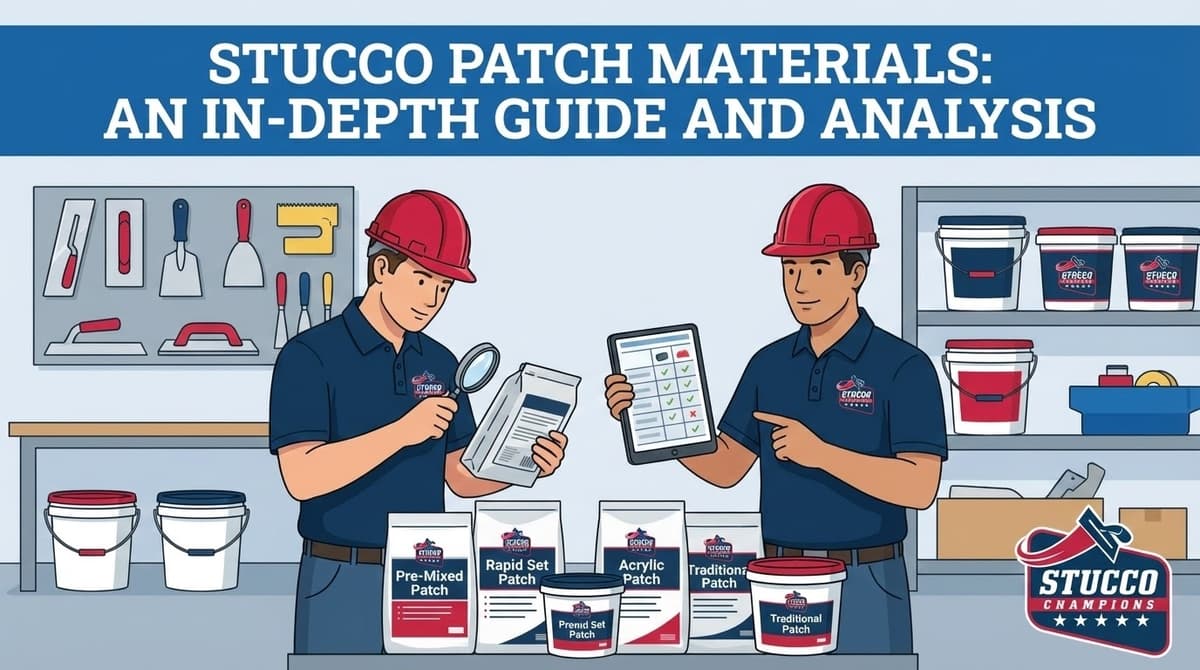
Stucco Patch Materials: An In-Depth Guide and Analysis
Written by Stucco Champions — Southern California’s Authority on Exterior Plastering.
Stucco Patch Materials: An In-Depth Analysis of What Actually Works
Walk down the aisle of any big-box hardware store, and you will see a dozen different tubs, bags, and boxes labeled "Stucco Patch." For a homeowner, this is confusing. For a professional, the difference between these products is the difference between a permanent repair and a patch that pops out in six months.
Not all patch materials are created equal. Some are essentially "exterior spackle," while others are hydraulic cements engineered for structural load. This guide breaks down the chemistry of the most common materials and when to use them.
1. The "Tub" Products (Acrylic Premix)
Common Brands: DAP Phenopatch, Sika Ready-Mix.
Composition: Acrylic polymers and sand (no cement).
Best For: Minor cosmetic flaws, nail holes, and hairline cracks under 1/16".
⚠️ The Limitation
Do not use "Tub Patch" for deep holes or structural cracks. Because it dries by evaporation (not chemical hydration), applying it too thick causes it to shrink and crack. It also lacks the compressive strength of real cement, making it a poor choice for large areas.
Free Assessment
Noticing Stucco Damage?
Get a free on-site assessment from a licensed contractor. $0 deposit, no obligation.
GET FREE ASSESSMENT2. Rapid-Set Cements (The Fast Fix)
Common Brands: Rapid Set Stucco Patch, Eisenwall.
Composition: Hydraulic cement that sets in 20-30 minutes.
Best For: Deep structural repairs where time is money.
Pros: Extremely hard, bonds well, and allows you to paint the same day.
Cons: It sets fast. If you are inexperienced, the material will harden on your tools before you finish smoothing it. It also tends to dry a lighter color than standard grey cement.
3. The "Finish" Bags (Color Match)
Common Brands: LaHabra Color Patch, Omega ColorTek.
Composition: Portland cement, lime, and pigment.
Best For: The final 1/8" layer (The "Beauty Coat").
The Strategy: Use these products only for the top layer to match the texture and color of your home. Do not use expensive color patch material to fill a deep hole; it will sag and crack.
4. Fiber-Reinforced Base Coats (The Workhorse)
Common Brands: Quikrete Fiberglass Reinforced Stucco, Omega One-Coat.
Composition: Portland cement mixed with chopped fiberglass strands.
Best For: Large patches (over 1 sq. ft.), window infills, and fixing water damage.
Why We Use It: The fiberglass fibers act like millions of tiny rebar rods, holding the patch together and preventing seismic cracking.
5. The Vital Step: Bonding Agents
Regardless of which material you choose, new cement struggles to stick to old, dusty cement. You must use a Bonding Agent.
- Liquid Bond (Weld-Crete): Painted onto the old surface like glue before applying the patch.
- Acrylic Additive: Mixed directly into the patch material (replacing some water) to increase adhesion and flexibility.
Conclusion: Choose Based on Depth
If the hole is deep (exposing wire), use Fiber-Reinforced Base Coat. If you are just skimming the surface to hide a blemish, use a Finish Patch. Avoid the pre-mixed tubs for anything larger than a golf ball. Using the right chemistry ensures the patch moves with your house, not away from it.
Related Resources
Last week, we shared In-Depth Guide to Choosing the Right Paint for Exterior Stucco. Once your patch cures, you need the right coating to seal it.