Stucco Rust: Fixing Rust Stains and Wire Lath
Written by Stucco Champions — Southern California’s Authority on Exterior Plastering.
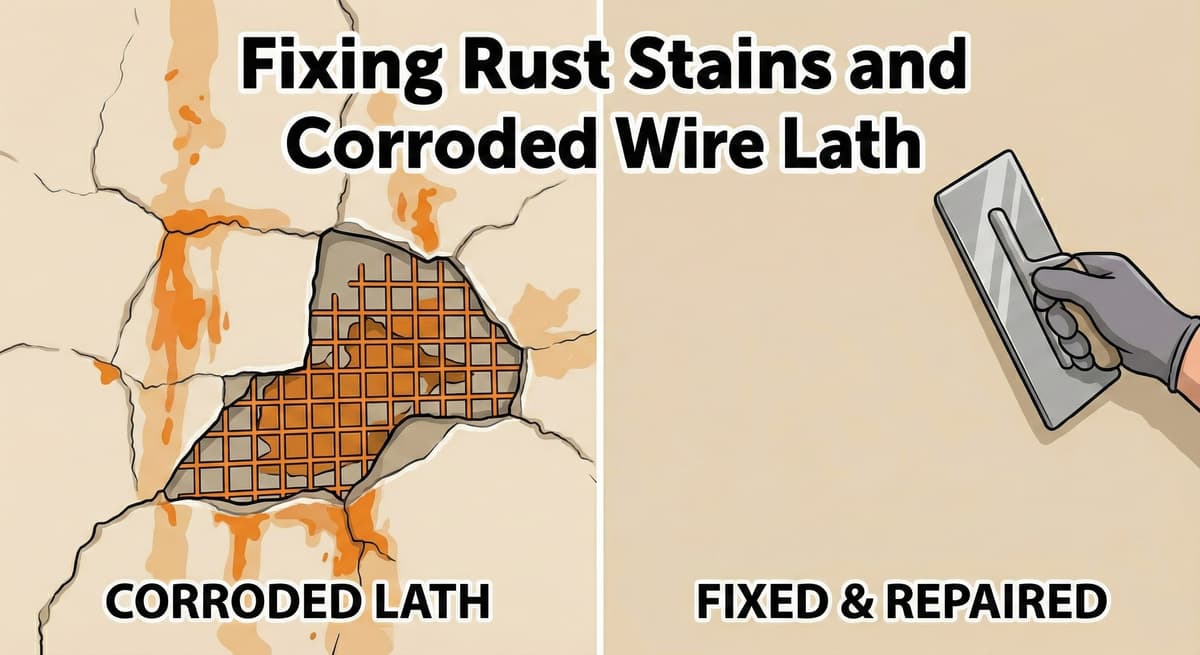
Fixing Rust Stains and Corroded Wire Lath
Seeing an orange or brown streak running down your freshly patched stucco is a homeowner’s nightmare. In Southern California, where coastal salt air accelerates corrosion, rust stains are more than just an eyesore—they are a diagnostic symptom.
Rust means metal is oxidizing. The critical question is: Which metal? Is it a surface nail head, or is it the structural wire lath dissolving inside your wall? Before you paint over a stain, you must identify the source, or the rust will bleed back through your new paint within months.
1. Diagnosis: Surface Rust vs. Rust Jacking
Not all stains are created equal. Before attempting a repair, categorize the issue:
- Surface Rust (Minor): Usually caused by an external ferrous metal touching the wall—a rusty light fixture, an iron railing bolt, or a non-galvanized nail head close to the surface. This is cosmetic.
- Rust Jacking (Major): If the stain is weeping from a crack, or if the stucco is bulging, the internal wire lath is corroding. As steel rusts, it expands to 4x its original volume. This expansion (jacking) pushes the stucco off the wall. This is a structural failure.
Free Assessment
Noticing Stucco Damage?
Get a free on-site assessment from a licensed contractor. $0 deposit, no obligation.
GET FREE ASSESSMENT2. The Rust Crisis: When the Skeleton Fails ("Rust Jacking")
In coastal Southern California, the #1 cause of stucco delamination is Corroded Lath.
When moisture penetrates the stucco and reaches the galvanized wire mesh, it begins to oxidize. As steel turns to iron oxide (rust), it expands to over 4 times its original volume. This massive internal pressure pushes the stucco outward, causing it to bulge and crack. We call this "Rust Jacking."
Why You Cannot Patch Over Rust
A common handyman mistake is to simply chip off the loose stucco, apply a bonding agent over the rusty wire, and patch it. This guarantees failure.
Rust is "infectious." If you leave active oxidation inside the wall, it will continue to eat the metal even under the new patch. Within months, brown stains will bleed through your new paint, and the patch will pop off.
The "Chasing" Protocol
To fix this correctly, we must perform a radical excision:
- The Chase: We start at the visible damage and cut the stucco back. We continue removing stucco until we hit clean, shiny galvanized wire. Sometimes a 6-inch crack reveals 4 feet of rotted wire. We do not stop until the metal is sound.
- The Treatment: Before installing new mesh, we treat the cut edges of the existing wire with a Rust Inhibitor (like Zinc-Rich Cold Galvanizing spray) to stop the chemical reaction.
- The Lap: We install new lath that overlaps the clean existing wire by a minimum of 2 inches. We use tie-wire to mechanically lock the new skeleton to the old one, ensuring structural continuity.
If you live within 5 miles of the ocean (Newport, Laguna, Dana Point), standard galvanized lath may not be enough. For repairs in these zones, we often recommend upgrading to Stainless Steel Lath or Non-Metallic (Fiberglass) Lath for the repair area. These materials are impervious to salt air and will never rust again.
3. The "Cover-Up" Mistake
The most common error we see is homeowners applying primer directly over active rust.
Why this fails: Rust is chemically active. Unless you neutralize the oxidation or remove the source, it will eat through standard primers and paints. You cannot seal rust in; you must treat it.
4. The "Bleed-Through" Blocker: Priming
Even after treating the metal, rust residue can stain new paint. You must use a specific type of primer.
Product RecommendationDo not use standard drywall primer. Use a Stain-Blocking Masonry Primer (like Zinsser or Kilz suitable for exterior use). Apply two coats over the repair area to lock in any residual minerals before applying your finish color.
5. Prevention: Galvanization Matters
Why did it rust in the first place? Usually, it’s because someone used the wrong hardware.
In Southern California, all lath and accessories (nails, corner beads, weep screeds) must be Hot-Dipped Galvanized. If a contractor used "Electro-Galvanized" (a thinner coating) or standard steel in a coastal zone, rust is inevitable.
Conclusion: Treat the Source
Rust is like a cavity in a tooth; ignoring it makes it worse. If you catch it early, a simple treatment and patch will work. If you let it spread, you may face a full wall resurfacing. Treat the metal, prime the patch, and use high-quality acrylic paint to seal the envelope.
Related ResourcesLast week, we shared How to Professionally Paint Exterior Stucco. Once the rust is treated, follow this guide for the final finish.
Need stucco repair in Southern California? Stucco Champions proudly serves homeowners throughout Orange County, Los Angeles, Riverside, and San Bernardino counties. Check out our Service Areas page to see all the cities we cover.