

Written by Stucco Champions — Southern California’s Authority on Exterior Plastering.
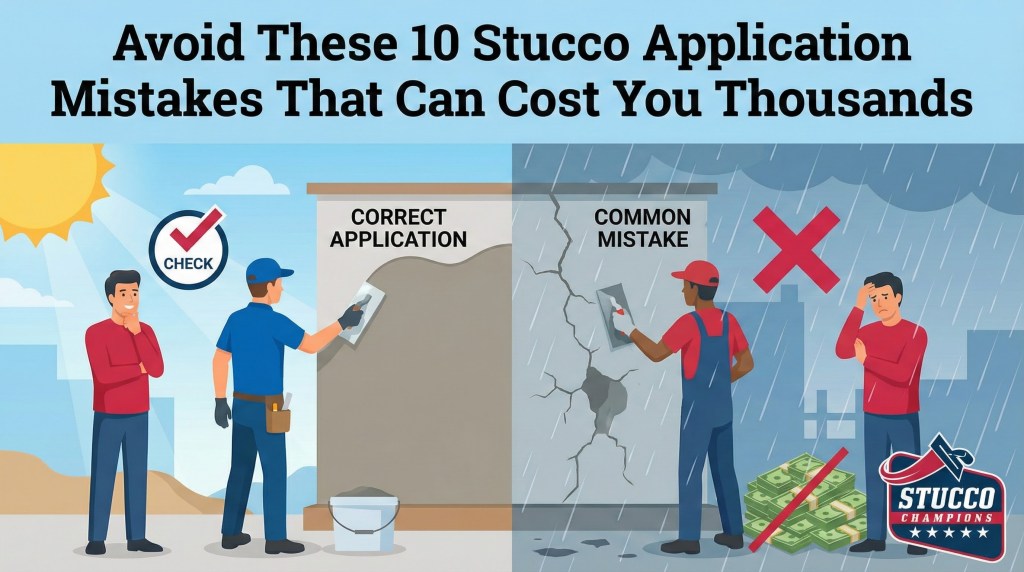
Avoid These 10 Stucco Application Mistakes That Can Cost You Thousands
Stucco is one of the most durable and visually appealing finishes for residential and commercial buildings in California—but only when installed correctly. Poor stucco work is more than just an eyesore; it is a ticking time bomb for moisture intrusion, structural rot, and massive repair bills.
At Stucco Champions, we’ve seen firsthand how avoidable errors can turn a promising project into a long-term liability. Whether you are a contractor, property manager, or homeowner, understanding these common pitfalls is essential to protecting your investment.
1. Using the Wrong (or Incompatible) Materials
Not all stucco mixes are created equal. A common mistake is using generic "big box store" mixes for specialized applications or mixing incompatible acrylics with traditional cement coats. This leads to weak adhesion and distinct color variations.
The Fix: Always use high-quality, Plastic Cement (ASTM C1328) formulated for the Southern California climate. Ensure that your scratch, brown, and finish coats are chemically compatible. Avoid cheap additives that promise speed but sacrifice flexibility.
2. Skipping Surface Preparation (The "Bond" Failure)
Applying stucco directly to dirty, painted, or smooth surfaces is a recipe for delamination (peeling). If the surface doesn't have "bite," the heavy stucco will eventually pull away from the wall.
If you are stuccoing over existing paint, Sandblasting is mandatory. You cannot bond cement to paint. We strip the old layers to expose the raw, open-pore stucco underneath to create a mechanical key.
3. Improper Mixing Ratios
Stucco is chemistry. Too much water ("soupy" mix) weakens the concrete structure, while too little makes it brittle. Inconsistent sand-to-cement ratios between batches will result in "checkerboarding"—patchy discoloration across the wall.
The Fix: Follow the manufacturer’s specifications strictly. Use a mechanical mixer to ensure a uniform consistency and measure your water intake precisely for every batch to ensure color continuity.
4. Rushing the Curing Process (Hydration)
This is the most common technical error. Cement-based stucco doesn't just "dry"; it cures via a chemical reaction with water known as Hydration. If it dries out too fast, it crumbles.
The Fix: Practice "Moist Curing." Lightly mist the walls with water for 48–72 hours after application. This is critical in our dry climate to prevent the brown coat from shrinking and cracking before the finish is applied.
5. Neglecting Control & Expansion Joints
Stucco is rigid, but buildings move. Without control joints (expansion joints), natural settling and thermal expansion will force the stucco to crack—usually diagonally off the corners of windows and doors.
Per ASTM C1063, panels should generally not exceed 144 square feet. Always place joints at stress points, such as window corners and between floor levels, to tell the stucco where to crack safely.
6. Poor Weather Timing (Flash Drying)
Stucco is sensitive to the elements during application. In Southern California, our primary enemy is the "Santa Ana" wind or extreme heat, which sucks moisture out too fast ("Flash Drying").
The Fix: Schedule installation when temperatures are between 40°F and 90°F. If applying in hot weather, work on the shady side of the building or use windbreaks/tarps to retain moisture.
7. Inadequate Moisture Barrier (WRB)
Stucco is porous; it absorbs water. If you fail to install a proper drainage plane behind it, water will become trapped against the wood framing, leading to black mold and dry rot.
The Fix: Never skip the Weather-Resistive Barrier (WRB). We strictly adhere to the code requirement for Two Layers of Grade D Building Paper. Crucially, ensure a Weep Screed is installed at the bottom of the wall with 4 inches of clearance from the earth.
8. Uneven Application Thickness
Slapping on stucco too thick causes sagging and cracking; applying it too thin exposes the lath and offers no fire protection.
The Fix: Adhere to ASTM C926 standards. A traditional three-coat system should be a nominal 7/8 inch thick. Professional plasterers use "rodding" techniques to shave the wall flat and ensure uniform thickness.
9. Ignoring Local Building Codes
What works in dry Arizona may fail in coastal Newport Beach. Each region has specific codes regarding fire resistance (WUI Zones) and energy efficiency (Title 24).
The Fix: Consult local building codes before starting. For example, using a One-Coat foam system can help meet energy requirements, while a Three-Coat system is better for fire ratings.
10. Hiring Inexperienced Installers
Stucco is an artisan trade requiring muscle memory and technical knowledge. "Handymen" often overlook flashing details or lath orientation (cups up/smooth down), leading to failures that appear 6 months later.
The Fix: Protect your property by choosing a dedicated specialist. Stucco Champions teams are trained in manufacturer best practices, modern drainage systems, and local compliance.
Summary: The Cost of Mistakes
Don't gamble with your property's exterior. If you want durability, beauty, and peace of mind, you need the experts.
| Mistake | Impact | Solution |
|---|---|---|
| Wrong materials | Cracking, moisture issues | Use plastic cement & washed sand |
| Skipped surface prep | Poor adhesion, peeling | Sandblast painted surfaces |
| Improper mixing | Weak finish, shrinkage cracks | Follow exact water ratios |
| Rushed curing | Delamination, bubbling | 48-hour moist cure |
| No expansion joints | Stress cracks | Install joints every 144 sq ft |
| No moisture barrier | Mold, rot, wall damage | Two layers of Grade D paper |
Last week, we shared Stucco Problems and How to Prevent Them. Read more about identifying early signs of failure.