
Written by Stucco Champions — Southern California’s Authority on Exterior Plastering.
What Is One-Coat Stucco? An In-Depth Guide to Energy Efficiency
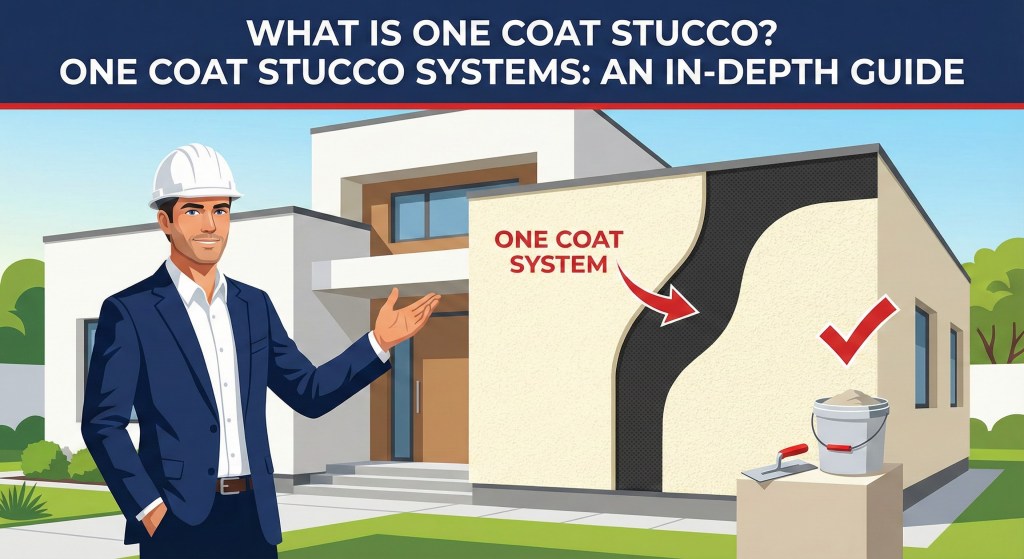
The name "One-Coat Stucco" is one of the most confusing terms in the construction industry. It implies a single layer of material. In reality, it is a sophisticated, multi-layered assembly designed to meet California's strict Title 24 energy codes.
Unlike the traditional "Three-Coat" system which relies on mass (thick cement) for strength, the One-Coat system relies on engineering (fiber-reinforced cement + foam insulation). This guide breaks down the anatomy of the system that dominates modern tract home construction.
1. The Anatomy of the System
A "One-Coat" system is actually three distinct layers applied over the framing. It gets its name because the grey cement base is applied in a single pass (3/8" to 1/2") rather than two separate passes (Scratch and Brown).
Layer 1: The Insulated Lath (R-Value)
This is the game changer. Instead of just wire paper, we install 1-inch rigid EPS Foam Board over the studs.
The Benefit: This provides "Continuous Insulation," breaking the thermal bridge of the wood studs and keeping your home cooler in summer.
The Wire: A 20-gauge wire mesh is attached to the face of the foam to hold the cement.
Layer 2: The Fiber-Reinforced Base Coat
This is the "One Coat." We apply a specialized cement mix (like Omega or Quikrete One-Coat) that contains chopped fiberglass strands.
Why Fibers? Because this layer is thinner than traditional stucco (3/8" vs 7/8"), the fiberglass acts as internal reinforcement to prevent cracking and add flexural strength.
Layer 3: The Finish Coat
Just like traditional stucco, the final layer is a decorative texture (1/8" thick). It can be a cement-based "Old World" finish or a modern Acrylic finish.
2. One-Coat vs. Three-Coat: Which is Better?
Homeowners often ask: "Is One-Coat cheaper/worse than Three-Coat?"
It isn't worse; it's different.
- Three-Coat (Traditional): Best for impact resistance (solid rock) and fire rating (1-hour). Preferred for custom estates.
- One-Coat (Modern): Best for energy efficiency (insulation) and speed of construction. Preferred for production homes and retrofits.
3. Application: Speed & Efficiency
The major advantage for builders is speed.
In a traditional system, you must wait 48 hours between the scratch and brown coats. In a One-Coat system, the base coat is applied in a single day. It typically cures for 7 days before the finish is applied, cutting the schedule in half.
Because the cement shell is thinner (approx 1/2" total), One-Coat stucco is easier to puncture. A heavy impact (like a baseball or car bumper) can punch through the cement and crush the foam behind it. Repairs on foam systems are more complex than solid cement repairs.
Conclusion: Efficiency vs. Mass
If your priority is lowering your AC bill and meeting modern energy codes, One-Coat Stucco is the superior choice. If your priority is a bulletproof wall that can take a beating, stick with Traditional Three-Coat. Both are excellent systems when installed to ASTM standards.
Last week, we shared What Is Stucco Lath?. The wire used for One-Coat is different from Three-Coat—learn why.
Need stucco repair in Southern California? Stucco Champions proudly serves homeowners throughout Orange County, Los Angeles, Riverside, and San Bernardino counties. Check out our Service Areas page to see all the cities we cover.